
Originally published 2025-12-15 · Cyclone Bolt
Corrosion is the silent killer of machinery. Whether it is a sedan driving through salted winter roads or a blowout preventer sitting on an oil rig, rust never sleeps.
For decades, the fastener industry relied on simple zinc plating or cadmium to stop the rot. But times have changed. Environmental regulations are tighter. Performance demands are higher.
Enter Zinc-Nickel (Zn-Ni) plating.
This alloy plating has taken the automotive world by storm. It offers superior protection, heat resistance, and hardness. But is it just for cars? Absolutely not. The standard set by automotive manufacturers is now rippling through heavy industry, oil and gas, and construction.
Cyclone Bolt, based here in Houston, Texas, understands that coating is just as critical as the steel substrate. We provide fasteners that meet the most rigorous standards, including high-performance Zinc-Nickel options.
Here is everything you need to know about this plating powerhouse and why your next project needs it.
The Evolution of Corrosion Protection
To understand why Zinc-Nickel is the current gold standard (or silver standard, visually), we have to look at what came before.
Plain Zinc Plating
Standard zinc plating is the baseline. It is cheap and effective for mild environments. Zinc acts as a “sacrificial” anode. It corrodes before the steel bolt does. However, plain zinc gives up the ghost relatively quickly. In a salt spray test, white rust (zinc corrosion) can appear in as little as 96 hours.
The Fall of Cadmium
For high-performance aerospace and defense applications, Cadmium was the king. It offered lubricity and excellent corrosion resistance.
There was just one problem: Cadmium is highly toxic.
Environmental regulations like the End of Life Vehicles (ELV) directive and RoHS (Restriction of Hazardous Substances) effectively banned Cadmium from the automotive sector. Engineers needed a replacement that matched Cadmium’s performance without the toxicity.
They found the answer in Zinc-Nickel.
What is Zinc-Nickel Plating?
Zinc-Nickel is an acid or alkaline alloy plating process. Unlike pure zinc, this coating is a mixture of two metals. The typical composition is roughly 85% Zinc and 15% Nickel.
This specific ratio is not an accident. It creates a single-phase structure (gamma phase) that provides optimized corrosion resistance.
The “Slippery” Science
The addition of nickel does two things:
-
Increases Barrier Protection: The alloy corrodes much slower than pure zinc.
-
Maintains Sacrificial Properties: It still protects the steel underneath if the coating is scratched.
It is the best of both worlds. You get the longevity of a barrier coating with the self-healing nature of a sacrificial coating.
Why Automotive Made It the Standard
Automotive manufacturers are brutal on their components. A bolt under a truck chassis faces:
-
Road salt and brine (extremely corrosive).
-
Stone chips and physical abrasion.
-
High temperatures from the exhaust and engine.
Standard zinc could not survive the warranty periods modern customers expect. Automotive OEMs (Original Equipment Manufacturers) pushed for Zinc-Nickel because it delivers:
-
1000+ Hours of Salt Spray Protection: While standard zinc fails around 96 to 120 hours, a quality Zinc-Nickel finish can withstand over 1,000 hours of neutral salt spray testing before red rust (base metal corrosion) appears.
-
Heat Resistance: Pure zinc plating can degrade and lose its protective power at temperatures above 250°F. Zinc-Nickel remains stable and effective up to 500°F. This is crucial for fasteners near engines or manufacturing equipment.
-
Hardness: The nickel content makes the coating harder than pure zinc. This means it resists scratches and tool marks during installation.
Moving Beyond Cars: Industrial Applications
What works for a Ford truck works for a Frac pump.
The industrial sector is catching on. Industries like Oil & Gas, Power Generation, and Heavy Construction are adopting Zinc-Nickel.
The Galvanic Corrosion Advantage
In Houston, we deal with a lot of aluminum components. When you put a stainless steel bolt into an aluminum housing, you create a galvanic cell. The aluminum will corrode rapidly.
Zinc-Nickel plating on a steel bolt has a potential difference that is closer to aluminum than stainless steel is. This reduces the galvanic reaction. It saves the expensive equipment housing from rotting away around the fastener.
The Cyclone Bolt Difference: Quality and Compliance
You might think all plating is the same. It is not.
Applying Zinc-Nickel is a complex chemical process. If the bath chemistry is off, the nickel content drops, and you lose protection. If the current density is wrong, the coating thickness varies.
This is why you need a supplier who understands Technical Standards. At Cyclone Bolt, we do not guess. We verify.
API Spec Q1 and ISO 9001:2015
We operate under a robust Quality Management System. Our certifications—API Spec Q1 9th Edition and ISO 9001:2015 Quality System Certificate—mean we track every step of the manufacturing and coating process.
When you order Zinc-Nickel plated studs from us, you aren’t just getting shiny bolts. You are getting documentation. You are getting traceability.
The Hydrogen Embrittlement Factor
This is the most critical point for high-strength fasteners.
When steel is acid pickled or electroplated, it absorbs hydrogen. In high-strength steels (like ASTM A193 B7 or API 20E BSL-3 bolts), this hydrogen can cause the bolt to crack under load. This is called Hydrogen Embrittlement. It is sudden, catastrophic, and invisible.
To prevent this, plated bolts must be baked immediately after plating.
Many generic bolt suppliers overlook this. They plate high-strength parts and skip the bake to save money.
Cyclone Bolt understands API 20E and API 20F requirements. We know the rules for baking. We ensure that if a spec requires a post-plating bake for hydrogen relief, it happens. We do not gamble with your safety.
Technical Specifications for Zinc-Nickel
If you are writing a purchase order or a project specification, you need the right callouts. Here are the common standards used for Zinc-Nickel:
-
ASTM B841: Standard Specification for Electrodeposited Coatings of Zinc Nickel Alloy Deposits.
-
AMS 2417: Aerospace Material Specification for Zinc-Nickel Plating.
Appearance Options
Zinc-Nickel usually comes in two finishes:
-
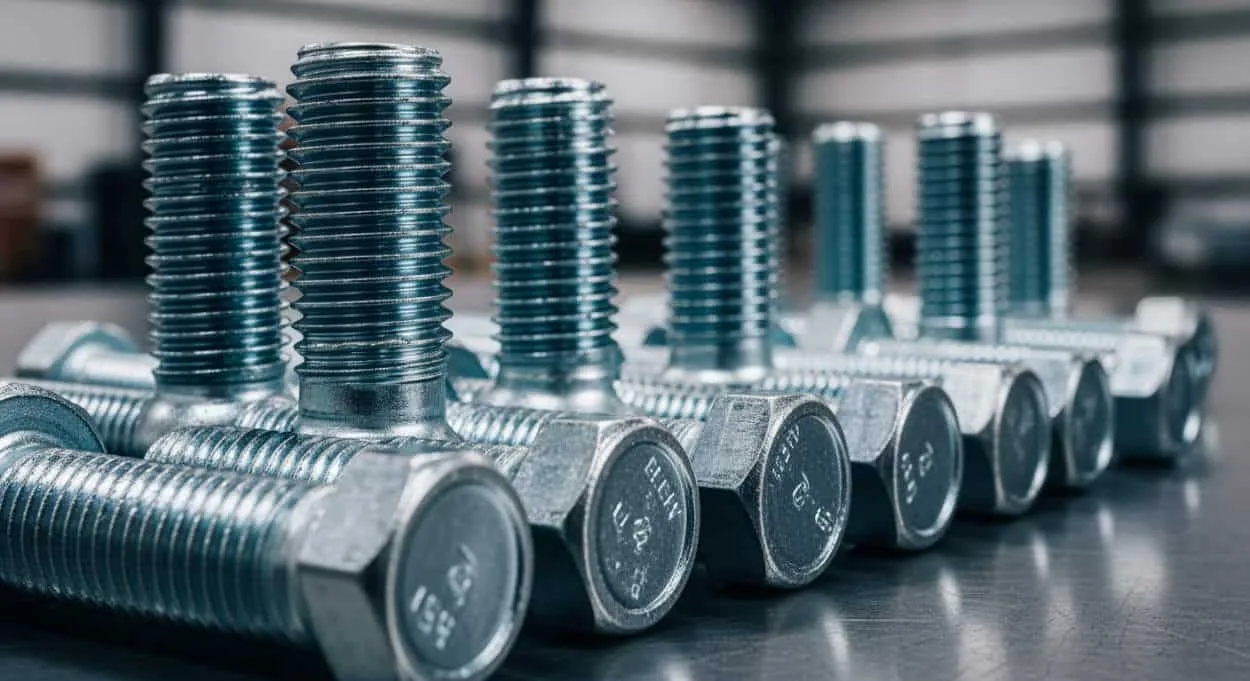
Clear/Blue: A silver appearance similar to standard zinc but slightly more bluish.
-
Black: A deep black finish often used for aesthetic purposes or specific military applications.
Both offer the same high-level corrosion resistance. The difference is primarily the chromate topcoat applied over the alloy.
Zinc-Nickel vs. The Alternatives
Is Zinc-Nickel always the right choice? Let’s compare it to other common coatings found in our Coating & Plating Technical Guide.
Zinc-Nickel vs. Hot Dip Galvanized (HDG)
Hot Dip Galvanizing is thick. It involves dipping the bolt in molten zinc.
-
HDG Pros: Excellent for structural steel, very thick coating.
-
HDG Cons: The coating is too thick for fine threads. You have to overtap the nut, which weakens the assembly. It looks rough.
-
Zn-Ni Advantage: Zinc-Nickel is thin (typically 8-14 microns). It does not interfere with thread fitment. It is precision protection.
Zinc-Nickel vs. PTFE (Xylan®/Teflon®)
PTFE coatings are essentially paint. They are excellent for chemical resistance and low friction.
-
PTFE Pros: Great against harsh chemicals and acids.
-
PTFE Cons: It is a barrier coating only. If you scratch it, the rust spreads underneath (undercutting).
-
Zn-Ni Advantage: Zinc-Nickel is sacrificial. If you scratch it, the surrounding plating works to protect the exposed steel.
-
Pro Tip: For the ultimate protection, we often apply a Zinc-Nickel base coat followed by a PTFE topcoat. This “duplex” system offers incredible longevity.
Why Location Matters: The Houston Advantage
Cyclone Bolt is located in Houston, Texas. This is the heart of the American energy and manufacturing sector.
Why does this matter for your fasteners?
-
Proximity to Platers: Houston has some of the best industrial platers in the world. We have relationships with top-tier metal finishers who specialize in high-spec Zinc-Nickel.
-
Speed: We can manufacture studs, send them for plating, and have them back for inspection in days, not weeks.
-
Logistics: We can ship globally from the Port of Houston or domestically via major trucking routes.
When to Choose Zinc-Nickel
You should switch to Zinc-Nickel if:
-
You are seeing red rust failures on standard zinc bolts.
-
You are operating in coastal or marine environments but cannot use stainless steel due to strength requirements.
-
You need to replace Cadmium to meet environmental standards.
-
Your application involves temperatures between 250°F and 500°F.
-
You need an extended warranty on your equipment.
A Partner in Technical Excellence
Navigating material grades and coating specs is complicated. You have API 20E for production bolting, API 20F for corrosion-resistant bolting, and dozens of ASTM standards.
You do not need to be a metallurgist to get the right bolt. You just need to call Cyclone Bolt.
We specialize in solving technical problems. Whether you need a B7 stud with Zinc-Nickel or a super-alloy fastener for a subsea stack, our team ensures it meets the print.
Our quality lab is equipped to verify materials. Our staff is trained on the latest industry standards. We don’t just sell bolts; we sell assurance.
Ready to Upgrade Your Corrosion Protection?
Rust is expensive. Quality fasteners are an investment.
If you are ready to explore Zinc-Nickel plating or need a quote for your next project, reach out to the team at Cyclone Bolt. We are ready to help you navigate the specs and deliver the hardware you need, when you need it.
Contact Cyclone Bolt today. Let’s build something that lasts.