
Coatings and platings protect fasteners from corrosion, control friction and extend service life. This guide summarizes the finishes most often specified on fasteners, with typical thickness, temperature and performance figures for reference. The finish, thickness and test requirements on your order govern.
Finishes on the Cyclone line card
Cyclone’s published finish offering: zinc, cadmium and black oxide; hot-dip and mechanical galvanizing; Modumetal® NanoGalv®; Xylan® and Fluorokote #1®; and Sermagard®. Other finishes are quoted on request. Coating and plating are performed by partner facilities to the requirements on the order. See coated and plated stud bolts.
Finishes on the Cyclone line card
Cyclone’s published finish offering: zinc, cadmium and black oxide; hot-dip and mechanical galvanizing; Modumetal® NanoGalv®; Xylan® and Fluorokote #1®; and Sermagard®. Other finishes are quoted on request. Coating and plating are performed by partner facilities to the requirements on the order.
Why surface treatment matters
- Corrosion protection. Barrier protection against moisture, chemicals and environmental degradation.
- Extended service life. Longer component life and fewer replacements.
- Appearance. A professional finish with specified colors and surface textures.
- Performance. Reduced friction, better wear resistance and, where needed, electrical properties.
- Environmental compliance. RoHS- and REACH-compliant options.
- Cost. Lower total cost of ownership through reduced maintenance and longer service intervals.
Quick comparison
Typical figures for the finishes below. Actual performance depends on the formulation, thickness and application conditions.
| Finish | Typical thickness | Maximum service temperature | Performance | Best suited to |
|---|---|---|---|---|
| Zinc plating | 5–25 μm | 200°F | 96–240 h salt spray | Mild, indoor |
| Hot-dip galvanizing | 45–85 μm | 392°F | 1,000+ h salt spray | Severe outdoor, marine |
| Cadmium plating | 5–12 μm | 450°F | 200–500 h salt spray | Marine, aerospace |
| Xylan® / Teflon® | 15–25 μm | 550°F | Friction 0.02–0.10 | Chemical, high temperature, low friction |
| Geomet® / Dacromet® | 8–12 μm | 480°F | 1,000+ h salt spray | Automotive, severe service |
| Zinc-nickel | 8–15 μm | 390°F | 720+ h salt spray | Automotive, industrial |
| Ceramic | 25–100 μm | 2,000°F | Friction 0.15–0.25 | Extreme heat |
| Mechanical galvanizing | 15–50 μm | 200°F | Friction 0.12–0.18 | Small parts, no embrittlement |
Choosing by environment
| Environment | Commonly specified | Why |
|---|---|---|
| Marine environments | Hot-dip galvanizing, Geomet®, zinc-nickel | Saltwater corrosion resistance with long-term protection |
| High temperature | Ceramic, Xylan®, cadmium | Maintains performance and integrity at elevated temperatures |
| Low friction required | Xylan® / Teflon®, cadmium, Geomet® | Reduces torque requirements and prevents galling in critical assemblies |
Coating systems
High-performance coatings for corrosion protection, friction reduction and extreme temperature resistance.
Xylan® / Teflon® coating

| Thickness | 15–25 μm |
|---|---|
| Service temperature | −400°F to +550°F |
| Coefficient of friction | 0.02–0.10 |
| Colors | Black, green, gray, custom |
| Options | FK1 |
Key features
- Ultra-low coefficient of friction
- Excellent chemical resistance
- Non-stick properties
- Prevents galling and seizing
- FDA-compliant options available
- Suited to high-torque applications
Typical applications: Aerospace, chemical processing, food and beverage, oil and gas.
Geomet® / Dacromet®

| Thickness | 8–12 μm |
|---|---|
| Service temperature | Up to 480°F |
| Coefficient of friction | 0.08–0.14 |
| Colors | Silver-gray, black, custom topcoats |
Key features
- No hydrogen embrittlement risk
- Superior corrosion resistance (1,000+ hours salt spray)
- Excellent cathodic protection
- Hexavalent chromium-free
- Thin coating maintains thread tolerances
- Suited to high-strength fasteners
Typical applications: Automotive, construction, wind energy, heavy equipment.
Zinc-nickel alloy

| Thickness | 8–15 μm |
|---|---|
| Service temperature | Up to 390°F |
| Coefficient of friction | 0.10–0.16 |
| Colors | Bright silver, black passivate, olive drab |
Key features
- Enhanced corrosion resistance compared with pure zinc
- Excellent thermal stability
- Superior salt spray performance (720+ hours)
- Automotive industry standard
- RoHS and ELV compliant
- Maintains appearance at high temperatures
Typical applications: Automotive, aerospace, defense, electronics.
Ceramic coating

| Thickness | 25–100 μm |
|---|---|
| Service temperature | Up to 2,000°F |
| Coefficient of friction | 0.15–0.25 |
| Colors | White, black, custom |
Key features
- Extreme temperature resistance
- Thermal barrier properties
- Excellent wear resistance
- Chemical and oxidation resistant
- Electrical insulation
- Suited to exhaust systems
Typical applications: Exhaust systems, turbines, furnaces, high-temperature equipment.
Mechanical galvanizing

| Thickness | 15–50 μm |
|---|---|
| Service temperature | Up to 200°F |
| Coefficient of friction | 0.12–0.18 |
| Colors | Gray, clear chromate, yellow chromate |
Key features
- No hydrogen embrittlement
- Uniform coating on complex shapes
- Excellent thread quality
- Cost-effective for small parts
- Good corrosion protection
- Environmentally friendly process
Typical applications: Fasteners, small parts, springs, clips.
Electroplating and galvanizing
Plating and galvanizing processes that provide corrosion protection and durability for fastener applications.
Zinc plating

| Thickness | 5–25 μm |
|---|---|
| Salt spray | 96–240 hours |
| Maximum temperature | Up to 200°F |
| Specification | ASTM B633 |
Key features
- Cost-effective corrosion protection
- Excellent adhesion to the base metal
- Available in clear, yellow or black chromate
- Good electrical conductivity
Typical applications: General industrial, indoor applications, mild environments.
Hot-dip galvanizing
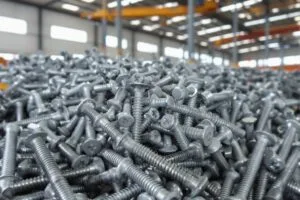
| Thickness | 45–85 μm |
|---|---|
| Salt spray | 1,000+ hours |
| Maximum temperature | Up to 392°F |
| Specifications | ASTM A153, ASTM F2329 |
Key features
- Superior long-term corrosion protection
- Self-healing properties
- Abrasion-resistant coating
- Metallurgically bonded to the steel
Typical applications: Outdoor structures, marine environments, highway infrastructure.
Cadmium plating

| Thickness | 5–12 μm |
|---|---|
| Salt spray | 200–500 hours |
| Maximum temperature | Up to 450°F |
| Specification | QQ-P-416 Type II |
Key features
- Excellent sacrificial protection
- Superior performance in saltwater environments
- Low friction coefficient
- Maintains the torque–tension relationship
Typical applications: Aerospace, military, high-performance applications.
Nickel plating

| Thickness | 10–50 μm |
|---|---|
| Salt spray | 500–1,000 hours |
| Maximum temperature | Up to 600°F |
| Specification | ASTM B689 |
Key features
- Excellent chemical resistance
- High hardness and wear resistance
- Bright, decorative finish
- Good electrical conductivity
Typical applications: Chemical processing, food industry, high-temperature environments.
Chrome plating

| Thickness | 2–20 μm |
|---|---|
| Salt spray | 200–400 hours |
| Maximum temperature | Up to 800°F |
| Specification | ASTM B177 |
Key features
- Extremely hard surface (850–1,000 HV)
- Low coefficient of friction
- Excellent wear resistance
- Mirror-like finish
Typical applications: Hydraulic systems, precision machinery, decorative applications.
Phosphate coating

| Thickness | 1–10 μm |
|---|---|
| Salt spray | 48–96 hours with oil |
| Maximum temperature | Up to 400°F |
| Specification | ASTM D6968 |
Key features
- Excellent oil retention
- Reduces galling and seizing
- Ideal paint base
- Dimensional stability
Typical applications: Automotive, pre-paint treatment, break-in protection.
What a coating order involves
Coating and plating on Cyclone orders are performed by partner facilities to the finish, thickness and test requirements on the order. A typical process has six stages.
- Surface preparation. Degreasing and cleaning, mechanical abrasion or chemical pickling as required, ultrasonic cleaning for complex geometries, surface activation and inspection.
- Pre-treatment. Phosphate or chromate conversion, passivation, anodizing for aluminum, primer where required, drying and curing.
- Coating application. Electroplating bath, spray, dip or fluidized-bed application with controlled thickness monitoring and multi-layer application where specified.
- Post-treatment. Chromate conversion, sealant or topcoat, heat curing or baking, cooling and stabilization, surface finishing.
- Quality control. Thickness measurement by X-ray fluorescence, adhesion testing, salt spray testing, visual and dimensional inspection, documentation and certification.
- Packaging and delivery. VCI packaging, moisture barrier protection, segregation by coating type, labeling, handling instructions and certificate of compliance.
Lead times
Standard and expedited coating and plating are available. Ask the team for current lead times when you request a quote.
Related: Material grade guides · Technical data sheets · Request a quote