
Originally published 2026-01-13 · Cyclone Bolt
Industrial environments in 2026 are more demanding than ever. Engineers and project managers face a constant battle against corrosion, high heat, and chemical degradation. While standard stainless steel or alloy bolts work for many applications, some “extreme” environments require something more robust.
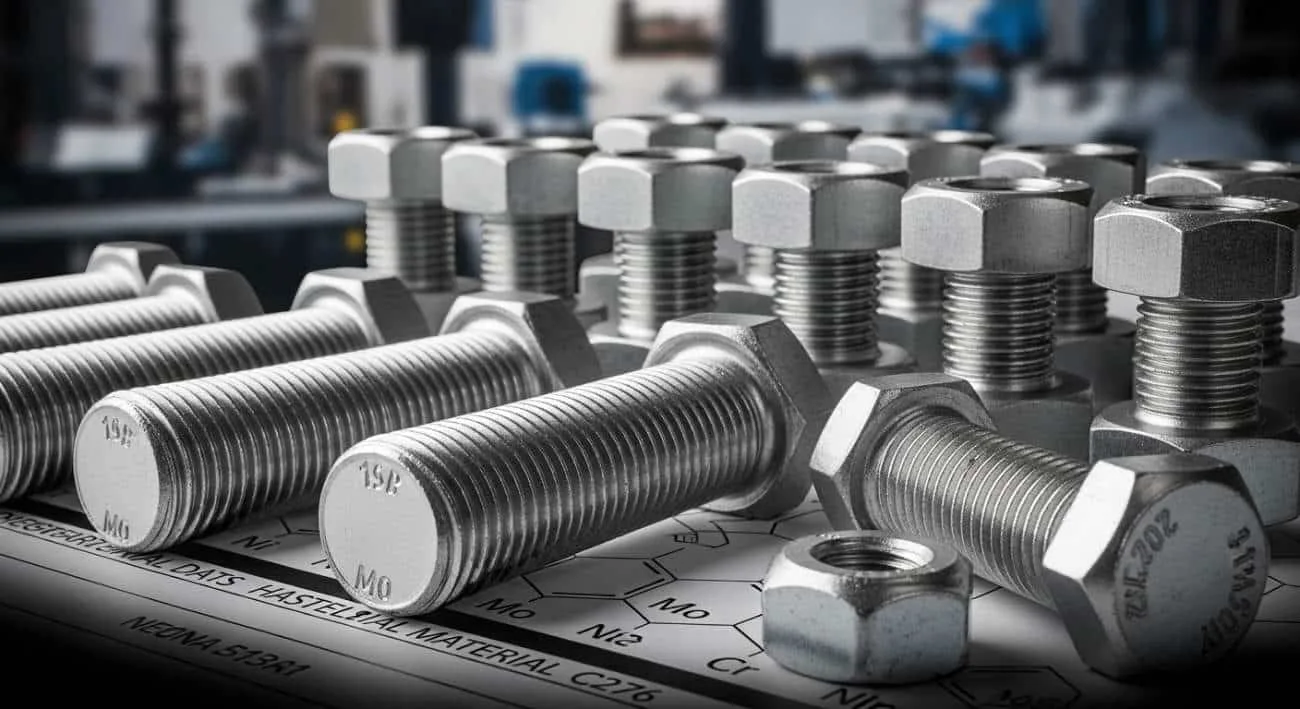
This is where Hastelloy C276 comes into play. Often referred to as a “superalloy,” C276 is a nickel-molybdenum-chromium-tungsten alloy. It is specifically designed to provide outstanding corrosion resistance in an incredibly wide range of severe environments.
Cyclone Bolt, located in Houston, Texas, specializes in providing these high-performance fasteners. We understand that in a chemical processing plant or a subsea oil rig, the cost of a failed bolt is astronomical. Choosing the right material at the start is the best way to prevent catastrophic failures later.
What is Hastelloy C276?
Hastelloy C276 is a wrought corrosion-resistant alloy. Its primary strength lies in its chemical composition. By combining nickel with high levels of molybdenum and chromium, the alloy becomes virtually immune to many of the most aggressive chemicals used in industry today.
The addition of tungsten is a key differentiator. This element enhances the alloy’s resistance to pitting and crevice corrosion in reducing environments. When you look at the materials specifications, you will see that C276 is often the “gold standard” for reliability.
Unmatched Corrosion Resistance
The most significant benefit of C276 fasteners is their versatility. Most alloys excel in either oxidizing or reducing environments. C276 excels in both.
Resistance to Pitting and Crevice Corrosion
In stagnant or low-velocity saltwater, many stainless steels suffer from pitting. This localized attack can eat through a bolt while the rest of the surface looks fine. C276 has an incredibly high Pitting Resistance Equivalent Number (PREN). This makes it the preferred choice for offshore marine applications.
Handling Aggressive Chemicals
C276 is one of the few materials that can withstand the corrosive effects of wet chlorine gas, hypochlorite, and chlorine dioxide. It also shows remarkable resistance to strong solutions of oxidizing salts, such as ferric and cupric chlorides.
If your facility handles sulfuric, hydrochloric, or phosphoric acids, C276 fasteners offer a service life that far exceeds standard materials. According to the NACE International (Association for Materials Protection and Performance), selecting the correct alloy for sour gas environments is a critical safety measure.
High-Temperature Stability
Industrial processes often involve heat as well as chemicals. Many fasteners lose their mechanical strength or oxidize rapidly when temperatures climb. Hastelloy C276 remains stable.
It maintains its structural integrity and corrosion resistance at temperatures where other alloys would begin to fail. This makes it essential for heat exchangers, reaction vessels, and exhaust gas desulfurization systems. The alloy’s ability to resist the formation of grain-boundary precipitates during welding also ensures that its corrosion resistance remains high in the “as-welded” condition.
Mechanical Strength and Reliability
While Hastelloy C276 is famous for its chemistry, it is also a physically strong material. It provides excellent tensile strength and ductility. In high-pressure applications, you need a fastener that can take the load without brittle failure.
We ensure that our Hastelloy fasteners meet the most rigorous technical standards. Whether you are following ASME(American Society of Mechanical Engineers) codes for pressure vessels or specific industry protocols, C276 delivers the mechanical performance required for high-risk zones.
Applications for Hastelloy C276 Fasteners
Where exactly do you use these superalloy bolts? They are found in the “heart” of the most difficult industrial processes.
-
Pollution Control: Stack liners, scrubbers, and fans used in flue gas desulfurization.
-
Chemical Processing: Equipment for the production of organic chlorides and processes using halide or acid catalysts.
-
Oil and Gas: Downhole equipment for sour gas wells and subsea components exposed to seawater.
-
Pulp and Paper: Bleach plants and digesters where chlorine and chlorine dioxide are used.
-
Waste Treatment: Piping and heat exchangers for hazardous waste incineration.
Quality Standards and Compliance
At Cyclone Bolt, we believe that a fastener is only as good as the quality system behind it. Manufacturing Hastelloy fasteners requires precision. It isn’t enough to just have the right material; the heat treatment and threading must be perfect.
API Spec Q1 and ISO 9001:2015
Our Houston facility operates under strict quality management systems. We are ISO 9001:2015 Quality System Certificate certified. We also adhere to API Spec Q1 9th Edition standards. These certifications prove that our manufacturing process is consistent, traceable, and focused on risk mitigation.
API 20E and 20F
For the energy sector, we focus heavily on API 20F, which covers corrosion-resistant bolting for use in the petroleum and natural gas industries. This ensures that the Hastelloy studs and bolts you receive have undergone the necessary testing for hardness, chemistry, and micro-structure. We also provide alloy and carbon steel solutions under API 20E.
Our commitment to quality and tech means that every Hastelloy fastener we ship comes with the documentation you need for your technical files.
Comparing Hastelloy C276 to Other Materials
Why choose C276 over, say, Stainless 316 or Monel?
-
vs. Stainless Steel 316: 316 is great for general marine use, but it will fail quickly in high-acid environments or in the presence of wet chlorine. C276 is vastly superior in chemical resistance.
-
vs. Inconel 625: Both are excellent, but C276 generally offers better resistance to pitting and stress corrosion cracking in reducing environments due to its higher molybdenum content.
-
vs. Titanium: While titanium is lightweight and corrosion-resistant, it can be difficult to work with and has limitations in certain acidic environments where Hastelloy excels.
You can explore these differences in more detail using our material grade guides.
Overcoming Hydrogen Embrittlement
Hydrogen embrittlement is a common cause of failure for high-strength fasteners in sour service. When hydrogen atoms diffuse into the metal, they cause the material to become brittle and crack under stress.
Nickel-based alloys like Hastelloy C276 are much more resistant to this type of failure than carbon steels. This is why C276 is often specified for subsea fasteners that are protected by cathodic protection systems, which can generate hydrogen on the surface of the metal.
Installation and Coating Considerations
Even a superalloy bolt needs to be installed correctly. For many Hastelloy applications, specialized coatings aren’t necessary because the base metal is already so resistant. However, if your project requires specific lubrication or secondary protection, our coating and plating technical guide can help you choose the right finish.
Proper torque is essential. Because C276 is a tough material, it can be prone to “galling” during installation if threads aren’t clean or if the nut and bolt are moving too fast under high pressure. Using a quality lubricant or a specialized coating can ensure that your joint is tightened to the correct specification without damage.
Traceability: The Cyclone Bolt Guarantee
In high-stakes industries, traceability is non-negotiable. You need to know that the bolt you are holding is actually the material it claims to be.
Every Hastelloy C276 fastener we provide is backed by a Mill Test Report (MTR). This report provides a “chemical fingerprint” of the specific heat of metal used to create your order. From our API-spec Q1 processes to our final inspection, we maintain a clear chain of custody.
The Cost Advantage of Long-Life Materials
Hastelloy C276 is an expensive material compared to carbon steel. However, savvy project managers look at the Total Cost of Ownership (TCO).
If a standard bolt fails every six months, the cost isn’t just the price of the bolt. It is the cost of the labor, the crane rental, the lost production, and the environmental risk. By installing C276 fasteners once, you often eliminate the need for maintenance for years or even decades. In the long run, Hastelloy is often the most economical choice for “bad actor” applications.
Why Houston is the Best Source for Superalloys
Based in Houston, Texas, Cyclone Bolt sits at the epicenter of the global oil, gas, and chemical industries. We see the harshest applications firsthand. This proximity allows us to stock the materials and maintain the expertise that specialized projects demand.
We aren’t just a supplier; we are a technical resource. Our team can help you navigate material grade guides to ensure you are selecting the right alloy for your specific temperature and chemical profile.
The Future of High-Performance Fastening
As industrial processes become more efficient, they also become more aggressive. Higher pressures and temperatures are the trend for 2026. Hastelloy C276 is the answer to these evolving challenges. It provides a safety margin that standard alloys simply cannot match.
Fasteners might be small components, but they are the only things holding your complex systems together. Treating them with the same engineering rigor as your pumps and valves is the key to a safe and profitable operation.
Ready to secure your extreme environment?
Don’t gamble with corrosion. When the environment is aggressive and the stakes are high, trust the superalloy performance of Hastelloy C276. Cyclone Bolt provides the high-quality, fully traceable fasteners you need to keep your facility running safely.
Our Houston team is ready to assist with your technical questions and material selections. Whether you need standard studs or custom-machined bolts, we have the quality systems in place to deliver.