
Originally published 2025-12-01 · Cyclone Bolt
The Unseen Heroes of Energy Infrastructure
In the massive, high-stakes world of the petrochemical and oil and gas industries, equipment failure is simply not an option. Refineries, pipelines, and processing plants rely on complex systems that operate under extreme heat, immense pressure, and relentless corrosion. The integrity of these systems often comes down to one of the smallest components: the industrial fastener.
Among the thousands of bolts, nuts, and studs used daily, one grade dominates as the absolute workhorse: ASTM A193 Grade B7 stud bolts.
At Cyclone Bolt, a leading industrial fastener manufacturer and supplier based in Houston, Texas, we specialize in the quality-controlled production of these critical components. Understanding the A193 B7 specification is not just about material; it’s about understanding the foundation of process safety and reliability in modern energy infrastructure.
This comprehensive guide will explain why the B7 grade has become the gold standard, detailing its material composition, mechanical properties, and the rigorous quality standards—like API Spec Q1, ISO 9001:2015, API 20E, and API 20F—that ensure its performance.
The Dominance of ASTM A193 B7: A Material Breakdown
The reason B7 stud bolts dominate applications in pressure vessels, valves, flanges, and fittings across the petrochemical sector can be boiled down to their superior blend of high tensile strength and thermal stability. This is all thanks to its base material: a specific form of chromium-molybdenum (Chr-Mo) alloy steel.
What is B7? The Chr-Mo Advantage
ASTM A193 is the standard specification for alloy-steel and stainless-steel bolting materials for high-temperature or high-pressure service. Grade B7 is the most common specification within this standard.
The core composition of a B7 stud is AISI 4140 alloy steel. The key alloying elements that give B7 its legendary performance are Chromium (Cr) and Molybdenum (Mo). Chromium, typically between 0.80% and 1.10%, is essential for increasing the material’s hardenability and corrosion resistance against operating conditions. Molybdenum, typically between 0.15% and 0.25%, significantly improves the material’s creep resistance and high-temperature strength. This is vital, as petrochemical plants frequently run at temperatures up to 850°F (454°C).
Why B7 Excels in Temperature and Pressure
Petrochemical plants are characterized by systems containing superheated steam, crude oil fractions, and various corrosive chemicals at elevated pressures. The materials holding these flanges and pipes together must maintain their structural integrity without deforming, stretching (creeping), or losing clamping force.
-
High Tensile Strength: B7 stud bolts are required to have a minimum tensile strength of 125,000 psi (125 ksi)and a yield strength of 105,000 psi (105 ksi). This massive strength capacity ensures the joint remains tight and leak-free even when systems are pressurized to hundreds or thousands of pounds per square inch.
-
Thermal Stability: The unique Chr-Mo structure resists a permanent reduction in strength even after prolonged exposure to high heat. While other materials degrade, B7 is designed to maintain its load-bearing capacity up to 850°F. This makes it ideal for continuous, high-temperature operations, which is the reality of crude oil refining.
Decoding the Specs: Understanding ASTM A193
The ASTM A193 B7 specification is more than just a chemical recipe; it is a roadmap of mandatory manufacturing and testing requirements. As a manufacturer committed to the highest quality, Cyclone Bolt strictly adheres to every step.
The Manufacturing Path to Quality
The performance of a B7 stud is determined by two critical manufacturing processes: Hot Forging or Cold Drawingand precise Heat Treatment. The material must undergo liquid quenching and tempering. It is heated and rapidly cooled to maximize hardness, and then reheated (tempered) to at least 1100°F (593°C) to introduce ductility and toughness, ensuring the bolt is strong without being brittle.
Mechanical Requirements
For a bolt to be certified B7 (for 2-1/2″ diameter and under), it must pass stringent mechanical tests guaranteeing its performance. The required minimum Tensile Strength is 125,000 psi (125 ksi), which resists breaking under high tension. The minimum Yield Strength is 105,000 psi (105 ksi), which prevents permanent deformation when subjected to load. The material must also exhibit a minimum Elongation of 16%, a measure of ductility that prevents brittle fracture. Finally, the material’s maximum Hardness is capped at 35 HRC (Rockwell Hardness C Scale) to ensure the bolt remains tough enough for reliable, long-term service.
It is the guaranteed delivery of these precise mechanical properties that makes the B7 stud so predictable and reliable, a non-negotiable trait in petrochemical engineering.
The Harsh Environment: Petrochemical Challenges
The petrochemical industry is notoriously tough on fasteners. The service conditions go beyond mere high pressure and temperature; they involve complex mechanical and chemical stresses that B7 is specifically designed to withstand.
Thermal Cycling and Creep Resistance
Plants often undergo thermal cycling, where temperatures swing between operational maximums and ambient lows (especially during shutdowns or maintenance). This constant heating and cooling causes materials to expand and contract. B7’s superior creep resistance—its ability to resist permanent deformation under continuous mechanical stress at high temperatures—is why engineers confidently spec B7 for continuous-duty flanges that must maintain high pressure integrity over years of service.
Corrosion and Environmental Stress
While B7 is not immune to corrosion, it provides a cost-effective balance of strength and resistance. For external use or applications in corrosive atmospheres like those found near cooling towers, B7 is often protected with a coating. Common coatings provided by Cyclone Bolt include hot-dip galvanization or various zinc and aluminum flake coatings. It is crucial to note that B7 cannot be used in applications where hydrogen sulfide (H₂S) gas is present (sour service), as this requires modified grades like B7M or other alloys compliant with NACE MR0175/ISO 15156.
Beyond the Stud: The B7/2H Bolt Assembly
In industrial fastening, the stud is only half the equation. A complete bolt assembly requires a matching nut that is equally capable of handling the specified stress and torque.
Pairing with ASTM A194 Grade 2H Nuts
ASTM A193 B7 studs are almost universally paired with ASTM A194 Grade 2H heavy hex nuts. This pairing is mandatory for a properly engineered and rated joint assembly. The Grade 2H nut is intentionally designed to be slightly stronger than the B7 stud material. This ensures that if the joint is over-torqued and failure occurs, the stud bolt will fail before the nut threads strip, which prevents galling (welding of the threads) and makes disassembly easier. The 2H nut is also an alloy steel subject to rigorous heat-treating and tempering processes to meet its minimum Brinell Hardness requirements.
Coatings and the Protection Layer
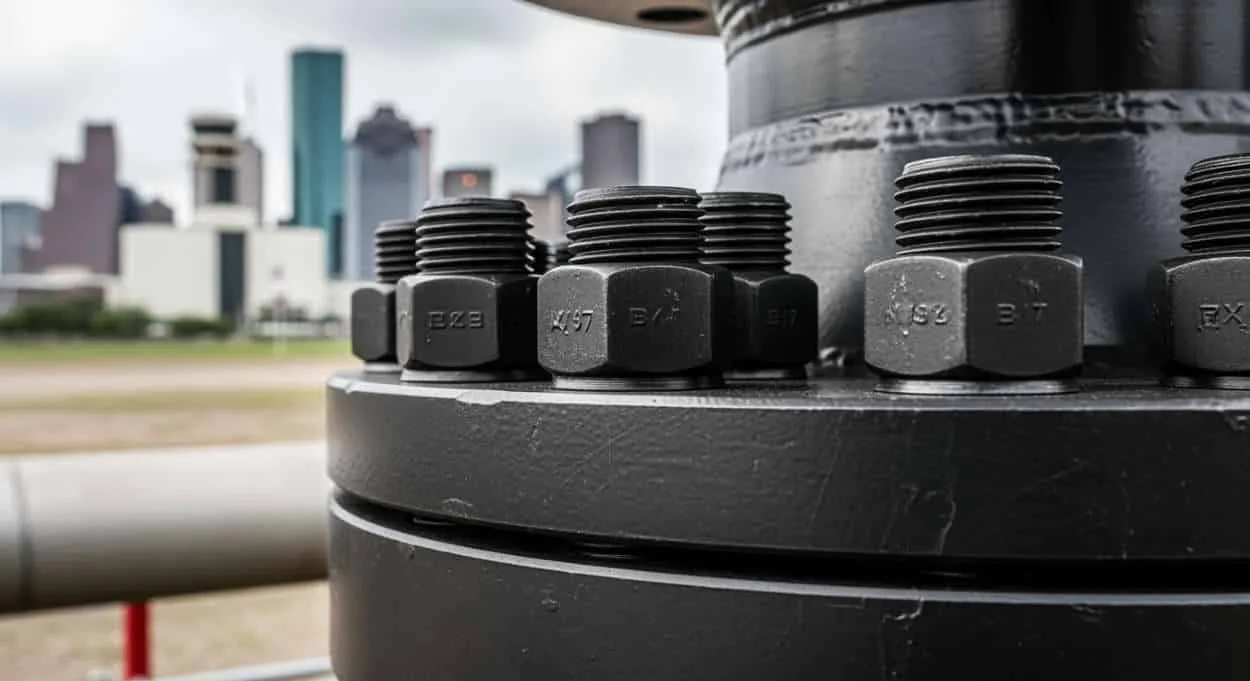
To protect the entire assembly from atmospheric or minor service corrosion, the studs and nuts are treated. Common finishes provided by Cyclone Bolt include Plain/Black Oxide (for internal, non-corrosive environments), Zinc Plated (for moderate resistance), Hot-Dip Galvanized (HDG) for excellent, long-lasting corrosion protection, and Fluoropolymer (PTFE) Coatings, which are excellent for high corrosion resistance and easy disassembly after prolonged service.
Uncompromising Petrochemical Quality: Adhering to Global Standards
The sheer scale and danger involved in petrochemical operations mean that quality standards for fasteners must be exceptionally high and non-negotiable. Cyclone Bolt has built its reputation on adherence to the most demanding certifications in the industry.
API Specification Q1 and ISO 9001:2015
The American Petroleum Institute (API) provides the most respected standards in the oil and gas sector. API Specification Q1 is the highest-level quality management system (QMS) standard for manufacturing organizations, mandating a rigorous process-based approach that includes Risk Assessment, Contingency Planning, and strict Management of Change (MOC) procedures. Complementing this, ISO 9001:2015 is the global benchmark for a quality management system, ensuring that every process, from raw material procurement to final inspection, is consistent and focused on customer satisfaction.
The Pinnacle of Petrochemical Bolting Manufacturing: API 20E and API 20F
In recent years, the industry recognized the need for even more stringent, specific quality standards for critical service bolting. This led to the creation of the API 20E and API 20F specifications, which represent the highest level of assurance for industrial fasteners.
What is API 20E? Alloy and Carbon Steel Bolting
API Specification 20E (Alloy and Carbon Steel Bolting) establishes the technical and quality requirements for critical bolting used in various applications. It defines different Bolting Specification Levels (BSLs): BSL-1 (Basic requirements), BSL-2 (Supplementary requirements, including non-destructive examination, or NDE), and BSL-3 (The most stringent level, requiring comprehensive NDE and traceability). B7 studs intended for the most critical, high-risk applications are often required to meet API 20E BSL-2 or BSL-3, guaranteeing unparalleled material quality, process control, and documentation.
What is API 20F? Corrosion Resistant Bolting
The need for fully corrosion-resistant alloys (CRAs)—such as Nickel-based alloys or Duplex Stainless Steels—is growing for sour service or high-chloride environments. API Specification 20F (Corrosion-Resistant Bolting)provides the framework for these materials, complete with their own stringent BSLs. The ability of a manufacturer like Cyclone Bolt to produce B7 studs to API 20E BSL-3 and also supply API 20F materials underscores their comprehensive technical capability across the full spectrum of petrochemical bolting needs.
Cyclone Bolt: Houston’s Trusted Petrochemical Bolting Partner
Cyclone Bolt’s location in Houston, Texas, places us at the epicenter of the global energy industry. This location is a testament to our commitment to serving the major refining, chemical processing, and distribution hubs of the Gulf Coast, and the world.
Local Expertise, Global Standards
We are more than just a supplier; we are a specialized manufacturer. When you procure your A193 B7 stud bolts from Cyclone Bolt, you receive a product with Guaranteed BSL Compliance to meet API 20E, API 20F, and ASTM B7 specifications. We maintain full Traceability, often down to the heat number, for critical components, allowing for precise material history documentation. Furthermore, all mechanical, chemical, and non-destructive examination (NDE) testing is performed and documented according to the required standards. We understand that speed and quality must go hand-in-hand, particularly when a facility shutdown or emergency repair is at stake.
Why Choose a Manufacturer Who Prioritizes Quality
Choosing a certified, quality-focused manufacturer mitigates risks associated with substandard materials, which can lead to catastrophic joint failure, lost production, and serious safety incidents. By choosing a company that voluntarily adheres to standards like API Spec Q1 and ISO 9001:2015, you are securing a product manufactured under the most demanding quality protocols in the world.
Trust the Petrochemical Workhorse, Trust Cyclone Bolt
The ASTM A193 B7 stud bolt is undeniably the workhorse fastener of the petrochemical industry. Its chromium-molybdenum composition, combined with rigorous heat treatment, provides the necessary strength, creep resistance, and thermal stability to secure critical joints under extreme conditions.
For engineers and procurement managers who cannot compromise on safety or performance, the specification is clear: demand quality, demand precision, and demand full adherence to API and ISO standards.
Cyclone Bolt is your Houston-based partner for API 20E and API 20F certified bolting. Trust the workhorse. Trust the experts.
Ensure the integrity and safety of your next high-pressure project. Contact the certified bolting specialists at Cyclone Bolt in Houston today for a quote on fully traceable, API-compliant ASTM A193 B7 studs and assemblies.