
Originally published 2025-11-05 · Cyclone Bolt
In a pressure vessel, a heat exchanger, or a critical pipeline, the most important components are often the smallest. A 10,000-pound flange is only as strong as the bolts holding it together. These “vessel fasteners” are the linchpins of operational safety, holding back immense pressure and temperature, often in highly corrosive environments.
When a vessel fastener fails, it’s not an inconvenience. It’s a catastrophic event.
The reliability of these fasteners isn’t determined at the moment of installation. It’s forged deep in the manufacturing process, long before the bolt ever reaches your site. It’s determined by a system.
For the most critical applications in the world, that system is API Spec Q1, 9th Edition.
Many manufacturers claim “quality.” But API Spec Q1 is an entirely different standard. It’s not just a certificate on the wall; it’s a rigorous, risk-based philosophy that is the only way to ensure reliability when failure is not an option.
As a Houston-based leader in certified bolting, we live by this standard. This article will explain what API Spec Q1 is, how it differs from other standards, and how it directly translates to vessel fasteners you can trust with your assets and your people.
What Are Vessel Fasteners and Why Are They So Critical?
First, let’s define our terms. “Vessel fasteners” are not standard bolts you buy at a hardware store. They are highly-engineered components—stud bolts, nuts, and washers—designed to meet specific technical standards for use in:
- Pressure vessels
- Reactors
- Heat exchangers
- Critical pipeline flanges
- Blowout preventers (BOPs)
The operating conditions for these components are extreme. They must withstand high pressures (HP), high temperatures (HT), cyclic loading (vibration and pressure changes), and aggressive chemical or saltwater corrosion.
A fastener failure here doesn’t just mean a leak. It can mean a blowout, a fire, an environmental disaster, and a grave risk to human life. This is why the source of your fasteners is a critical safety decision.
What is API Spec Q1?
Let’s answer the most important question first.
API Spec Q1 is the Specification for Quality Management System Requirements for Manufacturing Organizations for the Petroleum and Natural Gas Industry.
That’s a mouthful, so let’s break it down.
- API: The American Petroleum Institute. It sets the global standards for the oil and gas industry.
- Quality Management System (QMS): This is the key. API Q1 is not a product standard (like API 20E or 20F, which we’ll get to). It is a process standard. It defines how a company must operate to ensure quality, safety, and reliability.
- For Manufacturing: It is written specifically for companies that make physical products, like fasteners.
In short, API Spec Q1 is the rulebook for how a manufacturer must run its entire operation—from sales to shipping—to produce parts for high-risk environments.
“But We Are ISO 9001 Certified.” Why API Q1 is Different.
This is the most common point of confusion. Many companies are ISO 9001:2015 certified, which is an excellent standard for a Quality Management System.
But API Q1 is built on top of ISO 9001 and then adds critical, non-negotiable requirements specifically for the high-consequence oil and gas industry.
Here’s the difference in simple terms:
- ISO 9001: Proves you have a quality system. Its main goal is consistency and customer satisfaction.
- API Q1: Proves you have a risk-based quality system. Its main goal is failure prevention.
API Q1 mandates several crucial elements that ISO 9001 only suggests or omits entirely:
- Mandatory Risk Management: An API Q1 manufacturer must proactively identify, assess, and mitigate risks at every single stage. This includes supply chain risk, process risk, and even risk of equipment failure.
- Management of Change (MOC): This is a huge differentiator. Under API Q1, if anything changes, it triggers a formal MOC process. This includes:
- A new raw material supplier
- A new piece of machinery
- A change in a heat-treat process
- A new software update for a testing machine Each change must be formally documented, its risks assessed, and the change validated before it can be implemented. This prevents a “small tweak” from causing an unforeseen failure.
- Contingency Planning: API Q1 requires a documented plan for how to continue operations and ensure product quality during an emergency (like a hurricane in Houston or a supply chain collapse).
- Rigorous Supplier Controls: ISO 9001 requires supplier monitoring. API Q1 requires a far more deeply integrated and audited supplier verification process. You can’t just trust a supplier’s paperwork; you must have a system to validate it.
- Product-Specific Validation: API Q1 mandates that all testing and inspection equipment is not just calibrated, but that the methods themselves are validated to be effective for the specific product being made.
How API Q1 Manufacturing Ensures Fastener Reliability
Let’s walk a vessel fastener through a true API Q1 manufacturing process. This is how we at Cyclone Bolt use the Q1 framework, supported by our Quality & Tech team, to build reliability into every part.
Step 1: Raw Material Control
- The Problem: A bolt made from the wrong steel alloy (or an alloy with impurities) will fail under pressure. Forged Material Test Reports (MTRs) are a known industry problem.
- The API Q1 Solution: We don’t just buy from anyone.
- Approved Supplier List (ASL): We maintain an ASL of steel mills and suppliers that have been rigorously vetted and audited by our quality team.
- MTR Validation: We don’t just accept an MTR. We have processes to validate it, including independent, third-party testing to confirm the material’s chemical and mechanical properties.
- Full Traceability: From the moment it arrives, the raw material is tagged with a unique heat lot number. This number will follow the material all the way to your final shipping label.
Step 2: Order Review and Planning
- The Problem: A customer orders a fastener for a critical application, but the specification is ambiguous or incomplete.
- The API Q1 Solution: The sales and engineering process is part of the QMS.
- Contract Risk Review: We must formally review every order to identify risks. Is the application clear? Are all technical standards (ASTM, ASME, NACE) understood? Can we, with 100% confidence, meet this requirement?
- Validated Process: The order is then translated into a manufacturing “traveler” document that specifies the exact machines, processes, and tests required. This isn’t left to chance.
Step 3: The Manufacturing Process
- The Problem: A machine tool is slightly out of calibration, cutting threads that are just outside of tolerance. An operator uses a non-approved cutting fluid, introducing a new variable.
- The API Q1 Solution:
- Process Control: Every step—from cutting to thread rolling to heat treatment—is governed by a documented, validated procedure.
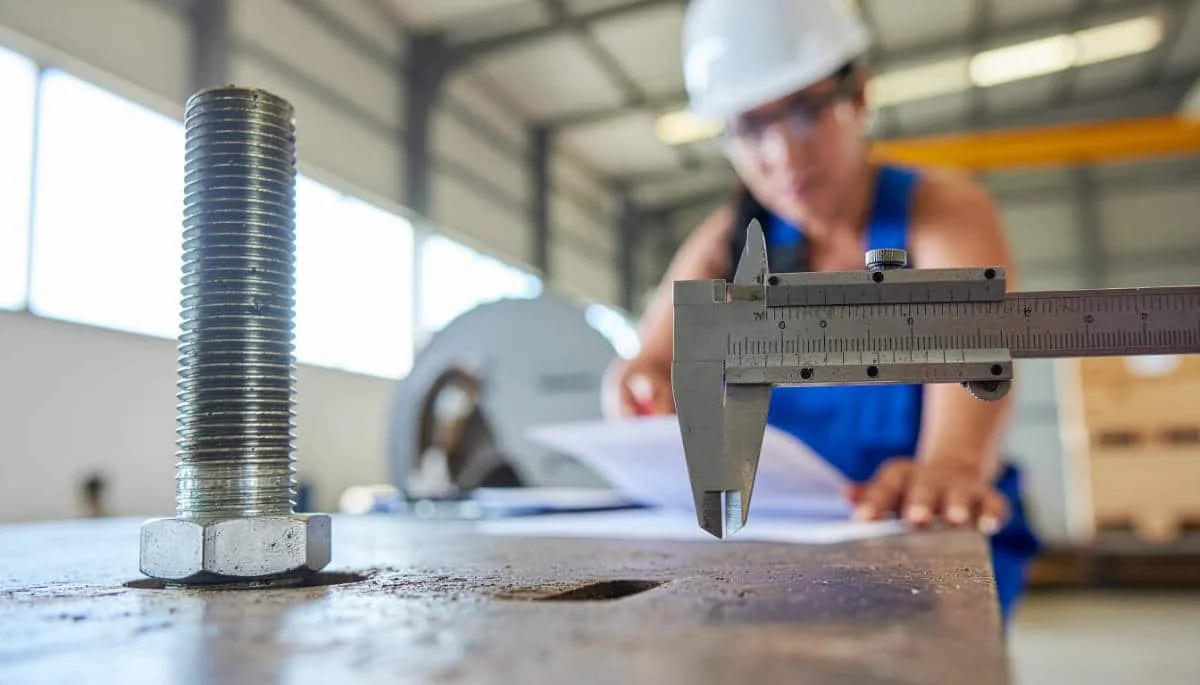
- Equipment Calibration: All inspection tools (calipers, micrometers) and production machines are on a mandatory, documented calibration schedule.
- MOC in Action: If a machine operator wants to try a new tool, they can’t. It would have to go through the Management of Change process to be tested and approved, ensuring it doesn’t negatively impact the fastener’s quality.
Step 4: Quality Control and Testing
- The Problem: A micro-fracture from heat treatment is missed by a simple visual inspection.
- The API Q1 Solution: Quality is focused on prevention and validation, not just final inspection.
- In-Process Inspection: Parts are checked at multiple stages, not just at the end.
- Validated Testing: The QMS dictates the exact tests required. This can include tensile testing, hardness testing, Charpy impact testing (for low-temp toughness), and Non-Destructive Testing (NDT) like Magnetic Particle Inspection (MPI) to find surface cracks invisible to the eye.
- Total Traceability: Every test result is documented and tied directly to the fastener’s heat lot.
The Next Level: API 20E and 20F
API Q1 is the system that proves how we manufacture. For critical vessel fasteners, that system is then used to create products that conform to specific product standards:
- API 20E (Bolting Specification Level 1, 2, & 3): This is for alloy and carbon steel bolting, the workhorses of the industry (like B7 and L7 studs).
- API 20F (Corrosion-Resistant Bolting): This is for stainless steel and nickel-alloy bolting used in highly corrosive environments.
These standards introduced Bolting Specification Levels (BSL).
- BSL-1: Standard quality, for general use.
- BSL-2: For high-consequence applications, requires more testing and process controls.
- BSL-3: For the most critical, non-redundant, extreme-risk applications (like subsea or HPHT). This is the highest level of fastener manufacturing.
You cannot reliably produce BSL-2 or BSL-3 fasteners without the backbone of an API Q1 system. The documentation, traceability, and process integrity required by Q1 are what make it possible to prove, without a doubt, that a bolt meets the intense requirements of API 20E or 20F.
A Guarantee, Not a Guess
When you specify a fastener for a pressure vessel, you are making a risk-based decision.
- Buying from a non-certified distributor or manufacturer is a guess. You are guessing the MTR is real. You are guessing the heat treatment was done correctly. You are guessing the material is what it claims to be.
- Buying from an API Q1 certified manufacturer like Cyclone Bolt is buying a guarantee.
You are not just buying a bolt. You are buying a component backed by a documented, audited, and proven system of risk management. You are buying the guarantee that a thousand details—from supplier audits to MOC to calibration—have been meticulously managed.
This is the API Q1 difference. It’s the difference between hoping for reliability and manufacturing it.
Here in Houston, we are at the center of the energy world. We understand the consequences of failure. That’s why our commitment to API Q1 isn’t just a business strategy; it’s our fundamental promise of safety and reliability to our partners.
Don’t leave your critical vessel integrity to chance. Contact the Cyclone Bolt team today to get a quote on fasteners manufactured to the industry’s highest standards.