
Originally published 2025-12-20 · Cyclone Bolt
Imagine a piece of metal that needs to hold a massive structure together while sitting inside a jet engine or at the bottom of a high-pressure oil well. Most metals would soften, warp, or simply snap under that kind of stress. But Inconel 718 isn’t most metals. It is a superalloy designed for the most punishing environments on the planet.
If you work in the energy, aerospace, or chemical processing industries, you’ve likely heard the name. But what makes it so special? At Cyclone Bolt, based in the heart of Houston, Texas, we deal with these high-performance materials every day. We know that choosing the right bolt isn’t just about size; it’s about the science of the metal itself.
Let’s break down why Inconel 718 is the gold standard for high-temperature performance.
What Exactly Is Inconel 718?
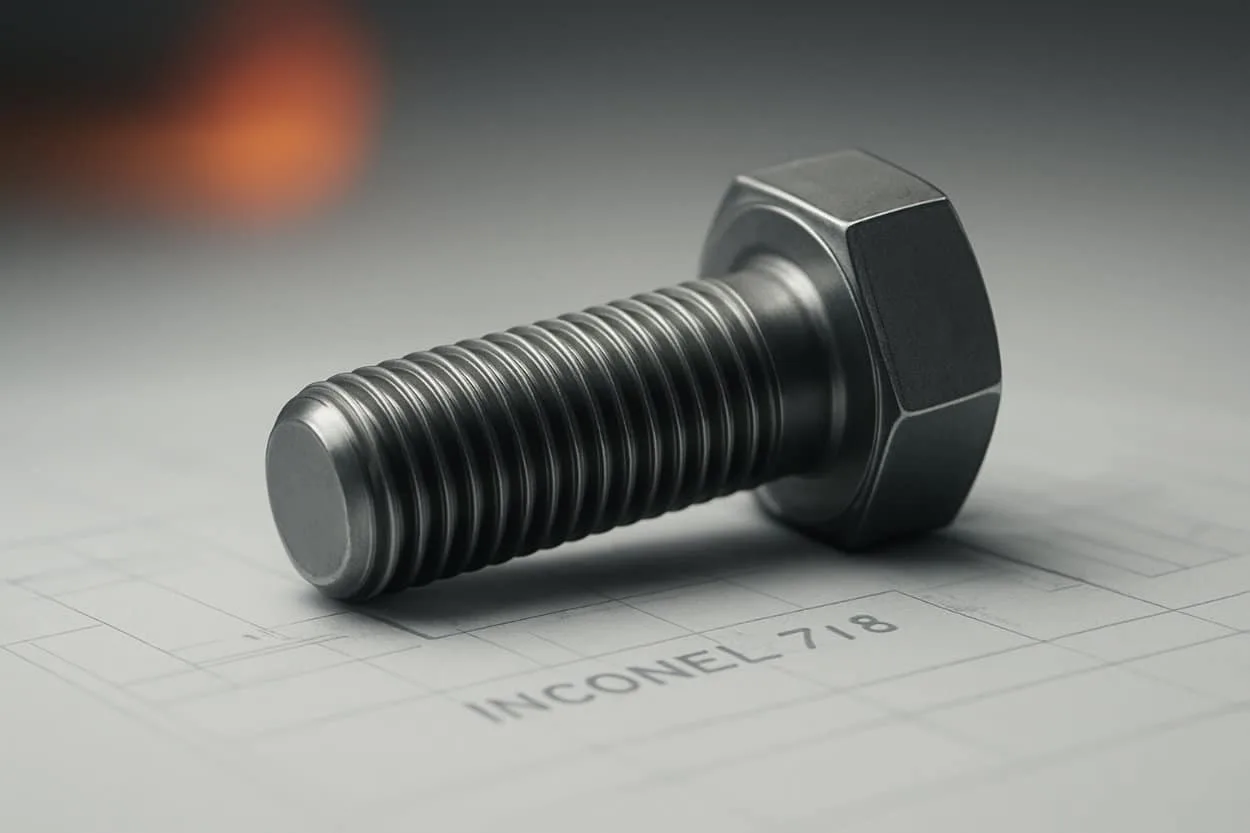
Inconel 718 is a nickel-chromium-based superalloy. While nickel is the primary ingredient, it also contains significant amounts of iron, columbium (niobium), and molybdenum. It also has smaller amounts of aluminum and titanium.
This specific cocktail of elements isn’t random. Each one plays a role in how the metal behaves when things get hot. You can see how this compares to other options in our material grade guides.
What sets Inconel 718 apart from other alloys is that it is “precipitation-hardenable.” This means it undergoes a specific heat-treatment process to increase its strength. It doesn’t just rely on its base elements; it relies on how those elements are structured at a molecular level.
The Heat Factor: Why It Doesn’t Give Up
Most metals have a breaking point when heat rises. As the temperature climbs, the atoms in the metal start to move more freely, and the material becomes “ductile” or soft. Inconel 718 laughs at temperatures that would melt a standard steel bolt.
Performance Range
This superalloy maintains its high strength from cryogenic temperatures all the way up to 1300°F (704°C). That is a massive window of operation. Because of this, it is used in:
-
Gas turbine engines
-
Rocket motors
-
Spacecraft components
-
Nuclear reactors
The secret lies in its “gamma prime” and “gamma double prime” phases. Without getting too bogged down in the chemistry, these are microscopic structures that act like “anchors” inside the metal. They stop the layers of atoms from sliding past each other when the heat tries to soften them.
According to ASM International, nickel-based superalloys like 718 are essential because they maintain mechanical properties at temperatures where most materials lose their structural integrity.
Corrosion Resistance: More Than Just Heat
In Houston, we know that heat is only half the battle. If you’re drilling in the Gulf or working in a chemical plant, you’re also dealing with salt, acids, and high pressure. Inconel 718 is incredibly resistant to “creep-rupture” and various forms of corrosion.
Fighting the Elements
-
Oxidation Resistance: It won’t flake or rust away when exposed to high-heat oxygen environments.
-
Pitting Resistance: It stands up to chloride-ion stress-corrosion cracking.
-
H2S and CO2 Resistance: This is why it’s a favorite in the oil and gas industry for sour gas environments.
When you look at our materials specifications, you’ll see that 718 is often chosen over stainless steel because it can survive where stainless would corrode in weeks.
Compliance and Quality: The API Standards
At Cyclone Bolt, we don’t just sell bolts; we sell peace of mind. High-temp environments have zero room for error. A single bolt failure can lead to catastrophic damage or environmental disasters. That’s why we adhere to the strictest industry standards.
API 20F and API 20E
In the world of fasteners, these are the heavy hitters.
-
API 20F: This standard specifically covers corrosion-resistant bolting (like Inconel 718) for use in the petroleum and natural gas industries. It ensures the material has been tested for hardness, chemistry, and microstructure.
-
API 20E: This is for alloy and carbon steel bolting. Knowing the difference between when to use a 20E bolt and a 20F bolt is critical for your project’s safety.
We also maintain ISO 9001:2015 Quality System Certificate certification and follow API Spec Q1 9th Edition guidelines. These certifications mean our manufacturing processes are tracked, measured, and consistently high-quality. You can meet the team behind these standards on our quality page.
Manufacturing Challenges with Inconel 718
You might wonder: if Inconel 718 is so good, why isn’t everything made out of it? The answer is simple: it is incredibly difficult to work with.
Because it is designed to be strong at high temperatures, it “work-hardens” very quickly during machining. If you try to cut it like regular steel, your tools will dull or snap almost immediately. It requires:
-
Slow cutting speeds
-
Heavy-duty machinery
-
High-quality carbide tools
-
Expert knowledge of heat treatment
At Cyclone Bolt, our technical standards ensure that we aren’t just cutting metal; we are managing the stresses inside the alloy. This expertise is what makes us a leader in Houston’s manufacturing sector.
Coatings and Platings: Do You Need Them?
One of the great things about Inconel 718 is that it often doesn’t need a coating. Its natural oxide layer protects it. However, in some specific high-friction or extreme chemical environments, a coating might be necessary to prevent “galling” (where the threads of the bolt lock up during installation).
We offer a coating and plating technical guide to help you decide if your Inconel fasteners need an extra layer of protection. Usually, for 718, the focus is on lubricants or anti-seize compounds rather than traditional zinc plating.
Common Applications for Inconel 718 Fasteners
Where exactly will you find these bolts? If a project involves “extreme” anything, 718 is usually there.
-
Subsea Equipment: Valves, fasteners, and wellhead components that must survive high pressure and salt water for decades.
-
Aerospace: Fasteners for turbine blades and exhaust systems where temperatures reach white-hot levels.
-
Power Generation: Fasteners used in steam generators and heat exchangers.
-
Racing: High-performance engine head bolts and manifold bolts.
Research from NASA shows that Inconel 718 has been a staple in liquid rocket engines for decades because it stays tough even when it’s surrounded by freezing liquid fuel on one side and burning exhaust on the other.
Why Source from Houston’s Cyclone Bolt?
Houston is the energy capital of the world. The standards here are higher because the stakes are higher. When you work with Cyclone Bolt, you’re getting more than just a box of hardware. You’re getting a partner that understands the technical standards required for your specific field.
We understand that a lead time isn’t just a date; it’s a project milestone. We use our deep knowledge of materials to help you choose the most cost-effective option that doesn’t compromise on safety. Whether you need a small batch of custom fasteners or a large-scale order, our quality and tech department ensures every piece meets your specs.
Is Inconel 718 Right for Your Project?
Choosing a material like Inconel 718 is an investment. It costs more than steel or stainless, but it saves you a fortune in avoided downtime and repairs. If your application involves temperatures above 1000°F or high-pressure corrosive fluids, 718 is almost certainly the right move.
However, it is always worth checking our material grade guides to see if a different alloy might fit your budget while still providing the necessary protection.
Let’s Secure Your Next High-Temp Project
You shouldn’t have to guess when it comes to material performance. At Cyclone Bolt, we’ve spent years mastering the complexities of superalloys and the manufacturing standards that govern them. We are here to ensure your project stays held together, no matter how hot things get.
Whether you need API 20F compliant bolting or custom-manufactured Inconel 718 studs, we have the expertise to deliver. Our Houston facility is ready to handle your toughest requirements with the speed and precision you expect.