
Originally published 2025-12-21 · Cyclone Bolt
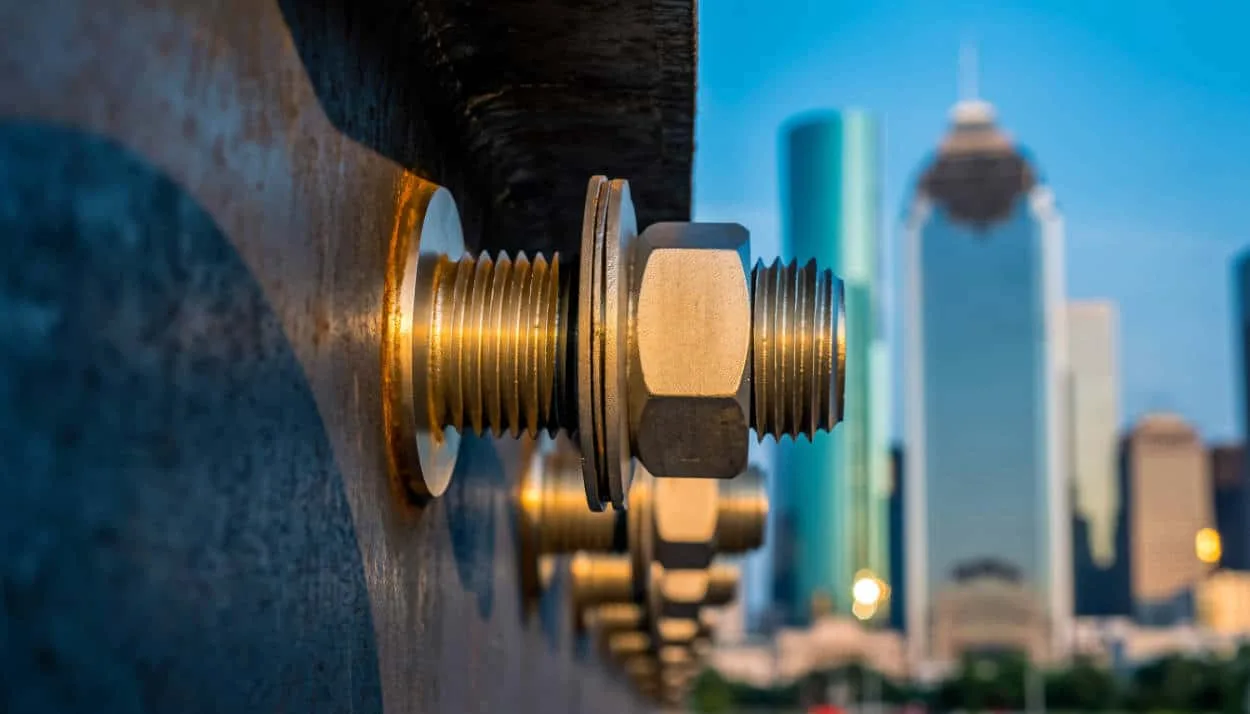
If you stand in the middle of downtown Houston and look up, you see a forest of steel. These massive skyscrapers aren’t just held together by luck. They stay standing because of the tension held within millions of individual fasteners. In the world of structural steel building, we don’t just “tighten” a nut. We pre-tension the bolt.
Pre-tensioning is the difference between a building that sways safely and one that suffers a catastrophic failure. At Cyclone Bolt, we manufacture the high-spec fasteners that make these structures possible. Based in the heart of the energy and construction hub of Houston, Texas, we know that when it comes to structural integrity, the details are everything.
What Exactly is Pre-Tensioning?
To understand pre-tensioning, you have to stop thinking of a bolt as a rigid piece of metal. Think of it as a very stiff spring. When you install a bolt in a structural steel joint and tighten the nut, you are actually stretching the bolt.
This stretching creates a “clamping force” on the steel plates being held together. Pre-tensioning is the act of tightening that bolt to a specific, predetermined tension. This tension is usually much higher than what you would get with a standard wrench. It ensures the joint stays tight under massive loads, vibrations, and wind.
Why We Can’t Just Use “Snug-Tight”
In some light construction, “snug-tight” is enough. This means you’ve tightened the bolt as much as a worker can with an ordinary spanner. But for skyscrapers, bridges, and oil rigs, snug-tight is just the starting line.
Structural joints are often subject to “shear” forces—forces that try to slide the steel plates past each other. If a bolt is only snug-tight, the plates can slip. This slip causes the bolt to slam against the side of the hole. Over time, this creates fatigue and can lead to the bolt snapping.
Pre-tensioning creates so much friction between the steel plates that they physically cannot slide. The friction, not just the bolt itself, carries the load. This is the hallmark of a “slip-critical” joint.
The Role of Material Grade and Specifications
You can’t pre-tension just any bolt. If the metal is too soft, it will simply stretch and deform like taffy. If it is too brittle, it will snap under the pressure. This is why following material grade guides is critical for engineers.
For structural steel, we often look at specific grades like A325 or A490. These are designed to handle the high-stress environments of a pre-tensioned joint. At Cyclone Bolt, our materials and specifications ensure that every fastener meets the exact chemical and mechanical properties required for the job.
Methods for Achieving Proper Tension
How do you know if a bolt is stretched enough? You can’t see it with the naked eye. Construction crews use several proven methods to ensure they’ve reached the “sweet spot” of tension.
-
Turn-of-Nut Method: The worker tightens the bolt to snug-tight and then turns the nut a specific fraction of a full turn (like 1/3 or 1/2 a turn). This physical rotation correlates to a specific amount of stretch.
-
Calibrated Wrench: Using a torque wrench that has been calibrated to the specific lot of bolts being used.
-
Tension Control (TC) Bolts: These have a “spline” on the end that snaps off only when the correct tension is reached.
-
Direct Tension Indicators (DTIs): These are special washers with small bumps. When the bumps flatten out to a certain gap, you know the tension is right.
API and ISO: The Gold Standards of Quality
In Houston, we deal with more than just office buildings. We supply the oil and gas industry, where the stakes are even higher. This is why we adhere to the most rigorous technical standards in the world.
Our facility is proud to be ISO 9001:2015 certified. This means our quality management systems are world-class. Furthermore, we follow the API Spec Q1 9th Edition, which is specifically designed for the petroleum and natural gas industries.
For heavy-duty structural applications, we offer fasteners that meet API 20E and API 20F standards. These standards cover everything from bolting for offshore platforms to high-temperature refinery equipment. When you see these labels, you know the fastener can handle the extreme pre-tensioning required for harsh environments.
The Importance of Coating and Plating
Pre-tensioning creates a lot of friction, not just in the joint, but in the threads of the bolt itself. If a bolt is dry or rusted, the torque you apply will go toward fighting friction rather than stretching the bolt. This leads to “false” tension readings.
This is why coatings are so important. A good coating acts as a lubricant during installation and a shield against corrosion later. Our coating and plating technical guide explains how different finishes—like hot-dip galvanizing or zinc plating—affect the “K-factor” or torque-tension relationship.
Fatigue Resistance and Longevity
Buildings are dynamic. They move with the wind and settle over time. If a bolt isn’t properly pre-tensioned, the constant “on-off” loading of the wind can cause metal fatigue.
Properly pre-tensioned bolts are much more resistant to fatigue. Because they are always under a high state of “pull,” the relative change in stress during a wind storm is much smaller. It keeps the steel “clamped” tight, preventing the microscopic movements that eventually lead to cracks.
Thermal Expansion and Pre-Tensioning
In a place like Texas, temperature swings are real. Steel expands when it’s hot and contracts when it’s cold. This changes the tension in the bolts.
Engineers must account for this when they calculate the required pre-tension. By using high-quality fasteners that have been tested for their quality and tech specifications, you ensure the structure stays safe whether it’s a 100-degree August day or a rare Houston freeze.
Why Fastener Origin Matters
In the construction world, “counterfeit” or sub-par bolts are a real danger. A bolt that looks right but doesn’t meet the chemical requirements can fail during the pre-tensioning process. This puts workers in danger and compromises the building.
Sourcing from a reputable, Houston-based manufacturer like Cyclone Bolt gives you a paper trail. We provide full traceability for our products. We know exactly where the steel came from, how it was heat-treated, and how it was tested. In structural steel, peace of mind is worth every penny.
The Impact of Improper Pre-Tensioning
What happens if we get it wrong?
-
Loose Joints: Leads to “rattling” or swaying in high winds.
-
Bolt Failure: If one bolt fails, it puts more load on the others, leading to a “zipper” effect of failures.
-
Corrosion: Loose joints allow water to seep between plates, causing “pack rust” that can eventually burst the steel apart.
By getting the pre-tensioning right the first time, you avoid million-dollar repair bills ten years down the road.
Summary Checklist for Structural Bolting
-
[ ] Verify the bolt grade (A325, A490, etc.) matches the engineering specs.
-
[ ] Ensure threads are clean and properly lubricated for consistent tensioning.
-
[ ] Use a verified method (like DTIs or Turn-of-Nut) to confirm tension.
-
[ ] Inspect for proper coating to prevent long-term corrosion.
-
[ ] Source from a certified manufacturer with API and ISO credentials.
Partner with Houston’s Fastener Experts
Structural steel buildings are the skeletons of our cities. They deserve the best possible “connective tissue.” At Cyclone Bolt, we don’t just sell bolts; we sell the structural integrity of your project.
Whether you are working on a mid-rise office building or a massive offshore energy project, our team in Houston is ready to help. We understand the nuances of API standards, material science, and the critical nature of pre-tensioning.
Ready to secure your next project with world-class fasteners? Contact Cyclone Bolt today for a quote on high-strength structural bolts!