
Originally published 2025-12-19 · Cyclone Bolt
There is nothing quite like a freshly installed marine deck. Whether it is classic teak on a yacht, durable composite on a commercial pier, or fiberglass on a workboat, it looks pristine.
Then, a few weeks later, you see it.
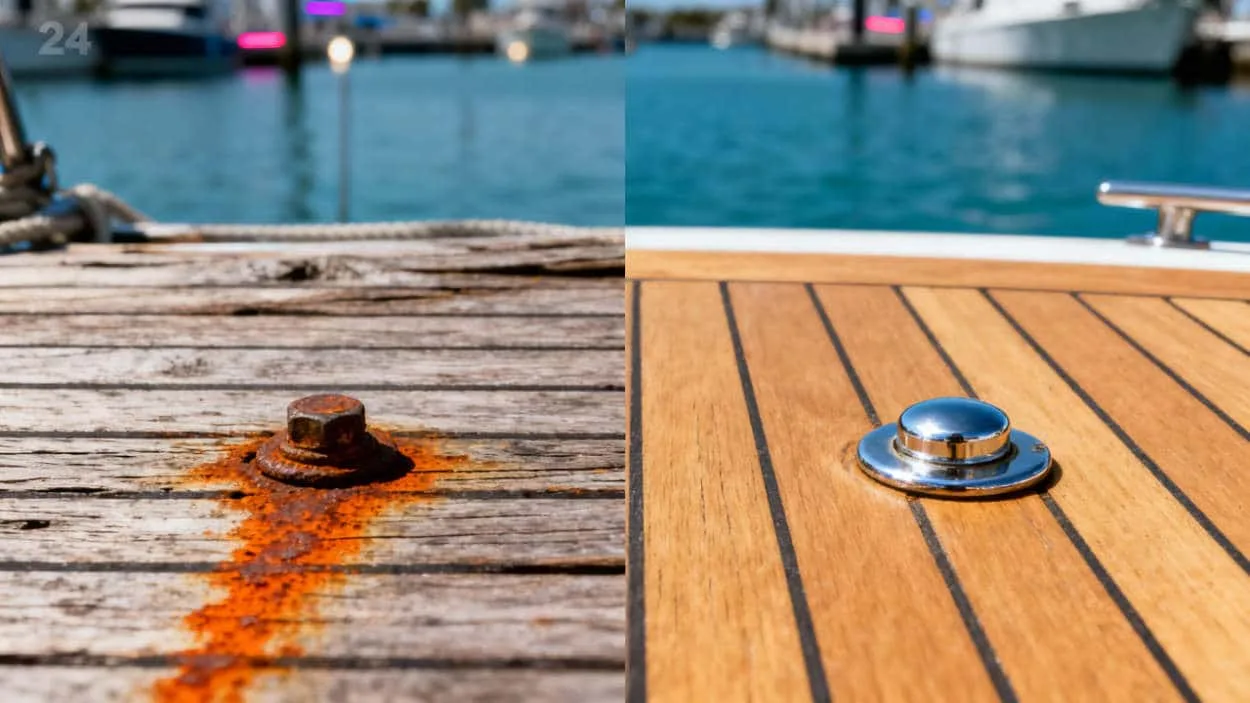
A thin, orange line trickling down from a screw head. It stains the wood. It stains the fiberglass. You scrub it, but it comes back.
This is “bleeding.” It is the nightmare of every boat owner and marine builder.
The problem isn’t the wood. It isn’t the water. It is the fastener.
Choosing the wrong bolt or screw for a marine environment guarantees rust stains. At Cyclone Bolt in Houston, Texas, we understand that fasteners are more than just hardware. They are the first line of defense against the harsh saltwater environment.
Here is how to choose marine decking fasteners that won’t ruin your hard work.
The Science of the Stain
To stop the stain, you have to understand where it comes from.
Rust is iron oxide. It forms when iron reacts with oxygen and moisture. Saltwater acts as an electrolyte, speeding up this reaction significantly.
You might be thinking, “But I used stainless steel! It’s not supposed to rust.”
This is the most common misconception in the marine industry. Stainless steel is not stain-proof. It is stain-less. It creates a passive layer of chromium oxide on its surface that protects the iron inside.
If that passive layer is breached—by scratching, chemical attack (salt), or oxygen starvation—the iron inside starts to rust. That rust bleeds out, creating the ugly orange streak on your deck.
The Material Grade Matters: 304 vs. 316
Not all stainless steel is created equal. The two most common grades you will find are 304 and 316.
304 Stainless Steel This is the standard “kitchen sink” grade. It is strong and resists rust in normal environments. It is cheaper. Many general hardware stores sell this as “stainless.”
-
The Problem: It lacks resistance to chlorides (salt). In a marine environment, 304 will develop pitting corrosion and rust stains very quickly.
316 Stainless Steel This is the marine standard. The key difference is the addition of Molybdenum (about 2-3%).
-
The Solution: Molybdenum drastically increases the metal’s resistance to pitting and crevice corrosion caused by chlorides. If your deck will see saltwater, you must use at least grade 316.
At Cyclone Bolt, we supply traceable, certified 316 stainless steel. We verify the chemistry so you don’t get a “316” bolt that is actually 304.
The Hidden Enemy: Crevice Corrosion
Decking presents a unique challenge called crevice corrosion.
Stainless steel needs oxygen to repair its protective layer. When you screw a bolt into a wet deck, water gets trapped in the tight threads or under the head. The water is stagnant. It runs out of oxygen.
Without oxygen, the stainless steel cannot heal itself. The chlorides in the seawater attack, and the bolt starts to rot from the inside out.
The Fix:
-
Use High-Quality 316L: The “L” stands for Low Carbon. It is more resistant to this type of decay, especially if the fastener was welded or heated.
-
Sealants: Proper bedding compounds prevent water from entering the tight spaces between the bolt and the deck.
Beyond Stainless: The Ultimate Solutions
If you are building a commercial pier, an offshore platform, or a high-end vessel where failure (and staining) is not an option, you might need to move beyond standard stainless.
Silicon Bronze This is the traditional choice for wooden boat building. It is an alloy of copper and silicon.
-
Pros: It does not rust like steel. It develops a protective patina. It is incredibly resistant to saltwater corrosion.
-
Cons: It is softer than steel. It can turn green (verdigris), but it won’t leave that ugly orange rust stain.
Monel 400 Monel is a nickel-copper alloy. It is the heavyweight champion of corrosion resistance.
-
Pros: It is virtually immune to saltwater corrosion. It is stronger than bronze. It will not stain your deck.
-
Cons: It is significantly more expensive than stainless steel.
Titanium Titanium is immune to corrosion in seawater. It is lightweight and strong.
-
Pros: Zero corrosion. Zero staining.
-
Cons: High cost. It can also cause galvanic corrosion in other metals connected to it if not isolated.
The Trap of Counterfeit Fasteners
This is the biggest risk in the marine industry today.
You order 316 Stainless bolts online. They arrive shiny and look perfect. You install them. Three months later, they are rusting.
Why? Because they were not actually 316.
Low-quality manufacturers often cheat on the alloy mix. They reduce the Molybdenum or Nickel to save money. The bolt looks the same, but it behaves like cheap steel.
The Cyclone Bolt Difference Cyclone Bolt is an API Q1 and ISO 9001:2015 certified manufacturer. We operate in the high-stakes world of oil and gas and industrial construction.
We use Positive Material Identification (PMI). We test our raw materials. When we say a bolt is 316 Stainless or Monel, we have the documentation to prove it.
For critical marine infrastructure, you cannot rely on a generic “bin” of bolts. You need traceability.
Coatings: The Second Line of Defense
Sometimes, the base metal needs help. Advanced coatings can prevent staining even if the environment is extreme.
Xylan / PTFE Coatings We apply fluoropolymer coatings like Xylan to marine fasteners.
-
Barrier Protection: It seals the metal off from the water.
-
Low Friction: It prevents galling (seizing) of stainless steel threads.
-
Color Matching: We can coat fasteners in black, blue, or other colors to blend with the decking material.
Hot Dip Galvanizing (HDG) HDG creates a thick zinc coating. While excellent for structural steel (like the frame under the deck), it is rarely used for the deck surface itself because it is rough and eventually the zinc sacrifices itself, leading to potential discoloration.
Galvanic Corrosion: Don’t Mix Your Metals
Another source of staining is galvanic corrosion. This happens when two different metals touch in the presence of saltwater.
If you use a Stainless Steel screw to hold down an Aluminum plate on your deck, the Aluminum will corrode rapidly. It will turn to white powder and pit.
If you use a Carbon Steel washer with a Stainless Steel bolt, the washer will rust instantly, leaving a massive stain.
Rules to Live By:
-
Isolate dissimilar metals using plastic or nylon washers.
-
Use metals that are close to each other on the “Galvanic Series” chart.
-
When in doubt, use the same metal for the bolt, nut, and washer.
Maintenance Tips for a Stain-Free Deck
Even the best fasteners need care.
-
Freshwater Rinse: Wash your deck with fresh water regularly. This removes the salt crystals that accelerate corrosion.
-
Passivation: For stainless steel, you can use a citric acid passivation treatment. This chemically removes surface iron and boosts the protective chromium oxide layer.
-
Inspect Regularly: If you see a spot of rust, address it immediately. Remove the fastener, inspect it for crevice corrosion, and replace it if necessary.
Why Cyclone Bolt?
You are building something to last. The fasteners are the glue that holds it all together.
Cyclone Bolt specializes in critical service fasteners. We don’t just sell bolts; we manufacture confidence.
Located in Houston, Texas, we have access to the best raw materials and heat-treating facilities in the world. Our quality management systems are audited to the highest standards (API Spec Q1).
Whether you need 316 Stainless studs, Monel hex bolts, or Xylan-coated heavy hex nuts for a marina project, we can manufacture to your exact specifications.
Traceability. Quality. Speed.
Don’t let a fifty-cent bolt ruin a fifty-thousand-dollar deck. Choose fasteners that are engineered to survive the sea.
Contact Cyclone Bolt today. Let’s discuss your marine project and ensure your decking stays stainless forever.