
Originally published 2026-02-12 · Cyclone Bolt
When an aircraft is cruising at thirty thousand feet, the margin for error is non-existent. We often think of flight in terms of massive engines and sweeping wings, but the true intelligence of a modern plane lies in its avionics. Avionics—a blend of “aviation” and “electronics”—comprise the navigation, communication, and flight-control systems that keep an aircraft on course.
These sensitive electronics are housed in specialized enclosures known as avionics housings. These aren’t just simple metal boxes. They are precision-engineered protective shells that must withstand extreme vibration, rapid temperature shifts, and electromagnetic interference.
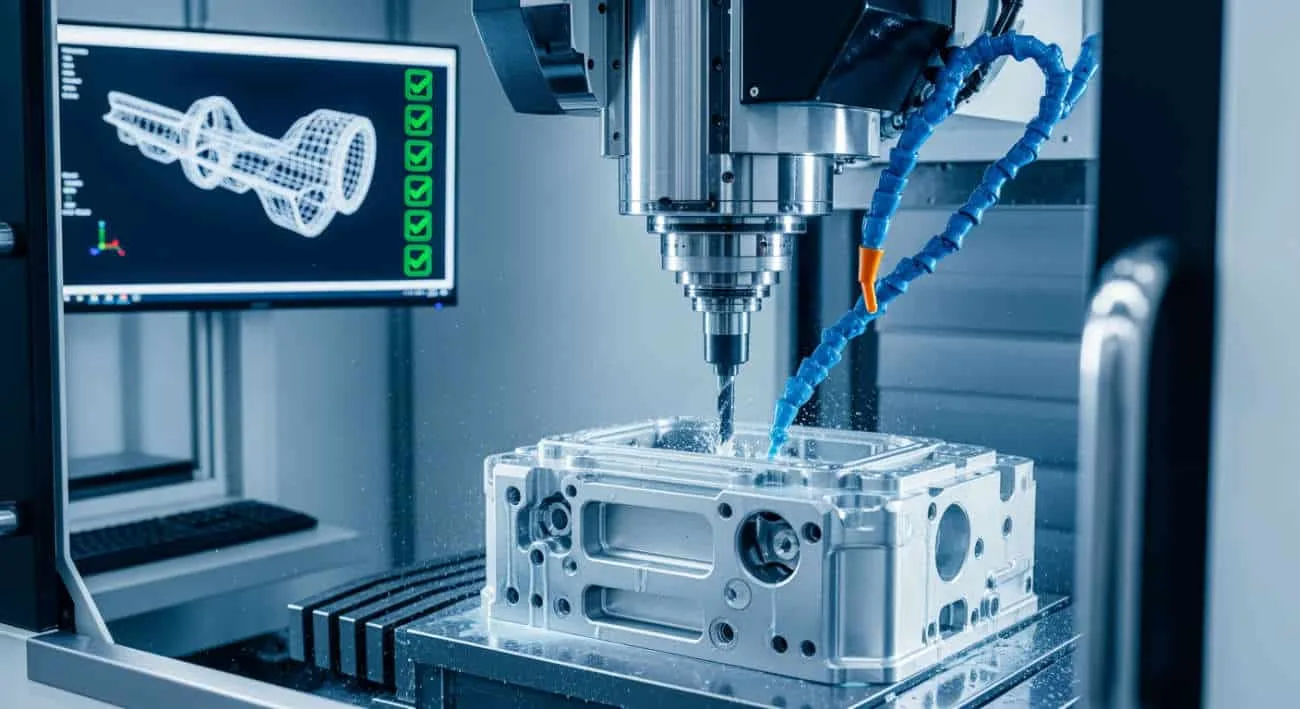
To create these housings, manufacturers rely on Computer Numerical Control (CNC) milling. Specifically, they require tight tolerance milling that can hold dimensions within microns. At Cyclone Bolt, we understand that in the aerospace world, a deviation the size of a human hair can lead to a system failure.
Understanding the Role of Avionics Housing
Avionics housings serve as the first line of defense for a plane’s “brain.” Inside these housings, you’ll find circuit boards, sensors, and processors that handle everything from fuel management to auto-pilot sequences.
If these components are exposed to the harsh environment of flight without adequate protection, they will fail. The housing must provide:
-
Structural Integrity: Maintaining shape under high G-forces and pressure changes.
-
Thermal Management: Dissipating heat generated by internal electronics.
-
Sealing: Preventing moisture and contaminants from reaching sensitive circuits.
-
EMC Shielding: Protecting the electronics from electromagnetic interference.
Achieving these goals requires more than just a sturdy material. It requires a manufacturing process that can produce complex geometries with absolute consistency. This is why CNC milling has become the industry standard for aerospace component production.
The Physics of Tight Tolerances
In manufacturing, a “tolerance” is the allowable limit of variation in a physical dimension. In general industrial work, a tolerance of ±0.005 inches might be perfectly acceptable. In avionics, we often work with tolerances as tight as ±0.0001inches.
Why does it need to be so precise? It comes down to fit and function. Avionics housings are often part of a larger assembly. If the housing is slightly out of spec, the connectors won’t line up perfectly. This can create “micro-gaps” that allow moisture to seep in or cause connectors to vibrate loose over time.
Furthermore, many avionics housings serve as heat sinks. If the mating surface between a heat-generating component and the housing isn’t perfectly flat—measured in microns—heat won’t transfer efficiently. The electronics could overheat, leading to a mid-flight “blackout.”
How CNC Milling Delivers Micron-Level Accuracy
CNC milling is a subtractive manufacturing process. A computer-controlled cutting tool removes material from a solid block of metal to create the final part. To reach the levels of precision required for aerospace, several factors must align perfectly.
1. Multi-Axis Control
Modern aerospace housings often feature complex internal channels for cooling or intricate mounting points. Traditional 3-axis machines move in X, Y, and Z directions. However, to achieve the geometries needed for avionics, 5-axis CNC milling is often used.
A 5-axis machine can rotate the part while cutting. This allows the tool to reach every angle of the housing in a single setup. By reducing the number of times a part has to be moved and “re-fixtured,” you eliminate the tiny alignment errors that creep in during manual transitions.
2. High-Speed Spindles and Tooling
The tools used in CNC milling for avionics are often made of solid carbide or diamond-coated materials. These tools spin at tens of thousands of revolutions per minute (RPM). This high speed allows for “high-speed machining” (HSM), which reduces the physical force applied to the part.
Lower force means less “tool deflection”—the tiny bending of the drill bit that can throw off a measurement. When you’re aiming for ±0.0001 inches, even a microscopic bend matters.
3. Real-Time Feedback Systems
High-end CNC mills use closed-loop feedback systems. These systems use optical encoders to monitor the exact position of the cutting tool thousands of times per second. If the machine detects a deviation due to thermal expansion or vibration, it makes an instantaneous correction.
Material Selection: The Backbone of Stability
The material you choose is just as important as the machine you use. In the Houston aerospace hub, we work with materials that offer the best strength-to-weight ratios. You can explore our material grade guides to see how different alloys behave under stress.
-
Aluminum 6061 and 7075: These are the workhorses of avionics. They are lightweight, have excellent thermal conductivity, and are highly “machinable,” meaning they hold a tolerance well without warping.
-
Titanium: Used for housings that will be exposed to extreme heat or corrosive environments. Titanium is incredibly strong but difficult to machine, requiring specialized CNC strategies to maintain tight tolerances.
-
Stainless Steel: Often used for components requiring high durability and corrosion resistance, particularly in naval aviation.
Choosing the right material ensures that the part doesn’t just meet the tolerance on the shop floor but maintains that tolerance when it’s freezing at 40,000 feet. According to the National Institute of Standards and Technology (NIST), dimensional stability in extreme temperatures is a primary focus for aerospace manufacturing standards.
The Role of Quality Management: ISO 9001 and API Spec Q1
Precision machining isn’t just about the machine; it’s about the system behind the machine. At Cyclone Bolt, our facility is governed by rigorous quality standards.
The ISO 9001:2015 Quality System Certificate certification is the foundation. it ensures that every step of our process—from the moment we receive raw material to the final inspection—is documented and repeatable.
For even more critical applications, we adhere to API Spec Q1 9th Edition. While originally developed for the oil and gas industry, API Q1 is one of the most stringent quality management systems in the world. It focuses heavily on risk management and “contingency planning.” In aerospace, where failure isn’t an option, the “Q1” mindset ensures that every housing we mill is identical to the last one.
Fasteners and Housings: The API 20E and 20F Connection
An avionics housing is only as secure as the bolts holding it together. This is where Cyclone Bolt’s core expertise creates a complete solution. While the housing requires tight-tolerance milling, the fasteners securing those housings must meet their own set of high-performance standards.
We specialize in API 20E (Alloy and Carbon Steel Bolting) and API 20F (Corrosion Resistant Bolting). These standards define different Bolting Specification Levels (BSL). For aerospace and high-pressure environments, BSL-3 is the gold standard.
When a CNC-milled housing is paired with API 20E or 20F fasteners, you create an assembly that is:
-
Vibration Resistant: Preventing the housing from shaking loose during takeoff or turbulence.
-
Corrosion Proof: Essential for aircraft operating in humid or coastal environments.
-
Traceable: Every bolt and milled component can be traced back to its original “heat lot” or batch of raw material.
Coatings and Platings for Longevity
The final step in creating a pristine avionics housing is the surface finish. Raw aluminum or steel will eventually oxidize. To prevent this, housings undergo specialized treatments.
Our coating and plating technical guide details the options available for aerospace parts. Anodizing is a common choice for aluminum housings. It creates a hard, non-conductive surface that protects the metal while allowing for a specific color finish.
For housings requiring high electromagnetic shielding, chemical film (often called “Alodine”) is used. This provides corrosion resistance while maintaining electrical conductivity, which is necessary to “ground” the housing and protect the electronics inside from static and interference.
Why Houston is a Hub for Aerospace Machining
Houston, Texas, is synonymous with flight and space exploration. Being located here allows Cyclone Bolt to tap into a massive network of aerospace expertise and a supply chain built for speed.
We are “Houston’s fastest-growing custom bolt and fastener company,” and that growth is driven by our commitment to local manufacturing. In an industry where “AOG” (Aircraft on Ground) situations cost thousands of dollars per hour, having a local partner who can deliver tight-tolerance components quickly is a major advantage.
Our proximity to NASA and major aerospace contractors means we stay on the cutting edge of what the industry demands. Whether it’s a one-off prototype for a new sensor or a production run of a thousand housings, we bring the same level of precision to every job.
Advancements in CNC Technology for 2026
As we move through 2026, CNC milling is becoming even more intelligent. “Digital Twins” are now a standard part of our workflow. Before a single piece of metal is cut, we create a virtual simulation of the milling process. This allows us to predict tool wear and identify potential “bottlenecks” in the geometry.
Artificial Intelligence (AI) is also playing a role in quality control. Automated inspection systems use high-resolution cameras to check the dimensions of a milled housing against the original CAD model in real-time. This ensures that every part leaving our shop meets the “zero-defect” standard required by modern aviation.
The Future of Avionics Housing
The next generation of aircraft—including electric vertical takeoff and landing (eVTOL) vehicles—will require even lighter and more compact avionics housings. This will push CNC milling to its absolute limits. We are looking at thinner walls, more complex heat-dissipation fins, and integrated mounting features that were previously impossible to machine.
By combining the structural science of material grades with the extreme accuracy of 5-axis milling, we are enabling the next era of flight. Every micron matters, and every bolt counts.
Article Recap
-
Avionics Housing Purpose: Protects sensitive flight-control electronics from heat, vibration, and pressure.
-
The Power of Tight Tolerances: Machining within ±0.0001 inches is necessary for proper heat dissipation and sealing.
-
CNC Milling Advantages: 5-axis machines allow for complex geometries in a single setup, reducing alignment errors.
-
System Integrity: Fasteners meeting API 20E and 20F standards are vital for securing high-precision housings.
-
Quality Standards: Certifications like ISO 9001:2015 Quality System Certificate and API Spec Q1 guarantee repeatable, safe results.
-
Houston Advantage: Local expertise and fast turnaround times for critical aerospace components.
-
Advanced Protection: Using the coating and plating guide ensures housings survive the harsh environment of high-altitude flight.
Partner with Cyclone Bolt for Aerospace Excellence
Don’t gamble with your critical components. Whether you need custom-milled avionics housings or high-strength BSL-3 bolting, Cyclone Bolt is your Houston-based partner for precision. Our commitment to API Spec Q1 quality means you get parts that perform under the most extreme conditions.
Ready to start your next project? Request a quote from our engineering team today. Let’s build the future of flight together, one micron at a time.