
Originally published 2026-01-07 · Cyclone Bolt
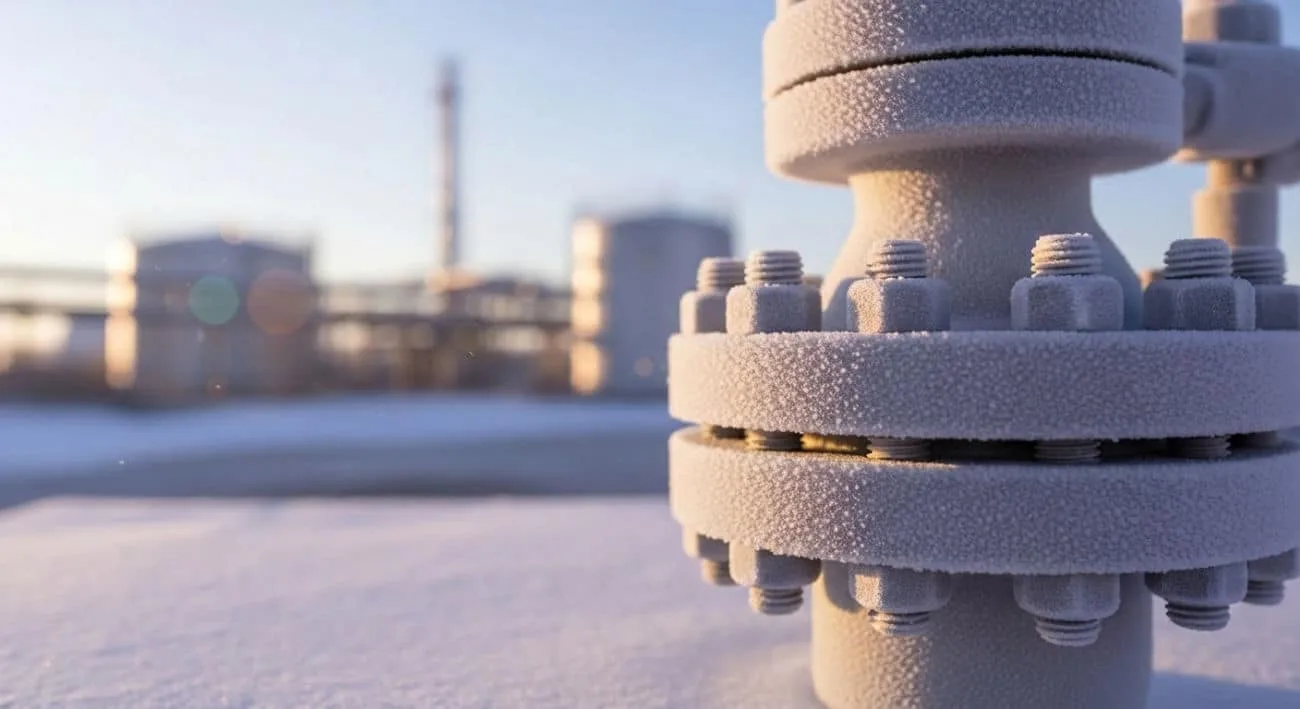
Cryogenic applications like Liquefied Natural Gas (LNG) processing and storage present some of the most brutal environments in the industrial world. When temperatures drop to -150°F or lower, standard carbon steel becomes as brittle as glass. If you use the wrong fastener, a single impact or sudden pressure change can cause a catastrophic “shatter” failure.
For engineers and procurement specialists in the Houston energy corridor, selecting the correct combination of bolts and nuts for cryogenic valves is a matter of safety and long-term reliability. The science of low-temperature bolting focuses on a property called “toughness.” This is the material’s ability to absorb energy and deform plastically rather than fracturing when cold.
Cyclone Bolt provides high-performance fasteners specifically tested for these sub-zero extremes. We ensure your valves stay secure when the mercury drops.
The Challenge of Cryogenic Temperatures
At room temperature, most industrial bolts are ductile. They can stretch slightly under load without breaking. However, as the temperature falls, many metals undergo a “ductile-to-brittle transition.”
In cryogenic valve assemblies, the bolts are under constant tension to maintain the seal. If the metal becomes brittle, it loses its ability to handle vibrations or thermal expansion. A bolt that is perfectly safe at 70°F might snap like a pencil at -150°F.
To prevent this, the industry relies on specific ASTM standards designed for low-temperature service. Specifically, we look to the ASTM A320 specification for bolting and the ASTM A194 specification for nuts.
Choosing the Right Bolt: ASTM A320 L7 and L43
The material grade guides at Cyclone Bolt highlight two primary workhorses for low-temperature valves: Grade L7 and Grade L43.
ASTM A320 Grade L7: The Standard for Low-Temp
Grade L7 is a liquid-quenched and tempered alloy steel. It is chemically similar to the common A193 B7 bolt used in standard oilfield applications, but with a critical difference: it must pass Charpy V-notch impact testing.
This test measures how much energy the steel can absorb at a specific low temperature. For L7, this testing is typically conducted at -150°F. This makes L7 the go-to choice for most low-temperature applications where the temperature does not drop below that threshold.
ASTM A320 Grade L43: Enhanced Performance for Thick Sections
When you are dealing with very large valves or heavy-duty flanges, L7 might not be enough. Grade L43 is a nickel-chromium-molybdenum alloy steel (specifically 4340 steel).
The addition of nickel improves “hardenability.” This means the bolt maintains its strength and toughness even in very thick diameters where L7 might lose its properties toward the center of the bolt. Like L7, it is impact-tested at -150°F but offers superior performance in heavy-wall valve assemblies.
Matching the Nut: ASTM A194 Grade 4 and Grade 7
A bolt is only as good as the nut that holds it. In a cryogenic valve, the nut must be able to withstand the same low temperatures without cracking. Standard A194 Grade 2H nuts, which are ubiquitous in the industry, are generally not recommended for true cryogenic service.
ASTM A194 Grade 4
Grade 4 nuts are made from carbon-molybdenum steel. They are designed to be paired with A320 L7 bolts in low-temperature service. They offer the necessary strength and are heat-treated to ensure they don’t become brittle.
ASTM A194 Grade 7
Grade 7 is often the preferred choice for high-pressure cryogenic valves. These are made from chromium-molybdenum alloy steel (similar to 4140). Grade 7 nuts are quenched and tempered, and they undergo the same Charpy impact testing as the L7 bolts they accompany. This ensures the entire fastener assembly behaves as a single, tough unit.
The Importance of Charpy Impact Testing
At Cyclone Bolt, our quality and tech department emphasizes the Charpy V-notch test because it is the only way to verify cryogenic readiness.
During this test, a small sample of the material is cooled to the service temperature (e.g., -150°F). A weighted pendulum strikes the sample. The amount of energy absorbed by the material during the fracture tells the lab if the steel is tough enough for the job.
If a bolt batch fails this test, it cannot be used for cryogenic valves, regardless of how strong it is at room temperature. We follow technical standards rigorously to ensure every L7 or L43 stud we provide has passed these vital benchmarks.
Managing Thermal Contraction in Cryogenic Valves
One of the most difficult aspects of cryogenic valve maintenance is thermal contraction. When a valve is put into service with liquid nitrogen or LNG, the metal components shrink.
If the valve body and the bolts shrink at different rates, the preload (clamping force) can be lost. This leads to leaks. Conversely, if the bolts shrink more than the valve body, the tension can increase to the point where the bolt snaps.
Using matched sets of A320 L7 bolts and A194 Grade 7 nuts ensures that the fastener assembly has a predictable rate of contraction. This allows engineers to calculate the correct “hot torque” or initial assembly load to account for the “cold” service conditions.
Why API 20E and API 20F Standards Matter
In the Houston oil and gas market, many cryogenic valves fall under the jurisdiction of the American Petroleum Institute (API). For critical service, we recommend fasteners manufactured to API 20E (Carbon and Alloy Steel) or API 20F (Corrosion-Resistant Bolting).
These standards are more stringent than basic ASTM requirements. They require:
-
Stricter control of the raw material source.
-
More frequent testing of mechanical properties.
-
Higher levels of traceability and documentation.
When you are managing a high-pressure LNG terminal, the “peace of mind” provided by API-compliant bolting is worth the investment. It minimizes the risk of a “non-conforming” bolt finding its way into a critical valve.
Quality Assurance through API Spec Q1 and ISO 9001:2015
Traceability is non-negotiable in cryogenic service. You need to know that the bolt in your hand matches the lab report in your file.
Cyclone Bolt operates under API Spec Q1 9th Edition and ISO 9001:2015 Quality System Certificate certifications. These quality management systems ensure that every step of the process—from receiving materials specifications to final shipping—is documented.
If there is ever a question about a bolt’s performance at -150°F, we can trace it back to the specific heat of steel and the specific impact test results. This level of technical standard adherence is what separates professional industrial suppliers from general hardware distributors.
Coating and Plating for Low-Temp Service
Corrosion can be a hidden enemy in cryogenic systems. Often, these valves are located in coastal areas where salt air is a constant. However, not all coatings are suitable for sub-zero use.
Some coatings can become brittle or flake off at cryogenic temperatures. At Cyclone Bolt, we refer to our coating and plating technical guide to recommend finishes that remain stable.
Common choices include:
-
Cadmium Plating: Offers excellent corrosion resistance and remains stable at low temperatures.
-
Xylan or PTFE Coatings: These provide a low coefficient of friction, which is vital for accurate torqueing, and they do not become brittle in the cold.
-
Zinc Plating: While common, it must be applied correctly to avoid hydrogen embrittlement, which can be exacerbated by cryogenic stresses.
Fastener Support in the Heart of Houston
Located in Houston, Texas, Cyclone Bolt is uniquely positioned to support the global energy industry. We understand the specific needs of LNG exporters and cryogenic equipment manufacturers. According to the Federal Energy Regulatory Commission (FERC), the US has become a leading exporter of LNG, and Houston is the logistical hub for this growth.
Safety in this sector relies on the “small parts.” A multi-million dollar valve is only as reliable as the $50 bolt holding its bonnet in place. Our team is dedicated to providing the high-strength, high-toughness fasteners that keep these systems running safely.
Avoiding Common Pitfalls in Cryogenic Bolting
Mistakes in fastener selection can be expensive. Here are the most common errors we see:
-
Using B7 Instead of L7: They look identical. They are often even marked similarly. But a B7 bolt has not been impact-tested and may fail in the cold.
-
Mixing Nut Grades: Using an A194 2H nut with an L7 bolt is common but incorrect for cryogenic service. The nut might crack, causing the bolt to lose tension.
-
Ignoring Lubrication: In cryogenic service, the threads must be properly lubricated to ensure even loading. Without it, you get “galling,” which can seize the valve joint.
-
Lack of Documentation: Using fasteners without a MTR (Material Test Report) that includes impact data is a major safety violation in cryogenic plants.
The Perfect Cryogenic Combination
Achieving a secure seal in a cryogenic valve requires a specific recipe of materials and testing:
-
Bolts: Use ASTM A320 Grade L7 for general service or L43 for heavy-duty applications.
-
Nuts: Pair with ASTM A194 Grade 4 or Grade 7 nuts.
-
Testing: Ensure all components have passed Charpy V-notch impact testing at or below the service temperature.
-
Quality: Source fasteners with full traceability under ISO or API certifications.
By following these guidelines, you protect your facility from the dangers of brittle fracture and joint failure.
Get a Quote for Your Cryogenic Bolting Needs
Stay secure at -150°F. The technical team at Cyclone Bolt is here to help you navigate the complexities of cryogenic fastener selection. Whether you are replacing bolts during a turnaround or engineering a new valve system, we have the inventory and expertise you need.
Our Houston-based warehouse is stocked with A320 L7 and L43 studs, along with the appropriate A194 nuts, ready for immediate dispatch.
Stay secure at -150°F. We are experts in cryogenic bolting. Contact us for a quote today.
Visit our Materials Specifications page to see our full range of capabilities, or reach out to us at Cyclone Bolt to learn how we can support your low-temperature projects.