
Originally published 2026-01-08 · Cyclone Bolt
The Hidden Strength of High-Pressure Valves
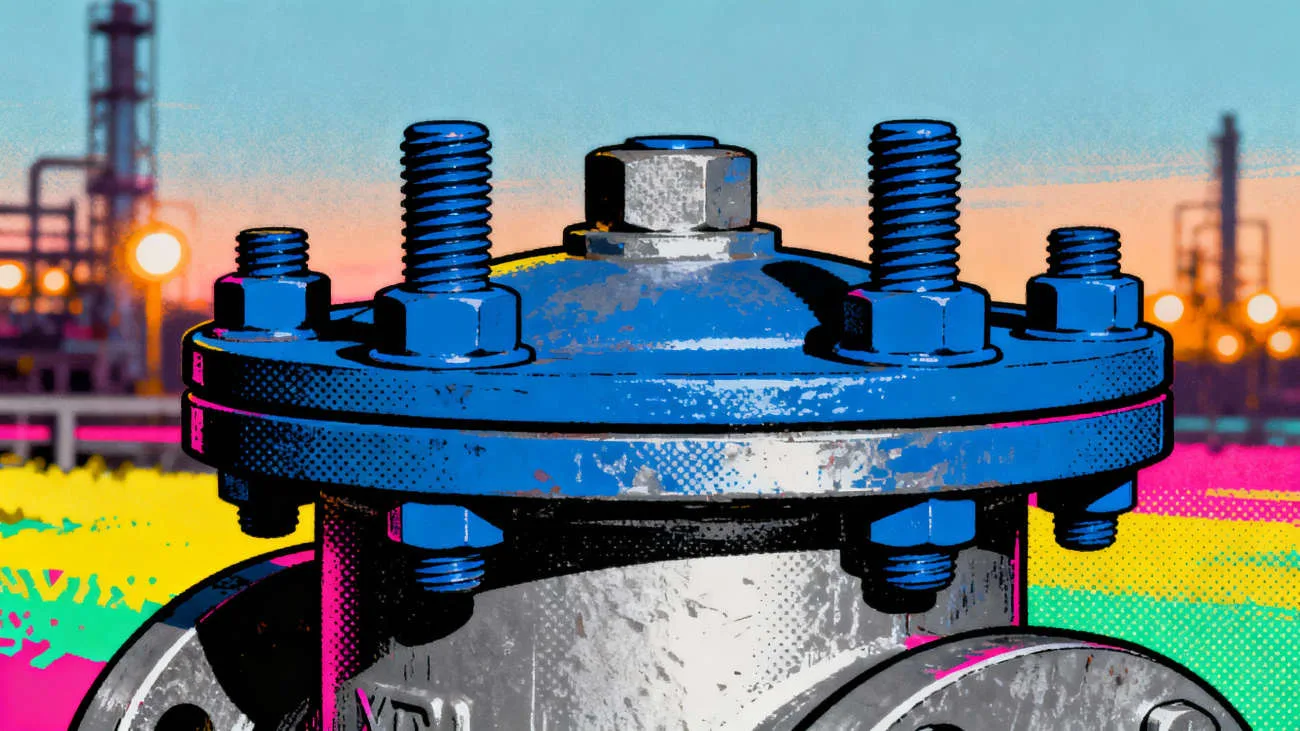
Inside a refinery or a midstream pipeline, thousands of valves manage the flow of volatile fluids. Gate and globe valves are the workhorses of these systems. They handle extreme temperatures and immense internal pressures. When you look at a high-pressure valve, you see a massive steel body and a sturdy bonnet.
What you might not notice immediately are the bolts holding them together. These bolts are the only thing standing between controlled flow and a catastrophic blowout. In high-pressure applications, the bolting assembly contains the entire line pressure at the valve’s bonnet. If the bolts fail, the valve fails.
Why the Bonnet Connection Is Critical
A valve bonnet is the cover for the opening in the valve body. In gate and globe valves, the stem passes through the bonnet to operate the internal mechanism. This creates a joint that must be perfectly sealed.
Internal pressure exerts a constant upward force on the bonnet. This force tries to push the bonnet away from the valve body. The bolts must provide enough clamping force to counteract this pressure and keep the gasket compressed.
If a bolt stretches too much or snaps, the seal is lost. At high pressures, even a tiny gap can lead to a high-velocity leak. This puts workers at risk and can lead to environmental disasters.
Understanding the Physics of Pressure Containment
The pressure inside a valve is measured in Pounds per Square Inch (PSI). In a Class 2500 valve, the internal pressure is immense. This pressure acts upon the total surface area of the bonnet.
Total Load = Pressure x Area.
For a large valve, the total force pushing against the bonnet can reach hundreds of thousands of pounds. The bolting assembly must be engineered to handle this “separation force” with a significant safety margin.
Materials Matter: Beyond Standard Steel
You cannot use hardware-store bolts for a high-pressure valve. The material must withstand tensile stress, temperature fluctuations, and corrosion. Cyclone Bolt, located in Houston, Texas, specializes in these high-performance materials.
Common Material Grades for Valves:
-
ASTM A193 Grade B7: The industry standard for high-pressure and high-temperature service. It is a chromium-molybdenum alloy steel.
-
ASTM A193 Grade B16: Designed for even higher temperatures. It contains vanadium for improved strength at heat.
-
ASTM A320 Grade L7: Specifically for low-temperature or cryogenic services. It undergoes impact testing to ensure it doesn’t become brittle in the cold.
-
Stainless Steel (B8 and B8M): Used when corrosion resistance is the primary concern, such as in offshore or chemical environments.
The Role of API 20E and API 20F
The American Petroleum Institute (API) sets the standards for bolting used in the oil and gas industry. These standards ensure that every bolt can handle the advertised load.
API 20E: Alloy and Carbon Steel Bolting
API 20E covers carbon and alloy steel bolts. This standard is crucial for high-pressure gate valves. It defines three Bolting Specification Levels (BSL-1, BSL-2, and BSL-3). As the BSL level increases, the testing and quality requirements become more stringent. BSL-3 represents the highest level of quality and traceability.
API 20F: Corrosion-Resistant Bolting
API 20F focuses on corrosion-resistant alloys (CRA), such as stainless steel and nickel alloys. These are essential for globe valves operating in “sour” environments containing hydrogen sulfide (H2S).
Why Manufacturing Quality Defines Safety
Cyclone Bolt adheres to API Spec Q1 and ISO 9001:2015. These certifications are not just pieces of paper. They represent a commitment to a rigorous manufacturing process.
When a bolt is manufactured for a high-pressure bonnet, every step is tracked.
-
Heat Lot Traceability: Knowing exactly which batch of steel was used.
-
Forging Control: Ensuring the internal grain structure of the bolt is strong.
-
Heat Treatment: Precision cooling and heating to achieve the right hardness.
-
Testing: Using Non-Destructive Examination (NDE) like ultrasonic or magnetic particle testing to find hidden cracks.
The Threat of Hydrogen Embrittlement
In high-pressure environments, hydrogen embrittlement is a silent killer. This occurs when hydrogen atoms enter the metal, making it brittle. Under the high tension of a valve bonnet, a brittle bolt can snap without warning.
To prevent this, Cyclone Bolt follows strict plating and coating guidelines. If a bolt is zinc-plated, it must undergo a baking process to drive out hydrogen. For many high-pressure valves, manufacturers prefer PTFE or Xylan coatings to provide corrosion resistance without the risk of embrittlement.
Gate Valves vs. Globe Valves: Bolting Challenges
Gate Valves
Gate valves are typically used for “on/off” service. They often face sudden pressure surges when opened or closed. The bolting must handle these dynamic loads. Because gate valves can be very large, the bonnet bolts are often significant in diameter and length.
Globe Valves
Globe valves are used for throttling. This means they often operate in a partially open state, which can cause vibration. Vibration is an enemy of bolting. It can lead to “self-loosening.” High-integrity bolts with precise threading are required to maintain the clamp load under constant vibration.
Technical Standards and Compliance
The technical landscape for bolting is complex. Engineers must navigate various standards to ensure safety.
-
ASME B16.34: Covers valves flanged, threaded, and welding end.
-
ASME Section VIII: The pressure vessel code that often dictates how bonnet bolting is calculated.
-
ASTM A194: The standard for the nuts that go with the bolts. A high-pressure bolt is useless without a matching high-strength nut.
How to Choose the Right Bolting Assembly
Selecting bolting for a valve bonnet requires looking at the full environment.
-
What is the pressure class? (e.g., Class 600, 1500, 2500)
-
What is the operating temperature?
-
Is the fluid corrosive?
-
Are there environmental factors like salt spray?
Cyclone Bolt’s Material Grade Guides provide a roadmap for these decisions. Choosing a lower grade of bolt to save money is a dangerous gamble when dealing with high-pressure containment.
The Importance of Correct Torque
Even the best bolt will fail if it is not installed correctly. Torque is the measurement of the twisting force used to tighten the bolt. However, what engineers actually care about is “preload.” Preload is the tension created in the bolt that holds the joint together.
Because of friction, much of the torque applied to a nut is lost. Using a Coating and Plating Technical Guide helps determine the “K-factor” or friction coefficient. This allows technicians to calculate the exact torque needed to achieve the required preload.
Houston: The Global Hub for Valve Bolting
Location matters. Being based in Houston, Texas, puts Cyclone Bolt at the center of the global energy industry. This proximity allows for rapid response to refinery shutdowns and urgent pipeline repairs. It also means the team understands the specific challenges of the Gulf Coast environment, where humidity and salt accelerate corrosion.
The Bottom Line on Valve Safety
The bonnet of a gate or globe valve is a primary pressure boundary. The bolts are the mechanical components that maintain that boundary. If you treat bolting as a secondary concern, you invite risk into your facility.
High-integrity bolting ensures that the valve performs its job without leaking. It protects your equipment, your people, and your reputation. When the pressure is on, the quality of the bolt is the only thing that matters.
External Resources for Technical Excellence
For more information on the standards governing these components, visit these authority sites:
-
American Petroleum Institute (API) – For detailed information on API 20E and 20F standards.
-
ASTM International – To research material specifications like A193 and A320.
Demand Quality for Your Pressure Containment
For high-pressure valves, demand high-integrity bolts. Demand Cyclone Bolt. We provide the traceability, testing, and material expertise required for the world’s most demanding applications. Our Houston facility is ready to support your next project with API-certified fasteners.
Get a quote today from Cyclone Bolt.
FAQs from Cyclone Bolt
1. What are the best bolt materials for high-pressure valve bonnets?
The most reliable materials for high-pressure valve bonnets are ASTM A193 Grade B7 for high-temperature service and ASTM A320 Grade L7 for low-temperature applications. For environments involving high corrosion or sour gas, stainless steel grades like B8M or nickel alloys are preferred. Choosing the right grade depends on the pressure class and chemical exposure of the valve.
2. Why do valve bonnet bolts fail in high-pressure systems?
Valve bonnet bolts typically fail due to hydrogen embrittlement, improper torque levels, or fatigue from thermal cycling. In high-pressure systems, if the bolts do not provide sufficient clamping force, the internal line pressure can overcome the seal, leading to a blowout. Using API 20E or 20F certified bolting from Cyclone Bolt ensures the material has been tested to resist these common failure modes.
3. What is the difference between API 20E and API 20F bolting?
API 20E specifies requirements for carbon and alloy steel bolting used in the petroleum and natural gas industries. API 20F covers corrosion-resistant alloys (CRA), such as stainless steel or nickel-based bolting. Both standards define Bolting Specification Levels (BSL-1, 2, and 3) to ensure traceability and high-quality manufacturing for critical pressure-containing applications.
4. How does line pressure affect valve bonnet bolt selection?
Line pressure creates a “separation force” that attempts to lift the bonnet off the valve body. The bolting must be strong enough to counteract this force while maintaining a specific preload to keep the gasket compressed. As the PSI increases, engineers must select bolts with higher tensile strength and larger diameters to ensure the safety of the pressure boundary.
5. What is the role of the bonnet in a gate valve?
The bonnet acts as the primary cover for the valve body and houses the internal moving parts like the stem and gate. Because it is a pressure-containing component, it must be securely fastened to the body. The bolting assembly is the only mechanical component that prevents the internal line pressure from forcing the bonnet open.
6. Do I need BSL-3 bolting for my high-pressure valves?
BSL-3 (Bolting Specification Level 3) is the highest quality standard under API 20E and 20F. It requires the most stringent testing, including non-destructive examination (NDE) and full heat-lot traceability. BSL-3 is typically required for critical applications where a failure could result in significant environmental damage or risk to human life.
7. How do I prevent corrosion on valve bonnet bolts?
Corrosion can be prevented by using specialized coatings like PTFE (Xylan), zinc plating, or cadmium plating. However, for high-pressure bolts, it is vital to use a coating process that avoids hydrogen embrittlement. Cyclone Bolt offers various technical coatings specifically designed to protect fasteners in harsh Houston oil and gas environments.
8. Why is torque accuracy important for globe valve bonnets?
In globe valves, especially those used for throttling, vibration can cause bolts to loosen over time. Applying the correct torque ensures the bolts reach the necessary preload (tension). If the torque is too low, the valve will leak; if it is too high, the bolt may stretch beyond its yield point and lose its ability to contain pressure.
9. What is ASTM A193 Grade B7 used for?
ASTM A193 Grade B7 is a heat-treated chromium-molybdenum steel used widely for pressure vessels, valves, and flanges. It is favored in the oil and gas industry because it maintains high tensile strength at temperatures up to 840°F, making it the industry standard for high-pressure bonnet bolting.
10. Where can I find API-certified bolting in Houston?
Cyclone Bolt, located in Houston, Texas, is a leading provider of API-certified fasteners. They specialize in API 20E and 20F compliant bolting, offering the traceability and technical expertise required for high-pressure gate and globe valve applications. You can request a quote directly through their website for custom or standard high-integrity fasteners.