
Originally published 2025-11-10 · Cyclone Bolt
7 Signs Your Pressure Vessel Bolts Need Immediate Replacement
In the high-stakes world of petrochemicals, oil and gas, and power generation, there are few pieces of equipment more critical—or more dangerous—than a pressure vessel. By design, these components operate under immense internal force, often at extreme temperatures.
What is the only thing holding that force in check?
A series of highly-engineered fasteners. The stud bolts and nuts holding a flange connection together are the single most critical component in the entire assembly. Their failure is not an option.
A single bolt failing can trigger a cascade, leading to a loss of containment. The results are catastrophic: project shutdowns, environmental damage, fires, and a severe threat to personnel safety.
As a Houston-based manufacturer of API-certified bolting, we at Cyclone Bolt live on the front lines of asset integrity. Your maintenance and shutdown (TAR) schedules are built around ensuring this equipment is safe.
How do you know when your bolts are at the end of their life?
It’s not guesswork. It’s a science. Here are the 7 signs your maintenance and reliability teams must look for.
1. Visible Corrosion (Rust or Staining)
This is the most common and obvious sign, but it is often dangerously misunderstood.
What you see: Red rust (iron oxide), white or grey scale, or dark staining on the bolt, nuts, or flange. Why it’s critical:Corrosion is not a cosmetic problem; it is a loss of material.
- Reduced Load Capacity: A bolt’s strength is based on its cross-sectional area. As rust flakes off, the bolt’s diameter shrinks. A 1/8″ reduction in the diameter of a 1″ stud can reduce its load-bearing capacity by over 20%.
- Increased Stress: The rough, uneven surface of a corroded bolt creates “stress risers,” concentrating the load in one small area instead of distributing it.
If you see heavy rust, you can no longer be certain of that bolt’s strength. It has become an unknown and unacceptable variable.
2. Localized Pitting
Pitting is a specific and far more dangerous form of corrosion.
What you see: Small, deep “pits” or pinholes in the surface of the bolt, often hidden under scale or rust. Why it’s critical: A small, deep pit is the “tip of the iceberg.” This localized attack is more aggressive than uniform rust and acts as a tiny drill.
- Creates Stress Risers: Just like corrosion, a pit creates a massive stress concentration point.
- The Start of a Crack: A pit is the most common place for a crack to begin. The force on the bolt will be focused on the bottom of that pit, and with every pressure cycle, it will work to pull the steel apart.
A pitted bolt is a bolt that is actively trying to crack.
3. Thread Damage (Galling or Stripping)
What you see: Threads that are “galled” (seized or torn), “stripped” (shaved off), or filled with debris. Why it’s critical: A bolt’s entire job is to provide clamping force, which it gets from being tensioned (torqued). This all happens at the threads.
- Inability to Torque: If the threads are damaged, you cannot get an accurate torque reading. Your torque wrench will “click” not because the bolt is at the right tension, but because the threads are grinding.
- Loss of Preload: A bolt that isn’t torqued correctly has zero “preload” (clamping force). It is literally just filling a hole. An un-torqued bolt in a pressurized system will quickly lead to a leak and eventual failure.
If a bolt is galled upon removal (a common issue with stainless steel), it must never be reused.
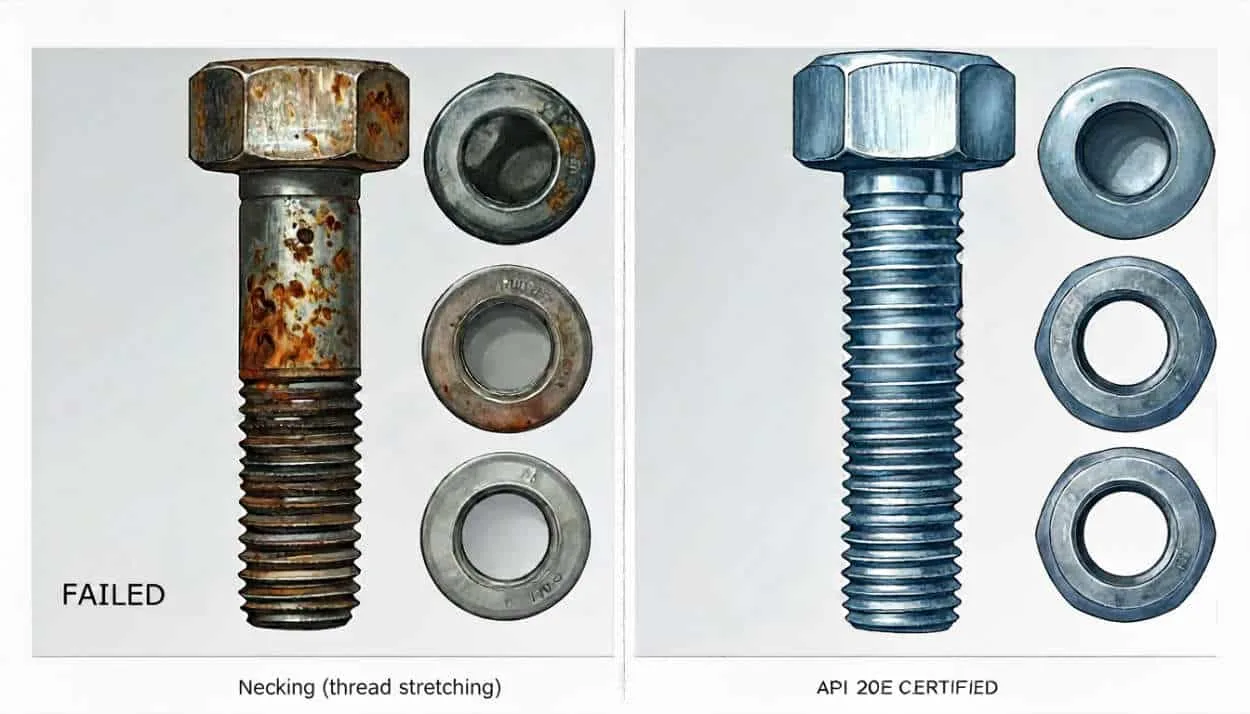
4. Bolt Stretching or “Necking”
This is one of the most critical and least understood signs of failure.
What you see: Visible “necking,” which is a noticeable reduction in the bolt’s diameter in one area. You may also see that the thread pitch looks “pulled apart” or stretched. Why it’s critical: All bolts are designed to be “elastic,” like a spring. When you torque them, they stretch a tiny, invisible amount to create clamping force. When you un-torque them, they return to their original length.
However, if a bolt is over-torqued or exposed to a pressure spike (an “excursion”), it can be stretched past its “yield strength.”
- Plastic Deformation: This is the point of no return. The bolt has permanently deformed.
- Total Loss of Strength: A bolt that has been permanently stretched (necked) has failed. It has lost its “spring” and its structural integrity. It will never hold the same load again.
A stretched bolt is a used-up bolt. It has already done its job and failed in the process. It must be replaced.
5. Heat Discoloration
What you see: A “rainbow” or “blue” discoloration on the bolt or nut. It might also look straw-colored or dark purple.Why it’s critical: High-strength bolts (like the industry-standard ASTM A193 B7) get their strength from a precise heat-treatment process. This process creates a specific “temper.”
- Compromised Temper: When a bolt is exposed to extreme temperatures beyond its design limit (from a fire, steam leak, or process upset), that heat-treat is ruined.
- Loss of Hardness & Strength: The “blue” color is a sign that the bolt’s internal metallic structure has changed. It has lost its hardness and its tensile strength. It is now just a piece of mild, weak steel.
You can no longer trust its mechanical properties. It is no longer a B7 bolt; it’s a liability.
6. Visible Cracks or Fractures
What you see: The most obvious of all: a visible crack, often starting at the root of a thread or at the fillet (where the head meets the shank). Why it’s critical: This is a bolt that is seconds from total failure. A crack does not get better; it only gets bigger.
- Fatigue Failure: This is often the result of “fatigue,” where the bolt has been exposed to millions of small vibration cycles.
- Stress Corrosion Cracking (SCC): This is a deadly combination of a corrosive environment and a bolt under tension.
A cracked bolt has zero load capacity. It must be replaced immediately. This is often found during inspection methods like visual (VT) or dye penetrant (PT) testing.
7. Damaged or Rounded Heads & Nuts
What you see: The corners of the hex nut or bolt head are rounded off, “chewed up,” or damaged. Why it’s critical:This is a clear sign of improper maintenance procedures, but the danger is real.
- Torque Inaccuracy: You cannot get an accurate torque reading on a rounded nut. The wrench will slip, or the socket will “ride” the rounded corner. This guarantees the bolt will be under-torqued.
- Future Maintenance Hazard: If you can’t get a grip on it, you can’t properly remove or re-torque it during the next shutdown. It’s a compromised part that compromises your entire procedure.
Why Your Replacement Strategy is Everything
A failing bolt is a symptom of a larger problem. The root cause is almost always one of these three things:
- Improper Installation: The bolt was under-torqued (leading to fatigue) or over-torqued (leading to stretching).
- Improper Material: The wrong bolt was used for the job (e.g., a B7 stud in an environment that required a stainless or corrosion-resistant alloy).
- An Unknown Part: The bolt was a “commodity” part with no traceability. No one knows its real strength, material, or origin.
This is where Cyclone Bolt provides the solution. You should never replace a critical-service bolt with an unknown “commodity” part.
The Cyclone Bolt Difference: Certified Quality, Not Commodity Parts
When you are facing an urgent shutdown, you don’t need a bolt; you need a guarantee.
A pressure vessel bolt is an engineered component, and its certification is its most important feature.
- ISO 9001:2015 & API Spec Q1: These certifications prove that our process is audited and repeatable. The bolt you receive from us is manufactured to the same high standard, every single time.
- API 20E & 20F: These certifications are for the product itself. They are the American Petroleum Institute’s “Bolting Specification Levels” for critical-use fasteners. This is your proof of traceability, material strength, and manufacturing integrity.
- Material Test Reports (MTRs): We provide full traceability. You know the exact chemical and mechanical properties of the steel you are installing.
Avoid Catastrophic Failure for Pressure Vessels. Call Us 24/7.
The signs of bolt failure are not to be taken lightly. At the first sign of corrosion, stretching, or damage, you must have a replacement plan.
Based in Houston, Texas, Cyclone Bolt & Fastener understands the urgency of shutdowns. We know that downtime is measured in hundreds of thousands of dollars per hour. We have built our business around being the 24/7 partner who can deliver the right, certified part, right when you need it.
Frequently Asked Questions on Bolt Integrity
1. Is a rusty bolt on a pressure vessel dangerous? Yes, a rusty bolt on a pressure vessel is extremely dangerous. Rust (corrosion) is not just a cosmetic issue; it’s a physical loss of the bolt’s material. This reduces the bolt’s diameter and, therefore, its load-bearing capacity. A corroded surface also creates “stress risers” (concentration points for force), which can lead to fatigue cracks and sudden, catastrophic failure.
2. What is “bolt necking” or stretching? “Necking” is a visible reduction in a bolt’s diameter, which makes it look “stretched” in one area. This is a sign of plastic deformation, meaning the bolt was over-torqued or exposed to a force beyond its yield strength. A stretched bolt has permanently failed; it has lost its elasticity (clamping force) and structural integrity and must be replaced immediately.
3. What does a blue or rainbow color on a bolt mean? This “blue” or “rainbow” tint is heat discoloration. It is a critical sign that the bolt has been exposed to extreme temperatures beyond its design limit. This excessive heat ruins the bolt’s carefully engineered “temper” from the heat-treatment process, severely reducing its strength and hardness. The bolt is no longer compliant with its material grade (like ASTM A193 B7) and is unsafe.
4. Can I reuse stud bolts after a shutdown? It is a very high-risk practice and is not recommended by maintenance or reliability experts. Bolts in high-pressure service are “single-use” components. They have been stretched (elastically) to their limit to create a clamp load. It is impossible to know their full service history (were they over-torqued? over-heated?). Furthermore, if a bolt is galled (seized) or corroded upon removal, it must be scrapped. Always use new, certified bolts for re-assembly.
5. What is the difference between bolt pitting and rust? While both are corrosion, pitting is often more dangerous than uniform rust. General rust eats away at the surface evenly, but pitting is a localized, deep attack that drills into the bolt. These small, deep pits create severe stress concentration points and are the most common origin sites for fatigue cracks, which can lead to a sudden, brittle failure.
6. What bolts are typically used for pressure vessels? The most common fastener for pressure vessels in the oil and gas industry is the ASTM A193 Grade B7 stud bolt. This is a high-strength, heat-treated chromium-molybdenum steel bolt. It is almost always paired with an ASTM A194 Grade 2H heavy hex nut.
7. What is an API 20E certified bolt? API 20E is a rigorous specification from the American Petroleum Institute for “critical-use” fasteners. An API 20E-certified bolt (like those from Cyclone Bolt) comes with a guarantee of full traceability, material chemistry, and verified heat treatment. It is the highest standard of quality assurance for bolts used in applications where failure is not an option.
8. What happens if a pressure vessel bolt fails? The failure of even a single bolt can be catastrophic. It causes an immediate loss of clamping force, leading to a gasket leak. This can release flammable or toxic materials at high pressure and temperature, causing fires, explosions, environmental damage, and a severe threat to personnel. The resulting unplanned shutdown can also cost a facility millions.
9. How do I know if a bolt is torqued correctly? You can’t know by visual inspection alone. However, a rounded or damaged nut/head is a clear sign that it cannot be torqued correctly. Proper torque requires a calibrated torque wrench and a clean, undamaged “heavy hex” surface to grip. Inaccurate torque is a primary cause of both leaks (under-torquing) and bolt stretching (over-torquing).
10. Where can I get replacement bolts for an emergency shutdown? For urgent turnarounds (TAR) or emergency shutdowns, you need a manufacturer with 24/7 service. Cyclone Bolt in Houston specializes in the rapid-response manufacturing of certified, traceable bolts (API 20E, A193 B7, etc.) to get your facility back online safely and quickly, any time of day or night.