Originally published 2025-11-11 · Cyclone Bolt
The Ultimate Checklist for Pipe Flange Bolt Inspection and Replacement
In a high-pressure petrochemical plant, on an offshore platform, or deep within a power generation facility, what’s the most critical component?
It’s not the multi-million dollar reactor. It’s not the complex SCADA system. It’s the humble, often-overlooked fastener. Specifically, the bolts holding your pipe flanges together.
A single flange joint is a complex system of bolts, gaskets, and flange faces. The bolts are the “muscles” of this system, providing the clamping force (preload) needed to compress the gasket and create a seal. If this muscle fails, the consequences range from a costly leak to a catastrophic, facility-wide disaster.
For maintenance, reliability, and operations (MRO) teams, flange bolt inspection isn’t just “part of the job”—it’s a core safety function. But what, exactly, should you be looking for?
It’s not as simple as “is it rusty?”
This article provides a comprehensive checklist for your maintenance teams, designed for use during walk-downs, shutdown planning, or any MRO activity.
The High Stakes: Why Flange Bolting Integrity is Everything
Before we dive into the “what,” let’s establish the “why.” A single leaking flange joint can lead to:
- Fugitive Emissions: Leaking product into the atmosphere, leading to environmental fines and safety hazards.
- Safety Incidents: A spray-out of hot, toxic, or flammable liquid or gas can be catastrophic for personnel.
- Unplanned Downtime: A single leak can force an entire unit, or plant, to shut down, costing millions in lost production.
- Catastrophic Failure: A “zipper failure,” where one bolt fails and overloads the next, and the next, leads to a complete blowout.
The bolting is the one component holding back immense pressure and temperature. Trusting it to chance isn’t an option.
Pre-Inspection Planning: Setting Your Team Up for Success
You can’t effectively inspect what you haven’t planned for. Before your team ever puts on their PPE, a successful inspection starts here:
- Review Documentation: Pull the P&IDs (Piping and Instrumentation Diagrams) and flange specifications. What material should be there? What is the correct bolt size, grade, and material (e.g., B7, B8M, B16)?
- Know the History: Has this joint been a “bad actor”? Does it leak regularly? This could point to a systemic issue like vibration, misalignment, or improper installation.
- Prioritize by Risk: Not all flanges are created equal. A flange on a high-pressure steam line is a higher priority than one on a low-pressure utility water line. Focus your resources on high-consequence systems first.
- Assemble Your “Inspection Kit”: This should include more than just a wrench.
- High-lumen flashlight (intrinsically safe, if required).
- Mirror-on-a-stick (for hard-to-see areas).
- Wire brush (to clean threads or heads for inspection).
- Camera (for documenting findings).
- Gage stick (to check thread engagement).
The Flange Bolt Inspection Checklist
Use this checklist to systematically evaluate the health of your bolted flange joints.
1. External Visual Inspection Checklist (The “Walk-Down”)
This is the first line of defense and can be done during routine operator rounds.
- [ ] Check for Active Leaks: Are there visible drips, stains, moisture, or “frosting” (on cold-service lines) around the flange? This is a Priority 1 finding.
- [ ] Inspect for General Corrosion: Look at the bolt heads, nuts, and exposed threads. Is there generalized “red rust” (carbon steel) or “white rust” (galvanized)?
- [ ] Inspect for Pitting or Crevice Corrosion: This is more dangerous than general corrosion. Look for small, deep pits, especially under the nut or bolt head where moisture can get trapped.
- [ ] Check for Physical Damage: Are any bolts bent? Are the heads or nuts deformed from a wrench slipping or being side-loaded? A bent bolt is a compromised bolt.
- [ ] Look at Coatings: If the bolts are coated (e.g., PTFE, Zinc), is the coating intact? Flaking, peeling, or bubbling paint can trap moisture underneath, hiding severe corrosion.
- [ ] Gasket Inspection: Can you see the gasket? Is it bulging out of the flange (“gasket extrusion”)? Is it cracked or visibly degraded? This indicates a problem with the entire joint, likely due to over-pressure or improper installation.
2. In-Situ “Hands-On” Inspection Checklist
This requires the joint to be accessible and may be part of a planned maintenance day.
- [ ] Check Bolt Length & Thread Engagement: This is critical.
- Too Short: The nut is not fully engaged with the threads. As a rule, at least one to three threads should be visible past the nut. If the nut is flush with the end of the bolt, it’s too short and may not have adequate load-bearing capacity.
- Too Long: The bolt is protruding so far that it’s a hazard or bottoms out on other equipment. It also exposes more thread to environmental corrosion.
- [ ] Check for Missing or Incorrect Washers: Are there washers present? Are they the correct type (e.g., hardened F436 washers)? Are they “cupped” or cracked, indicating extreme over-torquing? A soft, non-hardened washer will deform and lose preload.
- [ ] Check for Consistent “Nut & Bolt” Sizing: Does one bolt in the flange look different? Is it a different size, or does the nut look new while the bolt is old? This “hodgepodge” assembly is a major red flag that proper procedures weren’t followed.
- [ ] Check for Galling (Stainless Steel): On stainless steel bolts, look for signs of thread galling (cold-welding). The threads will look “smeared,” and the nut may be completely seized on the bolt.
- [ ] Verify Bolt Head Markings: If accessible, clean the head of one or two bolts. Do the head markings match the material specified in the P&ID? The most common bolt in a plant is an ASTM A193 B7. If you see anything else, investigate why.
3. Post-Removal Inspection Checklist (The “Autopsy”)
During a shutdown or turnaround, when a joint is broken for service, never re-use the bolts. (More on this later). Use the old bolts as a diagnostic tool.
- [ ] Inspect Threads for Stripping: Are the threads clean, or are they stripped or sheared? This points to over-torquing or a cross-threaded installation.
- [ ] Inspect for “Necking”: Look at the shank of the bolt. Does it look “stretched” or thinner in one area, like taffy being pulled? This is “necking,” a clear sign the bolt was loaded past its yield strength (over-torqued) and is permanently damaged.
- [ ] Inspect for Fatigue Cracks: Look for tiny, hairline cracks, especially at the root of the first thread or under the bolt head. This is a classic sign of fatigue failure from vibration or cyclic loading.
- [ ] Inspect for Hydrogen Embrittlement: Look for brittle, “glass-like” fractures, often with no “necking” at all. This is a dangerous, silent killer for high-strength bolts in certain service (e.g., H2S).
Common Bolt Failure Myths vs. Reality
Myth: “If it ain’t leaking, don’t mess with it.” Reality: A joint can be sealed right now but have severely corroded or yielded bolts that are one pressure spike away from failure. Proactive inspection prevents this.
Myth: “Tighter is always better.” Reality: Overtightening is just as bad as under-tightening. It yields the bolt, deforms the flange, and crushes the gasket, leading to a guaranteed leak path. Always use a calibrated torque wrench and follow the correct procedures.
Myth: “It’s fine, I’ll just re-use the bolts to save money.” Reality: This is the most dangerous myth. Once a bolt has been torqued to its correct load, it has been stretched (that’s how it creates clamping force). Re-torquing a used bolt is unreliable. The friction factor is unknown, the threads are likely damaged, and it may have already been yielded. Critical bolting must be a single-use item.
The Replacement Rule: Your Inspection Found a Problem. Now What?
The purpose of inspection is to identify risk. The purpose of replacement is to eliminate it.
When your inspection checklist flags a joint for replacement, you are not just buying a “bolt.” You are buying certainty. This is where procurement and maintenance must be aligned.
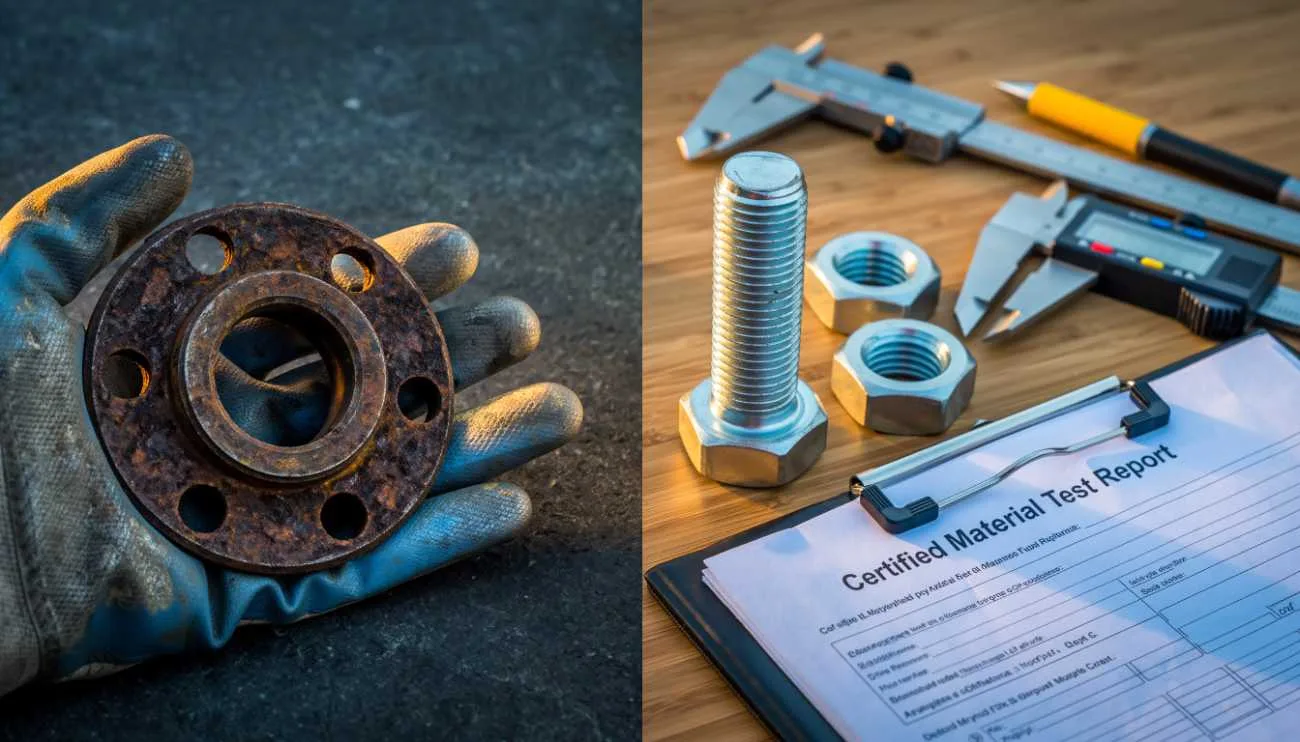
Grabbing a generic bolt from an open-stock bin is a recipe for disaster. How do you know its true material? Where was it made? Has it been tested? Is its Certified Material Test Report (CMTR) available?
This is why, as a Houston-based manufacturer, Cyclone Bolt was built to a higher standard.
- We are API Spec Q1 Certified: This isn’t just a plaque. It’s an exhaustive quality management system audited by the American Petroleum Institute (API). It means we have processes for everything, from raw material sourcing to final inspection. See our cert
- We Hold API 20E & 20F Monograms: These are manufacturing specifications, not just quality systems. They mandate rigorous testing, material traceability, and qualification for fasteners intended for critical-service applications.
- API 20E (BSL-1, 2, 3): Guarantees traceability and qualification for alloy and carbon steel bolting. See our cert
- API 20F (BSL-1, 2, 3): Guarantees the same for corrosion-resistant bolting. See our cert
- We are ISO 9001:2015 Certified: The global standard for quality management. See our cert
When you order replacement bolting from Cyclone Bolt, you aren’t getting a guess. You are getting a fully traceable, certified, and proven component that matches the spec, every single time.
Don’t Sing the “Leaky Flange Blues”
Planning a major turnaround or shutdown? The last thing you need is a surprise. You’ve inspected your flanges. You’ve built your replacement list. Now, you have a maintenance team on the clock, and the clock is ticking.
Don’t let your shutdown grind to a halt because your bolting supplier sent the wrong material, or their “B7” bolts fail PMI (Positive Material Identification) on-site. Don’t let your project’s theme song be the “Leaky Flange Blues.”
Make the right call. The first time.
Your checklist proved what needs to be done. Let us provide the certified quality to do it right.
Planning a shutdown? Order your certified, traceable API 20E & 20F replacement bolting from Cyclone Bolt for guaranteed quality and peace of mind.