
Originally published 2025-11-10 · Cyclone Bolt
What Is a Flange Bolt? A Procurement & Engineering Guide
In the world of industrial procurement, engineering, and manufacturing, the terminology can be overwhelming. You are tasked with sourcing components for a high-pressure system, a petrochemical plant, or an offshore rig. The bill of materials calls for “flange bolting,” and a simple mistake in ordering—a wrong material grade or an incorrect standard—can lead to costly project delays, budget overruns, or even catastrophic failure.
You need to “speak the language” of fasteners.
This guide is your foundation. It’s a comprehensive, clear-cut explanation for procurement agents, new engineers, and project managers who need to understand exactly what a flange bolt is, what types are available, and—most importantly—why quality certifications are non-negotiable.
As a Houston-based manufacturer on the front lines of the energy and petrochemical industries, we at Cyclone Bolt don’t just sell parts; we provide certified, traceable, and mission-critical solutions. Let’s break down the fundamentals.
First, What Is a Flange Connection?
Before defining the bolt, we must define the connection it’s for.
A flange is a protruding rim, lip, or collar on a pipe, valve, pump, or other piece of equipment. Its purpose is to provide a surface for connecting components.
When you press two flanges together (usually with a gasket in between to create a seal), you create a flanged connection. This is the most common method for joining pipes and equipment in high-pressure, high-temperature, or critical-service applications.
But what holds these two flanges together under immense force? That is the job of the flange bolt.
Defining “Flange Bolt”: A Job Description
Here is the most important concept: “Flange bolt” is a general term, not a specific part.
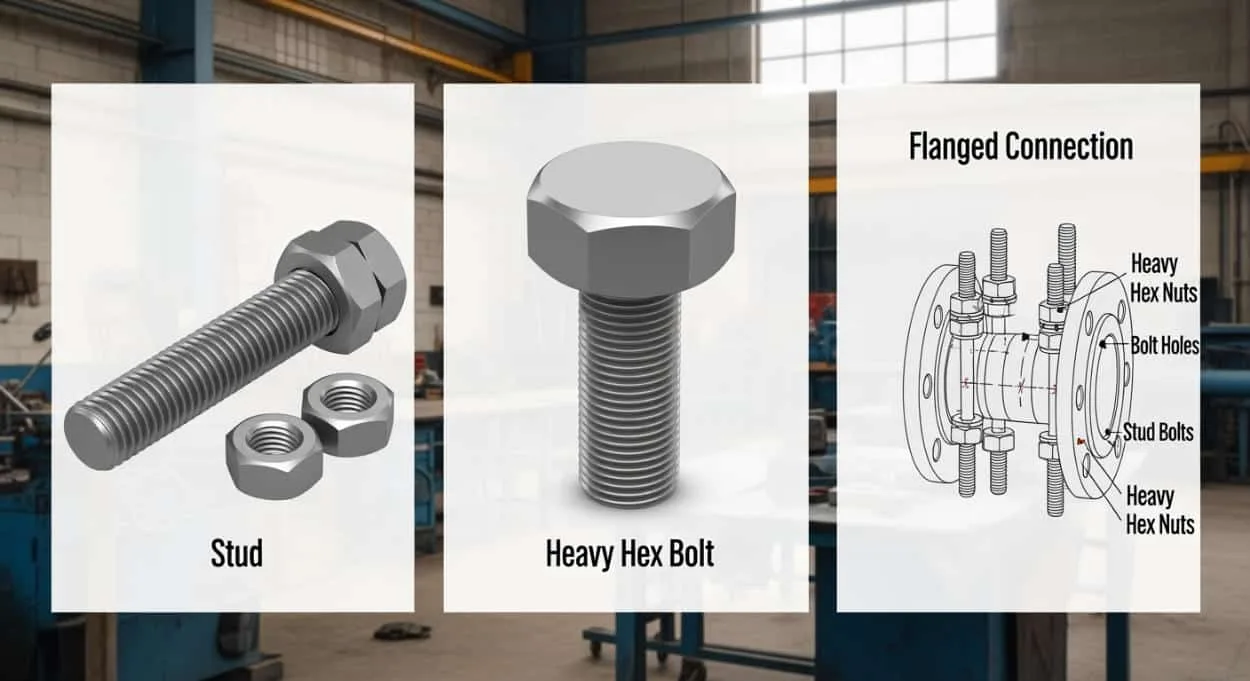
It’s a job description for a fastener used to join a flange connection. In the heavy industrial world (oil & gas, chemical, power generation), this job is handled by two main “employees”:
- Stud Bolts
- Heavy Hex Bolts (also called Heavy Hex Head Cap Screws)
Understanding the difference between these two is the first step in sourcing the correct component.
The Workhorse: What Is a Stud Bolt?
The most common fastener used in flanged connections, especially in the oil and gas industry, is the stud bolt.
A stud bolt is a piece of threaded rod (a “stud”). It is most often fully threaded from one end to the other (known as “fully threaded stud” or “all-thread”). It does not have a head.
How It Works:
A stud bolt is designed to pass completely through the bolt holes of both flanges. The joint is then secured by placing a heavy hex nut on each end of the stud.
Why It’s Used:
Stud bolts are the standard for high-pressure/high-temperature service for several key reasons:
- Even Clamping: Because the stud is tensioned by nuts on both ends, it provides a more accurate and evenly distributed clamping force (preload) across the flange face. This is critical for gasket performance.
- Ease of Maintenance: In tight spaces, it is often easier to remove two nuts than to try and turn a full bolt head.
- Predictable “Stretch”: The entire length of the stud stretches during torquing, which helps it maintain a secure load under fluctuating temperatures and pressures.
When a procurement sheet for a pipeline or pressure vessel lists bolting, it is most often referring to a stud bolt with two heavy hex nuts.
The Alternative: What Is a Heavy Hex Bolt?
The second type of fastener used for flange connections is the heavy hex bolt.
A heavy hex bolt is a bolt with a single large, thick, hexagonal head on one end and threads on the other. It is not a standard hardware store bolt; as its name implies, it is “heavy,” meaning the head is larger and thicker than a standard (or “finished”) hex bolt.
How It Works:
A heavy hex bolt is used in two main ways:
- Tapped Hole: It passes through the bolt hole of one flange and then threads directly into a tapped (threaded) hole in the mating piece of equipment (like a valve body or pump housing).
- Bolt-and-Nut: It passes through both flanges, just like a stud, and is secured with a single heavy hex nut on the end.
Stud Bolt vs. Heavy Hex Bolt: Which to Order?
As a purchasing agent, how do you choose?
| Feature | Stud Bolt (with 2 Nuts) | Heavy Hex Bolt (with 1 Nut) |
| Primary Use | High-pressure, high-temp flange-to-flange connections (e.g., pipelines). | Lower-pressure systems or connections to a tapped-hole (e.g., equipment housing). |
| Clamping Force | Excellent. Provides the most accurate and uniform preload. | Good, but the head can cause friction/torquing inaccuracies vs. a stud. |
| Installation | Requires two nuts. Passes through both flanges. | Requires one nut. Can also be threaded into a flange. |
| Industry Standard | The preferred choice for critical service in oil & gas (ASME B16.5). | Common in general industrial applications and equipment mounting. |
Why “Heavy” Matters: The Heavy Hex Standard
You will see the term “heavy hex” used for both the nuts on a stud bolt and the head on a heavy hex bolt. This is not a casual descriptor; it’s a specific technical standard.
- This specification is defined by the American Society of Mechanical Engineers (ASME) in standards like ASME B18.2.1 (for bolts) and ASME B18.2.2 (for nuts).
- A “heavy hex” profile has a larger bearing surface (width across flats) and is thicker than a standard hex.
- This design is critical for flange connections because it better distributes the immense clamping load and provides a more robust surface for the high torque required to seal the joint.
Beyond the Shape: Materials & Standards (The Cyclone Bolt Difference)
For a procurement agent, knowing the shape is only 10% of the battle. The material and manufacturing standard are what determine if a bolt will succeed or fail.
A bolt is not a simple commodity. It is a highly-engineered component.
Common Materials
The material must be chosen based on temperature, pressure, and corrosive environment.
- Carbon & Alloy Steel (e.g., ASTM A193 B7): This is the most common material for flange bolting in the oil, gas, and petrochemical industries. It is a high-strength, heat-treated chromium-molybdenum (chromoly) steel. The matching nuts are typically ASTM A194 2H.
- Stainless Steel (e.g., ASTM A193 B8/B8M): Used when corrosion resistance is the primary concern.
- High-Temp Alloys (e.g., ASTM A193 B16): Used for very high-temperature, high-pressure service.
The “Quality” is in the Certification
This is where Cyclone Bolt’s expertise becomes your greatest asset. In critical applications, you cannot simply order a “B7 stud.” You must order a certified B7 stud.
A failure in a flange connection can be catastrophic. That’s why the American Petroleum Institute (API) created specific, rigorous standards for “critical-use” fasteners.
When you partner with Cyclone Bolt, you are partnering with a manufacturer that has built its entire business on this level of quality.
- ISO 9001:2015: This is our baseline. It proves we have an audited, repeatable, and documented Quality Management System. The bolt you order today will be made with the same precision and process as the bolt you order next year.
- API Spec Q1 (9th Edition): This is ISO 9001 plus the stringent requirements of the oil and gas industry. It ensures full traceability, risk management, and supplier validation.
- API 20E (BSL-1, BSL-2, BSL-3): This is a product-specific “Bolting Specification Level” (BSL). When you order an API 20E bolt, you are getting a guarantee. It certifies that the bolt’s material, heat treatment, manufacturing, and testing have been inspected and verified to the highest degree.
- API 20F (BSL-2, BSL-3): This is the same rigorous standard, but for corrosion-resistant bolting (like stainless steel).
When you order an API 20E-certified B7 stud from Cyclone Bolt, you aren’t just buying a piece of steel. You are buying a guarantee of material chemistry, tensile strength, and heat-treat traceability, all documented and proven. This is the difference between a bolt and a solution.
How to Order Flange Bolts: A Procurement Checklist
Now you’re ready to “speak our language.” When you call for a quote, here is the information our team will need to provide a fast, accurate solution:
- Type: Stud Bolt (with 2 nuts) or Heavy Hex Bolt?
- Material Standard: ASTM A193 B7? A193 B8? A320 L7?
- Nut Standard: ASTM A194 2H?
- Dimensions:
- Diameter (e.g., 3/4″)
- Length (e.g., 4 1/2″)
- Finish/Coating: Plain (self-color), Xylan-coated, Zinc, or Galvanized?
- Certification Level: Do you require full traceability and MTRs (Material Test Reports)? Do you require API 20E or 20F compliance?
If you aren’t sure, that’s okay. Our expert team is here to help you navigate the specifications for your project.
Don’t Just Buy a Bolt. Buy a Guarantee.
Flange bolting is the muscle that holds our industrial infrastructure together. It is a precise science where quality is measured in traceability and compliance.
Don’t risk your project on a “commodity” part. Partner with an expert.
Speak our language. For expert advice and fast quotes on all your flange bolting needs, call Cyclone Bolt. Our team in Houston is ready to deliver the certified, American-made solutions your project demands.
Frequently Asked Questions About Flange Bolting
1. What is the difference between a stud bolt and a heavy hex bolt? A stud bolt is a fully threaded rod (stud) that passes completely through both flanges and is secured with two heavy hex nuts (one on each end). A heavy hex bolthas a large, built-in head on one end and is secured with only one nut. Stud bolts are generally preferred for high-pressure systems as they provide more even and accurate clamping force.
2. Why are stud bolts used for high-pressure flanges? Stud bolts are the standard for high-pressure, high-temperature service because they allow for more accurate and uniform clamping force (preload). As the entire length of the stud “stretches” during torquing, it maintains a consistent, reliable seal on the flange gasket. This is critical for preventing leaks in demanding environments like oil and gas pipelines.
3. What is a B7 stud bolt? A “B7 stud bolt” is the industry’s most common term for a flange bolt. It refers to a stud made from ASTM A193 Grade B7 steel. This is a high-strength, heat-treated chromium-molybdenum (chromoly) steel specifically chosen for its excellent performance and strength in high-temperature, high-pressure service.
4. What nut is used with an ASTM A193 B7 stud? The industry-standard and specified nut for an ASTM A193 B7 stud is an ASTM A194 Grade 2H heavy hex nut. These nuts are manufactured to have a compatible strength and chemistry. They are also heat-treated to properly handle the high torque and service loads required to tension the B7 stud effectively.
5. What does “heavy hex” mean for bolts and nuts? “Heavy hex” is a specific dimensional standard (defined by ASME B18.2.1 and B18.2.2) where the hexagonal head (or nut) is thicker and has a larger width across the flats than a standard “finished” hex. This larger bearing surface is essential for distributing the high clamping loads and providing a more robust surface for the high torque used in flange connections.
6. What is an API 20E certified bolt? API 20E is a “Bolting Specification Level” (BSL) from the American Petroleum Institute. It is a rigorous certification for critical-service fasteners. An API 20E-certified bolt (like those from Cyclone Bolt) guarantees the highest level of quality control, including full material traceability, verified heat treatment, and stringent testing. It is a non-negotiable standard for equipment where failure is not an option.
7. Do stud bolts come with nuts? Typically, no. When procuring flange bolting, a “stud bolt” (the threaded rod) and the “heavy hex nuts” are ordered as separate, distinct components. A common procurement error is forgetting to order the nuts. You must specify and order two nuts for every stud bolt you require.
8. What is a Material Test Report (MTR) and why is it important for bolts? An MTR (Material Test Report), or a “mill cert,” is a quality assurance document that certifies a material’s exact chemical and physical properties. For bolts, the MTR proves that the steel (e.g., A193 B7) is from a specific “heat” (batch), meets the required chemical composition, and has the correct tensile strength after heat treatment. It is the only way to guarantee traceability and is essential for critical applications.
9. What is the difference between a flange bolt and a regular bolt? A “regular” bolt from a hardware store is typically a low-strength, “finished hex” bolt. A “flange bolt” (like a B7 stud or heavy hex bolt) is a highly engineered component made from high-strength, heat-treated alloy steel. It is manufactured to precise “heavy hex” dimensions to handle the extreme pressures, temperatures, and clamping forces of industrial flange connections.
10. How is a stud bolt measured for procurement? Stud bolts are specified by three key measurements:
- Diameter: The nominal diameter of the threads (e.g., 3/4″).
- Length: The total end-to-end length of the rod.
- Thread Pitch: (e.g., 10 TPI – Threads Per Inch), though this is often standard for the diameter.
A typical order looks like: “3/4″-10 x 4 1/2″ ASTM A193 B7 Stud Bolt, Plain Finish.”