
Originally published 2025-12-15 · Cyclone Bolt
Commercial HVAC systems are massive investments. A single Rooftop Unit (RTU) can cost tens of thousands of dollars. Building owners expect them to last 15 to 20 years.
Yet, we often see these units failing prematurely. Panels rust loose. Fan mounts corrode. Structural integrity fails.
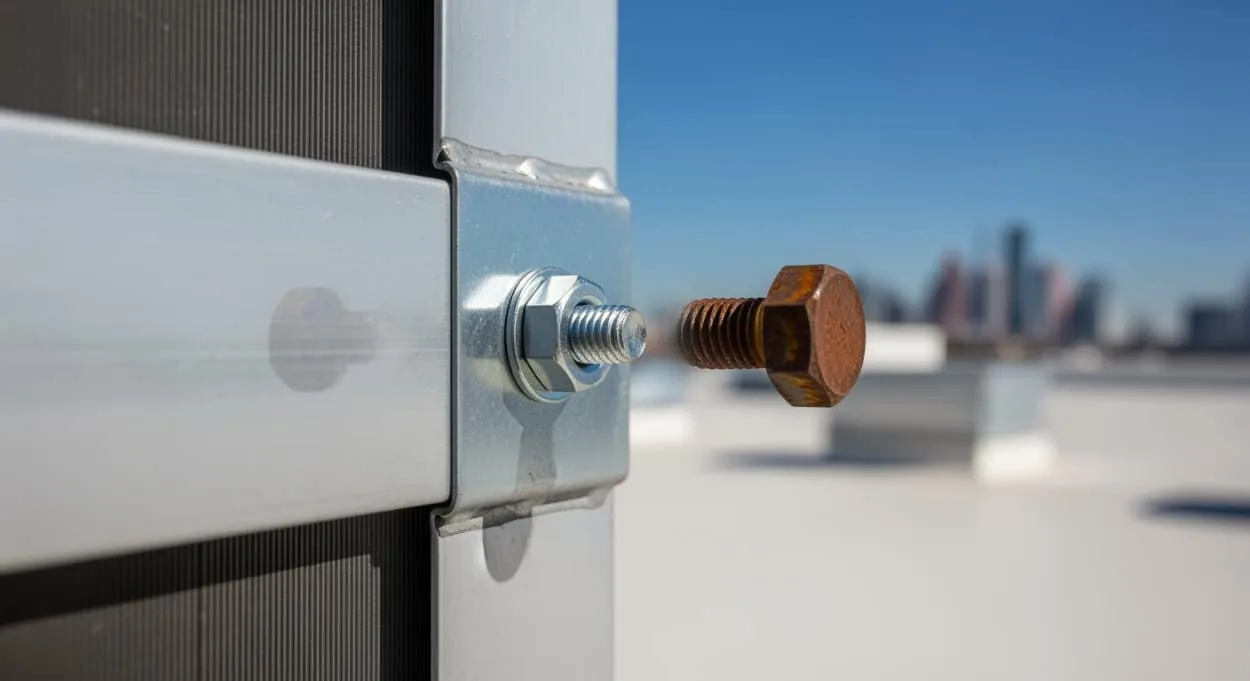
The culprit is rarely the compressor or the motor. It is the hardware. Specifically, it is the reaction between the fasteners and the unit casing.
This phenomenon is called Galvanic Corrosion.
It is a silent killer of HVAC equipment, especially here in the humid, salt-rich air of the Gulf Coast. If you are a technician, a facility manager, or a contractor, you need to understand how to prevent this.
Cyclone Bolt, located right here in Houston, Texas, specializes in fasteners that survive these harsh environments. We don’t just supply oil rigs; we supply the critical hardware that keeps infrastructure running.
Here is a deep dive into why your HVAC units are corroding and how to stop it.
The Science: What is Galvanic Corrosion?
To fix the problem, you must understand the chemistry.
Galvanic corrosion occurs when three specific conditions are met simultaneously:
-
Two Dissimilar Metals: You have two different types of metal connected to each other (e.g., a stainless steel bolt in a galvanized steel sheet).
-
Electrical Contact: The metals are touching.
-
An Electrolyte: A conductive liquid covers the connection. In Houston, this is rainwater, condensation, or just humid, salty air.
When these three things happen, you create a battery.
One metal acts as the anode (the sacrificial metal). The other acts as the cathode (the protected metal). Electrons flow from the anode to the cathode. The anode corrodes at an accelerated rate, while the cathode remains pristine.
In an HVAC unit, if your bolt is the cathode and the unit panel is the anode, the panel will rust away around the bolt. If the bolt is the anode, the head will snap off, and the panel will detach.
The HVAC Material Mismatch
The problem with modern HVAC manufacturing is the mix of materials.
Manufacturers aim for efficiency and weight reduction. This leads to widespread use of:
-
Aluminum: Used for fins, coils, and increasingly for chassis components.
-
Galvanized Steel: The standard for most RTU cabinets.
-
Stainless Steel: Often specified for fasteners because people assume “Stainless means no rust.”
The Stainless Steel Trap
This is the most common mistake we see. A contractor sees a rusting galvanized bolt and replaces it with Stainless Steel (304 or 316).
They think they are upgrading the system. In reality, they might be destroying it.
Stainless steel is “noble” on the galvanic chart. Aluminum and Zinc (the coating on galvanized steel) are “active.”
When you drive a stainless steel screw into an aluminum sheet or a galvanized frame, the stainless steel becomes the cathode. It pulls electrons from the aluminum or zinc. This causes the aluminum to pit and degrade rapidly around the screw hole. eventually, the hole gets too big, and the screw falls out.
Environmental Factors: The Houston Multiplier
If this equipment were in Arizona, galvanic corrosion would be slow. There is no electrolyte (water) to complete the circuit.
In Houston, we have the perfect storm for corrosion:
-
High Humidity: Our air is effectively an electrolyte.
-
Salt Air: Proximity to the Gulf means chlorides are in the air. Saltwater increases conductivity, speeding up the galvanic reaction.
-
Industrial Pollution: Sulfur and other industrial compounds in the air can increase acidity, further attacking metals.
A rooftop unit in Houston ages in “dog years” compared to one in a dry climate. This makes your choice of fastener critical. Standard “hardware store” bolts will not cut it.
Prevention Strategy 1: Material Selection
The first line of defense is choosing metals that play nice together. You want materials that are close to each other on the Galvanic Series chart.
If you are fastening into a galvanized steel frame, a standard carbon steel bolt with a high-quality zinc coating is often better than stainless steel. The zinc on the bolt matches the zinc on the frame. There is no potential difference, so there is no battery effect.
However, standard zinc plating is thin. It wears out.
The Cyclone Bolt Solution: Zinc-Nickel
For HVAC applications, we highly recommend Zinc-Nickel plating.
As detailed in our Coating & Plating Technical Guide, Zinc-Nickel offers the best of both worlds:
-
Compatibility: It is compatible with aluminum and galvanized steel, preventing the galvanic cell.
-
Durability: It offers over 1,000 hours of salt spray protection (compared to ~96 hours for standard zinc).
-
Hardness: It resists the scratches and torque damage that happen during installation.
Prevention Strategy 2: Protective Coatings (Barriers)
Sometimes, you need the strength of a specific alloy, like a B7 stud, but you can’t have it touching the aluminum frame.
In this case, you need a barrier coating.
Fluoropolymer / Xylan® / PTFE
You might know this as Teflon-type coatings. These are ceramic-like, non-conductive coatings.
If you coat a bolt in Xylan, you effectively insulate it. The coating prevents the metal of the bolt from electrically contacting the metal of the unit. No contact means no circuit. No circuit means no galvanic corrosion.
Cyclone Bolt specializes in these high-tech coatings. We can supply fasteners that are stronger than steel but have the non-conductive surface properties needed for sensitive equipment.
Prevention Strategy 3: Isolation
If you must use dissimilar metals—for example, a heavy stainless steel bracket on an aluminum frame—you must mechanically separate them.
This involves using:
-
Nylon Washers: placed under the bolt head and nut.
-
Isolation Sleeves: placed inside the bolt hole.
-
Neoprene Gaskets: placed between the two metal surfaces.
While effective, this adds labor and complexity. If a technician forgets one washer during a repair, the protection is lost. It is often more reliable to use a compatible bolt or a coated bolt from Cyclone Bolt that doesn’t require extra loose parts.
Why Quality Standards Matter for HVAC
You might think, “It’s just an air conditioner, not a subsea blowout preventer. Do I really need API spec bolts?”
The answer is yes, if you value reliability.
The fastener market is flooded with low-quality imports. A bolt might be stamped “316 Stainless,” but is it really? Does it have the right composition? Was the plating applied correctly?
If you buy a box of cheap bolts that have poor plating adhesion, the plating will flake off during installation. Now you have bare steel touching aluminum. Corrosion starts immediately.
The Cyclone Bolt Advantage
We operate under an API Spec Q1 9th Edition and ISO 9001:2015 Quality Management System.
This means:
-
Traceability: We know where the steel came from.
-
Testing: We verify the coating thickness and adhesion.
-
Consistency: Every bolt in the box is the same.
We apply the same rigor to industrial and HVAC customers that we apply to our oil and gas clients. You get access to API 20E and API 20F level quality, ensuring your rooftop units stay secure during hurricane season winds.
Reviewing Your Maintenance Plan
Facility managers should audit their rooftop units annually.
Look for:
-
White Rust: This is zinc corrosion. It looks like white powder. It means the galvanized coating is failing.
-
Red Rust: This is iron oxide. It means the base metal is being eaten away.
-
Paint Blistering: This often happens around fastener heads where corrosion is spreading underneath the paint.
If you see these signs, simply replacing the bolt with the same type won’t fix it. You need to upgrade the fastener solution.
How Cyclone Bolt Can Help
We are not just a vendor; we are technical partners.
If you are a manufacturer building units, or a contractor servicing them, bring us your corrosion problems.
-
Consultation: Tell us what metals you are connecting. We will look at the galvanic potential.
-
Selection: We will recommend the right substrate and the right coating (Zinc-Nickel, PTFE, Cadmium replacement, etc.).
-
Supply: We manufacture and coat quickly in Houston. No waiting for overseas shipments while your project stalls.
Tech Specs at a Glance
For those ready to dig into the details, here are the resources you need:
-
Material Grades: Understand the strength differences between Carbon Steel and Stainless in our Material Grade Guides.
-
Plating Options: Review the salt-spray hours and friction coefficients in our Coating Guide.
-
Quality Assurance: See our certifications on our Technical Standards page.
Don’t Let Rust Win
A $5 bolt should not ruin a $50,000 HVAC unit. But it happens every day.
By understanding galvanic corrosion and choosing the right fastener, you extend the life of your equipment. You reduce emergency service calls. You save money.
Stop guessing at the hardware store. Get engineered solutions that handle the heat, humidity, and salt of the real world.
Contact Cyclone Bolt today. Let’s secure your infrastructure with the best fasteners in Texas.