
Originally published 2026-03-08 · Cyclone Bolt
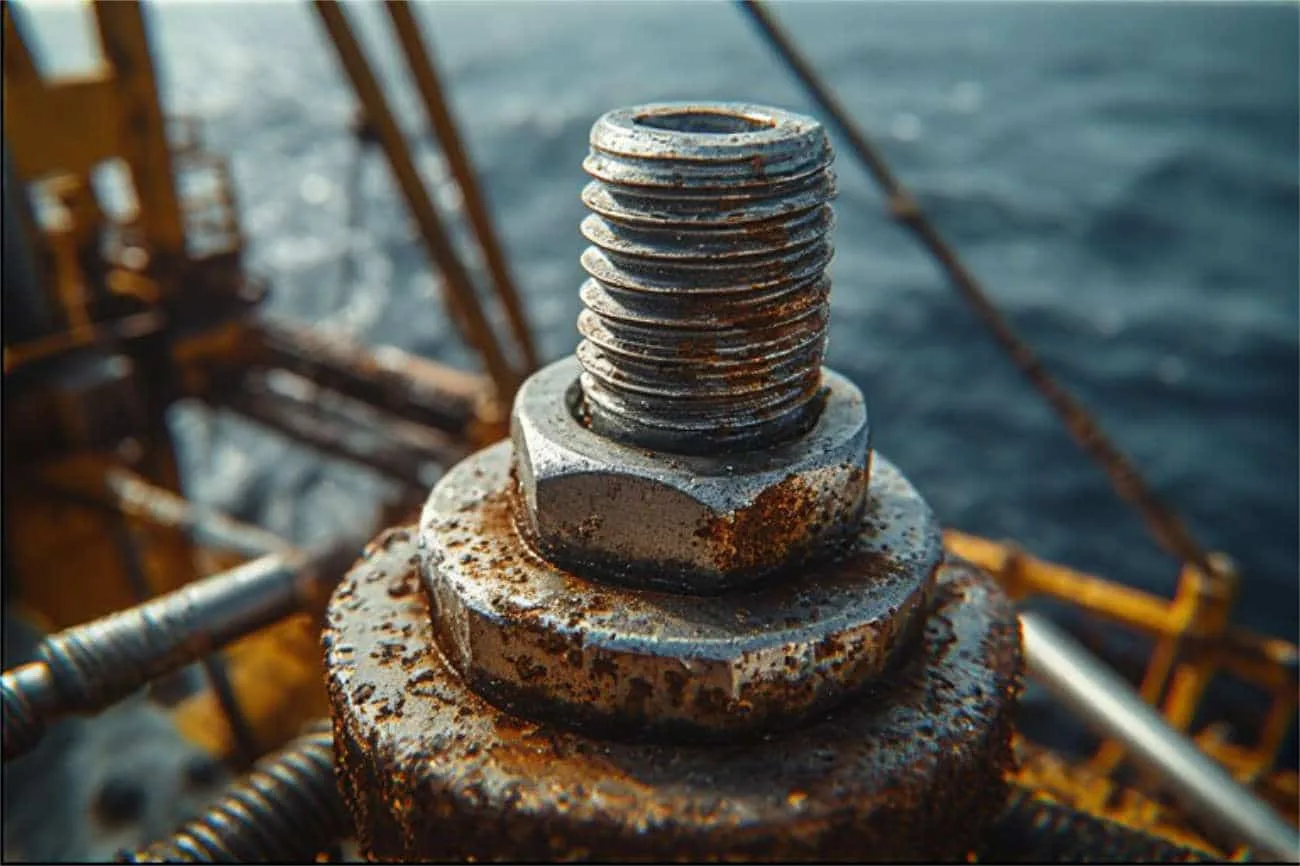
Marine environments are among the most unforgiving on the planet. Saltwater, high humidity, and constant temperature fluctuations create a perfect storm for metal degradation. Stainless steel is often the go-to choice for these conditions because of its “passive” layer. However, this material has a specific vulnerability that has caused countless structural failures: crevice corrosion.
For engineers and procurement specialists working in offshore oil and gas or maritime infrastructure, understanding this localized attack is vital. At Cyclone Bolt in Houston, Texas, we specialize in providing fasteners that stand up to these extreme conditions. Whether you are following API Spec Q1 9th Edition standards or looking for specific material grades, prevention starts with knowledge.
What Exactly is Crevice Corrosion?
Crevice corrosion is a localized form of attack that occurs in shielded areas on metal surfaces. You will typically find it in narrow gaps where a stagnant solution can pool. Think about the space under a bolt head, the gap between a washer and a flange, or the tight spots in a threaded connection.
Stainless steel relies on oxygen to maintain its protective chromium oxide film. When oxygen is depleted inside a tight crevice, that protective film breaks down. The chemistry inside the gap changes, becoming more acidic. This creates a small, highly corrosive cell that eats away at the metal while the rest of the surface looks perfectly fine.
Why Marine Environments Accelerate the Damage
Saltwater is rich in chlorides. These ions are particularly aggressive toward stainless steel. In a marine setting, the salt spray settles into every nook and cranny.
As the water evaporates, the chloride concentration increases. This high concentration, combined with the lack of oxygen in a tight gap, triggers the corrosion process much faster than it would in a freshwater environment. This is why fasteners used in the Gulf of Mexico or on offshore rigs require much higher standards, such as those found in API 20Efor alloy and stainless steel bolting.
Detection: Finding the Hidden Enemy
The most dangerous thing about crevice corrosion is that it is often invisible from the outside. You might look at a bolted joint and see clean, shiny stainless steel. However, underneath the washer, the bolt could be nearing total failure.
Visual Cues to Watch For
-
Bleeding or Staining: Look for streaks of rust or “tea staining” coming out from underneath a bolt head or nut. Even if the streak is small, it indicates the internal chemistry has shifted.
-
Pitting on Adjacent Surfaces: Often, pitting and crevice corrosion go hand in hand. If you see tiny holes on the open surfaces, the crevices are likely in worse shape.
-
Loss of Torque: If a fastener feels loose despite being properly installed, internal corrosion may have thinned the shank or the threads, reducing the clamping force.
Advanced Inspection Methods
In critical offshore applications, visual inspection isn’t enough. Many operators use ultrasonic testing or liquid penetrant inspection during maintenance turnarounds to check the integrity of API 20F corrosion-resistant bolting.
Prevention Through Material Selection
The best way to stop crevice corrosion is to choose a material that can handle the specific “Precipitation Hardening” or alloy requirements of your environment. Not all stainless steel is created equal.
High-Alloy Stainless Steels
Standard 304 stainless steel will fail quickly in a saltwater crevice. Even 316 stainless steel has its limits. For high-chloride environments, materials with higher molybdenum content are necessary. Molybdenum significantly increases the Pitting Resistance Equivalent Number (PREN).
You can find more details on which alloys fit your specific needs in our material grade guides. Moving to a Duplex or Super Duplex stainless steel is often the smartest move for long-term marine survival.
The Role of API Standards
Standardization ensures that the material you buy is actually capable of what the manufacturer claims. By adhering to ISO 9001:2015 Quality System Certificate and API specifications, Cyclone Bolt ensures that the chemical composition and heat treatment of every fastener are documented and verified. This reduces the risk of “mystery metal” failing in the field.
Design Strategies to Minimize Risk
Material choice is only half the battle. How you design the connection matters just as much.
-
Eliminate the Crevice: Where possible, use welded joints instead of bolted joints. Of course, this isn’t always practical for maintenance.
-
Use Gaskets Wisely: Use non-absorbent gaskets. Some older gasket materials can actually soak up saltwater and hold it against the metal, acting as a permanent corrosion reservoir.
-
Proper Drainage: Design equipment so that water cannot pool in recesses. If a bolt hole can hold water, it will eventually corrode.
Coating and Plating: The Final Shield
In many cases, the base metal needs an extra layer of defense. For marine fasteners, the right coating can act as a sacrificial or barrier layer that prevents the initial breakdown of the passive film.
Our coating and plating technical guide explores options like PTFE, Zinc-Nickel, and Xylan. These coatings are designed to provide a low-friction surface for consistent torquing while providing a robust barrier against chloride ions. In a crevice, these coatings prevent the electrolyte (saltwater) from ever touching the bare metal.
Maintenance and Cleaning Protocols
Even the best-designed system needs care. Regular rinsing with fresh water can help flush out accumulated chlorides from crevices. This is a common practice on naval vessels and offshore platforms. If the salt is washed away before it has a chance to concentrate, the corrosion cell never fully forms.
The Importance of Quality Fasteners in Houston
Being located in Houston gives us a front-row seat to the needs of the energy capital of the world. We know that a single bolt failure can lead to an environmental disaster or millions of dollars in downtime.
When you source your bolting from a shop that understands API 20E and API 20F requirements, you are buying insurance against crevice corrosion. We ensure that every piece of hardware meets the rigorous mechanical and chemical properties needed for deepwater and coastal applications.
Summary of Prevention Steps
To keep your marine infrastructure safe, follow these steps:
-
Select materials with high molybdenum content (check the PREN).
-
Ensure all fasteners meet API 20E or 20F standards.
-
Use professional coatings to provide a barrier in tight gaps.
-
Implement a fresh-water washdown schedule.
-
Inspect for “bleeding” around bolted joints during routine maintenance.
External Resources:
-
NACE International (The Worldwide Corrosion Authority): They provide incredible technical papers on localized corrosion mechanisms. Visit NACE
-
American Petroleum Institute (API): For a deeper look into why these standards exist for the global oil and gas industry. Visit API
Article Recap
-
Crevice corrosion happens in stagnant, oxygen-depleted gaps.
-
Saltwater chlorides accelerate the breakdown of stainless steel’s protective layer.
-
Detection involves looking for rust bleeding and tea staining.
-
Prevention requires high-PREN materials like Super Duplex or high-moly alloys.
-
Proper coatings and plating provide an essential barrier against chloride attack.
-
Adhering to API Spec Q1 and ISO 9001:2015 ensures material reliability.
Don’t let hidden corrosion compromise your marine project. Consult the experts at Cyclone Bolt in Houston for high-performance fasteners that meet API and ISO standards. Explore our material grade guides today and ensure your infrastructure is built to last!