
Originally published 2026-02-24 · Cyclone Bolt
Choosing the right machining process determines the quality, cost, and lead time of your industrial fasteners and components. At Cyclone Bolt in Houston, we utilize both CNC milling and CNC lathes to meet rigorous industry standards like API 20E and API 20F.
Understanding the mechanics of each method helps you make informed decisions for your specific parts. Whether you need complex geometries or high-volume cylindrical bolts, the choice between a mill and a lathe is the first step in precision manufacturing.
What is CNC Machining?
CNC stands for Computer Numerical Control. This technology uses specialized software to guide the movement of factory tools and machinery. It removes material from a solid block—known as a workpiece—to create a finished part.
Because the process is automated, it offers incredible precision. This is vital for the oil and gas industry, where a fraction of a millimeter can be the difference between a secure seal and a catastrophic failure.
Understanding CNC Milling
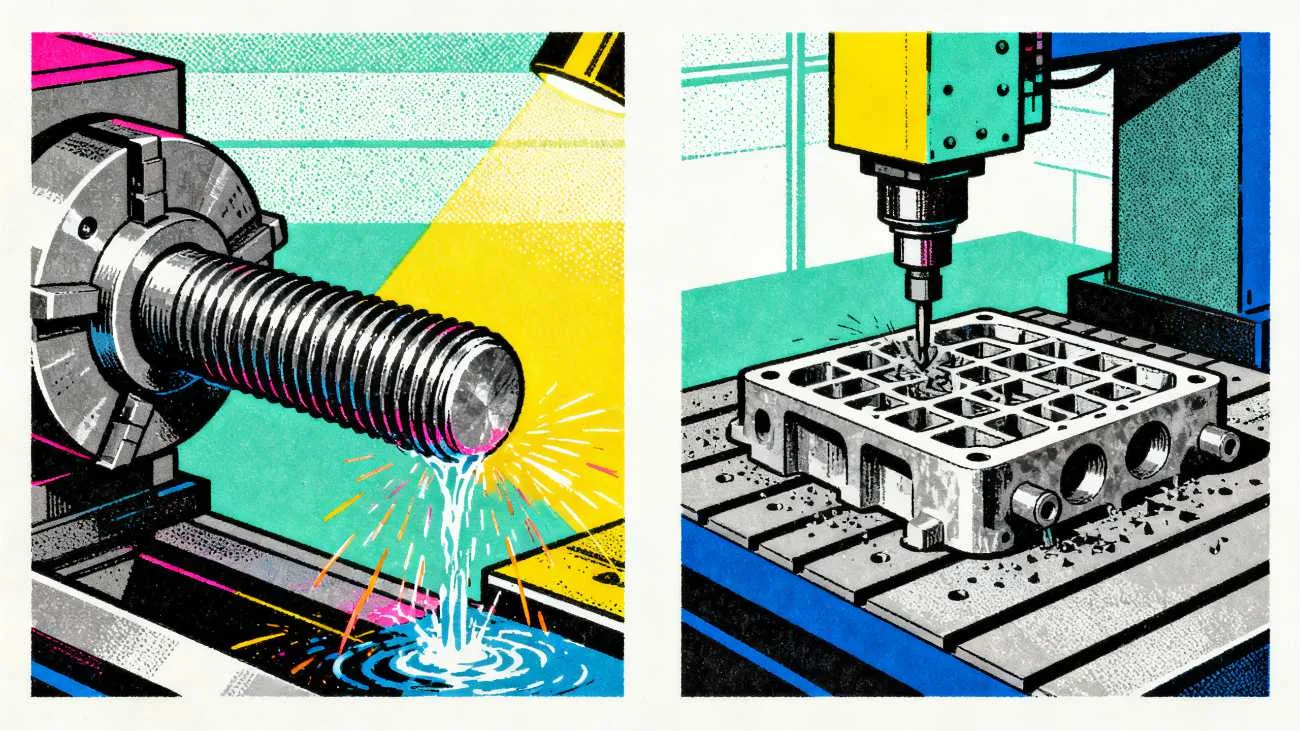
CNC milling is a versatile subtractive manufacturing process. In this setup, the workpiece remains stationary or moves along different axes while a rotating cutting tool moves around it.
How CNC Milling Works
The milling machine holds the material securely on a bed. The cutting tool, which can have multiple edges, spins at high speeds. As the tool moves across the surface, it chips away material to create shapes, slots, and holes.
Modern mills often operate on three, four, or even five axes. This allows the tool to approach the part from almost any angle, making it possible to create highly complex shapes that other machines cannot handle.
When to Choose CNC Milling
Milling is the preferred choice for parts that are not cylindrical. If your part has flat surfaces, deep pockets, or intricate internal designs, a mill is likely the right tool.
Common Milled Parts:
-
Brackets and housings
-
Manifolds
-
Gears with complex tooth profiles
-
Custom flanges with non-standard hole patterns
-
Tooling and fixtures
Understanding CNC Lathes (CNC Turning)
CNC lathes operate on the principle of “turning.” Unlike a mill, the lathe rotates the workpiece at high speeds while the cutting tool remains relatively stationary.
How CNC Lathes Work
In a lathe, the material is held in a chuck and spun rapidly. A single-point cutting tool is then pressed against the spinning material. The tool moves linearly along the part to shave off material, creating a perfectly symmetrical, cylindrical shape.
This process is exceptionally efficient for creating round parts. Because the part is spinning, the concentricity—how centered the various diameters are—is nearly perfect.
When to Choose CNC Lathes
Lathes are the workhorse for any part that is “round.” If your component looks like a cylinder, a cone, or a disk, it should likely be produced on a lathe.
Common Lathed Parts:
-
Stud bolts and heavy hex bolts
-
Shafts and axles
-
Bushings and spacers
-
Couplings
-
API-spec fasteners (BSL-1, BSL-2, BSL-3)
Key Differences Between Milling and Lathes
While both processes remove material, their “logic” is different.
Tool Movement vs. Part Movement
-
Milling: The tool rotates; the part stays mostly still.
-
Lathes: The part rotates; the tool moves along the part.
Symmetry
-
Lathes are built for radial symmetry. They excel at creating circular profiles.
-
Milling handles asymmetry. It can create squares, hexagons, and organic curves.
Surface Finish
For cylindrical surfaces, a lathe generally produces a superior surface finish because the cut is continuous. Milling involves “interrupted cuts” as the teeth of the tool hit the material, which can sometimes leave tiny tool marks that require secondary finishing.
Comparing Costs and Efficiency
Cost is always a factor in Houston’s competitive industrial market. The “cheapest” method depends entirely on the part geometry.
Setup Time
Lathes generally have faster setup times for simple cylindrical parts. Milling setups can be more complex, especially if the part requires multiple flips or specialized “workholding” fixtures to hold an odd shape in place.
Material Waste
Turning on a lathe is often more efficient for long, thin parts. However, because both are subtractive processes, the goal is always to start with a raw material size as close to the finished dimensions as possible to reduce waste and machine time.
Production Speed
For high-volume runs of bolts or studs, a CNC lathe is significantly faster. If you need 1,000 API 20E BSL-1 studs, the lathe’s ability to perform continuous cuts makes it the winner. If you need 1,000 complex valve bodies with internal ports, the mill is the only way to go.
Material Considerations
At Cyclone Bolt, we work with a wide variety of materials. The choice of machine is often influenced by how the material reacts to cutting.
Carbon and Alloy Steels
Materials like 4140 or L7 are common in our shop. These materials machine well on both lathes and mills. When following API Spec Q1 9th Edition standards, we ensure that the heat generated during machining doesn’t compromise the material integrity.
Stainless Steels and Superalloys
For corrosive environments, we use stainless steel or Inconel. These are “tougher” materials. CNC mills are often better at managing the heat in these materials through specialized cooling paths, though lathes are perfectly capable of turning these alloys with the right carbide inserts.
You can view our full range of materials in our Material Grade Guide.
Quality Standards and Precision
In the world of high-pressure fasteners, precision isn’t optional. It is a safety requirement.
API 20E and 20F Compliance
Cyclone Bolt specializes in API 20E (alloy and carbon steel bolting) and API 20F (corrosion-resistant bolting). These specs dictate everything from the raw material source to the final machining tolerances.
-
API 20E: Often requires precise threading that is best handled on a CNC lathe to ensure pitch diameter accuracy.
-
API 20F: Often involves materials that require the rigid setups provided by high-end CNC mills to prevent tool chatter.
ISO 9001:2015
Our ISO 9001:2015 certification ensures that whether we use a mill or a lathe, the process is documented, repeatable, and audited. This reduces the risk of errors and ensures that every part leaving our Houston facility meets your specifications.
Secondary Processes: Coating and Plating
Once a part is machined—whether by mill or lathe—it often requires a protective layer. This is especially true for subsea or offshore applications in the Gulf of Mexico.
Common coatings include:
-
Zinc Plating
-
Xylan® (PTFE) Coatings
-
Hot Dip Galvanizing
-
Cadmium Plating
The machining process must account for the “over-tap” or “under-cut” required to allow for the thickness of these coatings. Our Coating and Plating Technical Guide provides more detail on how these finishes affect the final dimensions of your machined parts.
Hybrid Machining: The Best of Both Worlds
Some modern machines are “Mill-Turn” centers. These are essentially lathes that have “live tooling”—small milling heads that can drill holes or mill flats while the part is still in the lathe.
This eliminates the need to move a part from one machine to another. It increases accuracy because the part never loses its “zero” point. At Cyclone Bolt, we look for the most efficient path to finish your part with the fewest setups possible.
How to Decide: A Simple Checklist
If you are unsure which method your part requires, ask these questions:
-
Is the part round? If yes, use a lathe.
-
Does the part have holes off-center? You will need a mill (or a mill-turn lathe).
-
Is the part larger than 24 inches in diameter? This usually requires a large-scale vertical lathe or a heavy-duty mill.
-
Are there complex internal cavities? Use a CNC mill.
-
Is it a standard hex bolt? Start with hex bar stock on a lathe.
The Importance of Houston-Based Manufacturing
Being located in Houston, Texas, puts Cyclone Bolt at the heart of the global energy industry. We understand the urgency of “rig down” situations and the necessity of local quality control.
When you work with a local manufacturer, you can verify the API and ISO certifications in person. You also save on the logistical headaches and shipping costs associated with overseas suppliers.
Choosing Your Machining Partner
The machine is only as good as the operator and the quality system behind it. When selecting a machine shop, look for:
-
Technical Expertise: Do they understand the difference between BSL-1 and BSL-3?
-
Equipment Range: Do they have both mills and lathes to handle diverse projects?
-
Material Access: Do they stock the high-grade alloys required for your industry?
-
Traceability: Can they provide the MTRs (Material Test Reports) and heat lot tracking required by API standards?
Summary Recap
-
CNC Lathes rotate the part and are ideal for cylindrical items like bolts and shafts.
-
CNC Mills rotate the tool and are best for complex, non-symmetrical shapes like brackets.
-
Lathes generally offer faster production for round parts and better concentricity.
-
Mills offer more flexibility with multi-axis movement (3, 4, or 5-axis).
-
API Standards (20E/20F) require high precision that both machines can provide, depending on the part’s shape.
-
Houston Location allows Cyclone Bolt to provide rapid, high-quality service to the oil and gas sector.
External Resource Ideas
-
Learn more about the fundamentals of subtractive manufacturing at NIST (National Institute of Standards and Technology).
-
Research the technical specifications for steel grades at ASTM International.
Ready for Precision Machining?
Whether your project requires the high-speed turning of a CNC lathe or the complex detailing of a CNC mill, Cyclone Bolt has the expertise to deliver. We specialize in high-strength fasteners and custom components that meet the strictest industry standards.
Contact Cyclone Bolt in Houston today to discuss your project requirements and get a quote.
Visit Cyclone Bolt