
Originally published 2026-02-23 · Cyclone Bolt
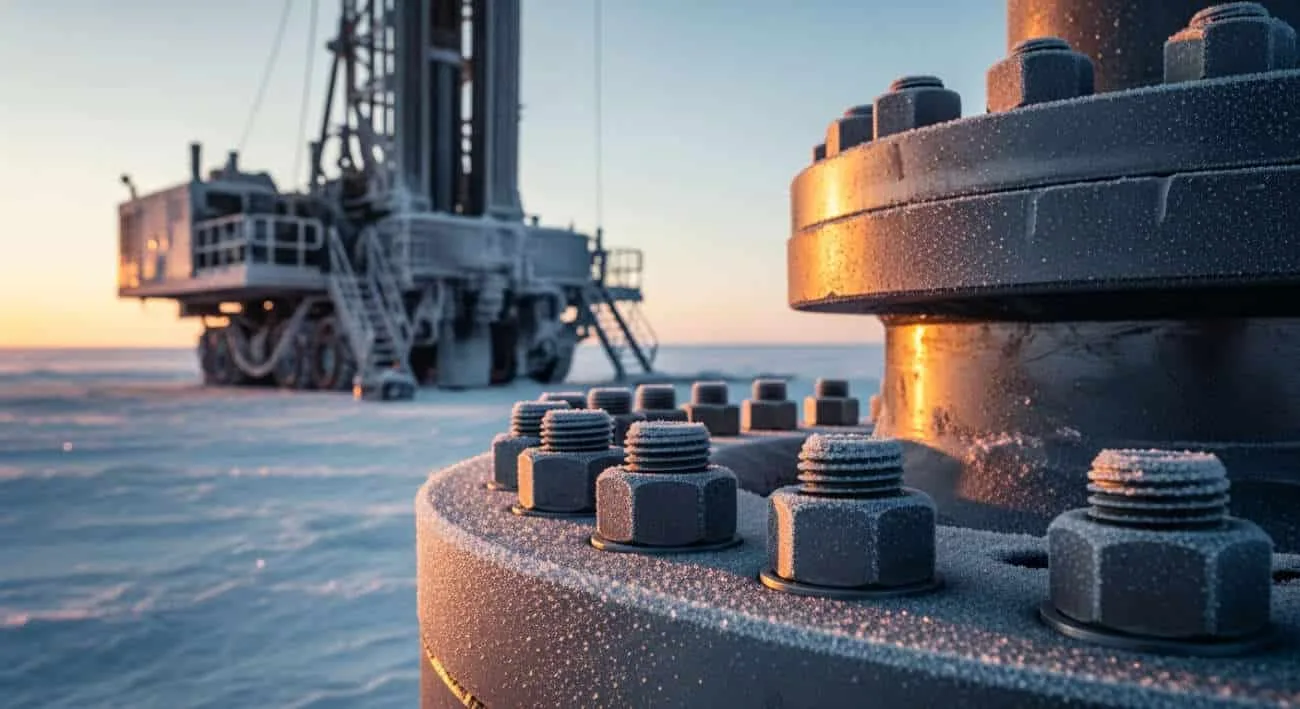
Arctic drilling is one of the most punishing frontiers in the energy industry. In places like the North Slope or the Barents Sea, temperatures can plummet to -60°C. For a drilling rig, these conditions aren’t just uncomfortable—they are mechanically transformative.
In these sub-zero environments, the “rules” of standard bolting change. Steel becomes brittle. Lubricants turn to solids. Most importantly, the relationship between torque and tension shifts. If you are managing an asset in the frozen north, understanding the science of cold-weather bolting is the difference between a productive season and a catastrophic failure.
The Cold Reality of Material Selection
The first step in managing torque is choosing a material that can survive the cold. Standard alloy steels that perform perfectly in the Gulf of Mexico can shatter like glass in the Arctic.
Why Standard Bolts Fail in the Cold
As temperatures drop, most carbon steels reach a “ductile-to-brittle transition temperature” (DBTT). Below this point, the metal loses its ability to deform under stress. Instead of stretching when overloaded, it snaps.
The Low-Temperature Champions
To combat this, Cyclone Bolt provides materials specifically engineered for low-temperature service.
-
ASTM A320 Grade L7: This is the industry standard for cold-weather bolting. While it shares chemistry with the high-temp A193 B7, it undergoes specialized heat treatment and mandatory Charpy V-Notch impact testing to ensure it remains tough at -101°C (-150°F).
-
ASTM A320 Grade L43: Used for larger diameters or even deeper cold, this grade offers higher strength while maintaining low-temperature resilience.
Check out our material grade guides to see the full spectrum of low-temperature options.
The Science of Torque vs. Tension in the Arctic
The goal of tightening a bolt isn’t “torque”—it is “tension” (also known as preload). Torque is simply the tool’s measurement of how hard it is to turn the nut. In arctic conditions, several factors “steal” your torque, leading to insufficient tension.
1. The Friction Factor
Friction accounts for about 90% of the torque you apply. In sub-zero weather, ice crystals can form in the threads. Standard greases thicken, increasing resistance. If your friction increases, your torque wrench might click at 500 ft-lbs, but the bolt hasn’t actually stretched enough to create a seal.
2. Thermal Contraction
Different materials shrink at different rates. If you have a stainless steel bolt in a carbon steel flange, the bolt may shrink faster than the flange as the temperature drops. This can lead to a “spontaneous” increase in tension that exceeds the bolt’s yield strength, causing it to fail.
3. Tool Calibration Errors
Pneumatic and hydraulic torque wrenches are sensitive to temperature. Cold air is denser, and cold hydraulic fluid is more viscous. A tool calibrated in a 70°F shop in Houston will not produce the same output in a -30°F arctic environment. Tools must be “warmed up” and, ideally, calibrated in-situ.
API Standards: Your Safety Net
When drilling in extreme environments, “good enough” isn’t an option. The American Petroleum Institute (API) has developed rigorous standards to ensure bolting integrity.
-
API 20E (Alloy and Carbon Steel): This specification ensures that bolts are manufactured with the highest levels of traceability and quality control. For arctic service, BSL-3 (Bolting Specification Level 3) is often required to ensure every single bolt has been tested for the intended environment.
-
API 20F (Corrosion Resistant): Arctic environments often involve high salinity and moisture. API 20F covers stainless and nickel-base alloys that prevent corrosion while maintaining mechanical endurance in the cold.
Cyclone Bolt is a leader in Houston for these specifications, holding certifications for API Spec Q1 9th Edition and ISO 9001:2015 Quality System Certificate.
Best Practices for Arctic Bolting
Managing torque in the cold requires a proactive strategy. Here is how the pros handle sub-zero installations:
-
Use Arctic-Grade Lubricants: Standard “Never-Seez” won’t cut it. You need molybdenum disulfide or nickel-based lubricants rated for -60°C. These ensure a consistent “K-factor” (friction coefficient) so your torque calculations remain accurate.
-
Verify with Tensioning: Whenever possible, use hydraulic bolt tensioners rather than torque wrenches. Tensioners physically pull the bolt to the correct stretch, eliminating the “friction variable” entirely.
-
The “Slow and Steady” Approach: Rapidly tightening a cold bolt can cause localized heating followed by rapid cooling, which can alter the grain structure of the metal. Gradual, multi-stage tightening is preferred.
-
Manage Your Coatings: Some coatings can become brittle and flake off in extreme cold, interfering with thread engagement. Consult our coating and plating technical guide to find the right finish for the Arctic.
The Importance of Traceability
In the Arctic, a failed bolt can lead to a blowout or a total rig shutdown. If a failure occurs, you need to know exactly which heat of steel that bolt came from.
At Cyclone Bolt, we provide full Mill Test Reports (MTRs) for our API-compliant bolting. This documentation proves that the material passed the Charpy V-Notch tests required for low-temperature service. Without this “paper trail,” you are essentially gambling with your rig’s safety.
External Resource:
-
American Petroleum Institute (API): Understanding API Standards for Bolting
-
American Society for Testing and Materials (ASTM): ASTM A320 Standard Specification
Arctic Bolting Recap
-
Material Resilience: Standard bolts become brittle in the cold; ASTM A320 L7 is the preferred choice for sub-zero service.
-
Torque vs. Tension: Friction increases in the cold due to thickened lubricants and ice, leading to false torque readings.
-
Thermal Dynamics: Fasteners and flanges shrink at different rates, which can lead to unexpected loss or gain of preload.
-
Compliance Matters: API 20E and 20F standards provide the manufacturing rigor necessary for high-stakes arctic drilling.
-
Houston Expertise: Based in Houston, Cyclone Bolt specializes in the high-spec bolting required for global extreme environments.
Secure Your Arctic Assets
Don’t let the cold compromise your drilling operations. Cyclone Bolt provides the API-certified, low-temperature fasteners you need to keep your rig running safely in the world’s harshest climates. Our Houston-based team understands the technical demands of sub-zero bolting.
Contact Cyclone Bolt today for a quote on your API 20E or 20F low-temperature fasteners!