
Originally published 2025-11-19 · Cyclone Bolt
In the high-stakes world of industrial processing, a pressure vessel is only as strong as its weakest link. Often, that link is the humble bolt. While massive steel plates and reinforced welds get the glory, the fasteners holding the flanges together bear the brunt of thermal cycling, immense pressure, and corrosive attacks.
Ignoring a compromised bolt isn’t just a maintenance oversight; it’s a gamble with safety, environmental compliance, and operational continuity.
At Cyclone Bolt, we engineer fasteners that withstand the most punishing environments. Located in the heart of Houston, Texas, our facility operates with military-grade precision, backed by API Spec Q1 (9th Edition) and ISO 9001:2015 Quality System Certificate certifications. But even the best bolts have a lifespan. Knowing when to retire them is the key to preventing a catastrophic blowout.
Here are the 7 unmistakable signs that your pressure vessel bolts need immediate replacement.
1. Visible Thread Necking and Stretching
When a bolt is over-torqued or subjected to pressure spikes beyond its yield strength, it undergoes plastic deformation. This permanent elongation is known as “necking.”
-
What to look for: The threads will appear thinned out or “stretched” in the middle of the bolt shank. The pitch (distance between threads) may look inconsistent.
-
Why it’s dangerous: A stretched bolt has lost its elasticity. It can no longer maintain the necessary clamping force (preload) on the gasket. The next pressure spike won’t just stretch it further—it will snap it.
-
The Cyclone Standard: We manufacture to strict API 20E and API 20F bolting specifications, ensuring every stud and hex bolt meets exact tensile requirements to resist premature elongation.
2. Severe Pitting and Crevice Corrosion
Surface rust is common, but pitting is a silent killer. This localized form of corrosion creates small cavities or “pits” on the bolt surface, often hidden under the bolt head or nut.
-
What to look for: Small, deep holes that look like pinpricks or larger craters.
-
The Cause: Pitting is often caused by chemical exposure or stagnant moisture trapped in the threads (crevice corrosion).
-
Why it’s dangerous: These pits act as stress concentrators. Under high pressure, a crack can initiate from a single pit and propagate through the entire bolt in milliseconds.
-
External Resource: Learn more about corrosion mechanisms in pressure vessels from OSHA.
3. Heat Discoloration (The “Rainbow” Effect)
If your pressure vessel operates at high temperatures, your bolts are constantly battling creep and stress relaxation.
-
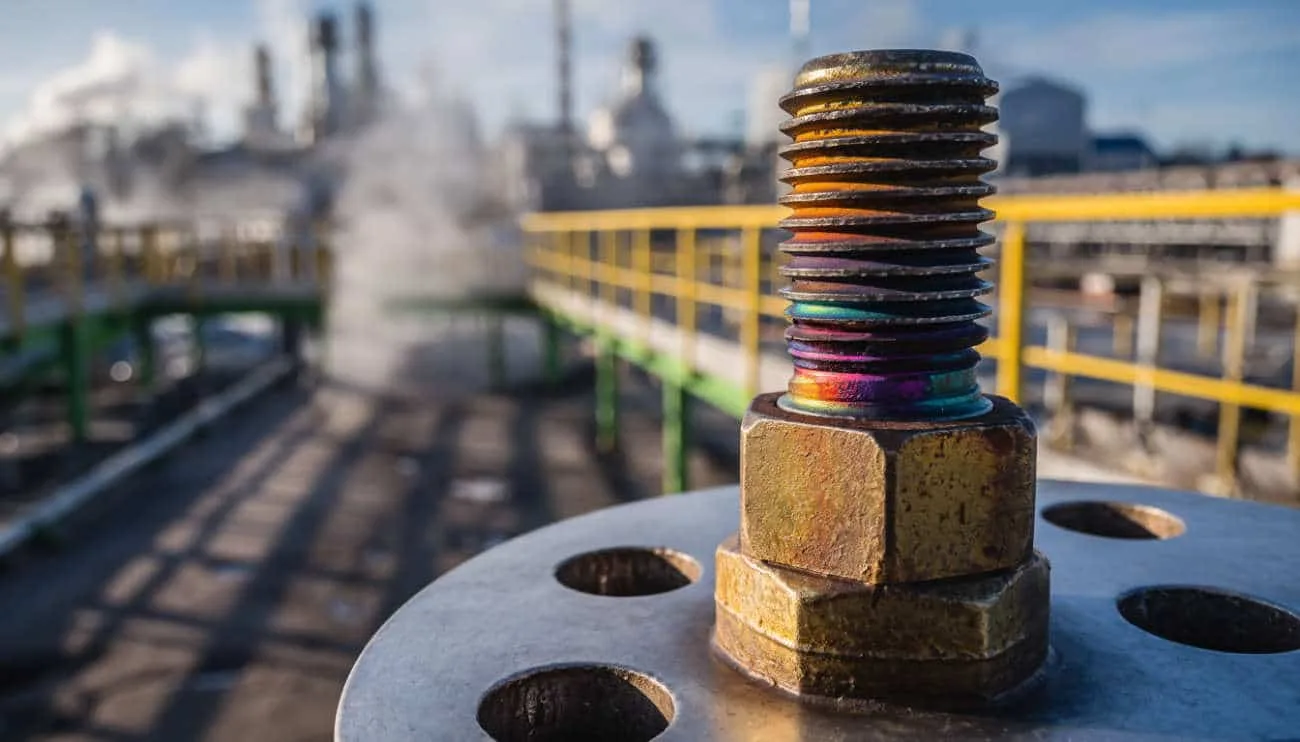
What to look for: A “rainbow” or bluish/purple tint on the metal surface.
-
Why it’s dangerous: This discoloration indicates the metal has been exposed to temperatures that may have altered its heat treatment. The bolt may have become brittle or lost its hardness properties.
-
Our Solution: Cyclone Bolt offers high-temperature alloys designed specifically to resist thermal degradation, fully traceable and compliant with technical standards.
4. Galled or Seized Threads
Gall occurs when the threads of the bolt and nut weld together due to friction and lack of lubrication during installation or removal.
-
What to look for: Torn, ripped, or balled-up metal on the thread surface. If a nut requires excessive force to turn, it’s likely galled.
-
Why it’s dangerous: You cannot achieve an accurate torque reading on a galled bolt. Your torque wrench might click at 500 ft-lbs, but if 200 ft-lbs was used just to overcome friction, your actual clamping force is dangerously low.
5. Cracks at the Root of the Thread
Fatigue cracks are often microscopic at first, usually forming at the “root” (bottom) of the thread where stress is highest.
-
What to look for: Hairline fractures that run perpendicular to the bolt axis. You may need a magnifying glass or dye penetrant testing to see them early.
-
Why it’s dangerous: This is the most common mode of sudden fatigue failure. Once a crack starts, repeated pressurization cycles will cause it to grow until the remaining metal can no longer hold the load.
-
The Fix: Regular Non-Destructive Testing (NDT) is crucial. Cyclone Bolt can supply replacement fasteners quickly when NDT flags a potential issue.
6. Washer Deformation or “Dishing”
Don’t ignore the washer. It spreads the load and protects the flange face.
-
What to look for: If the hardened washer has cupped, cracked, or “dished” into the bolt hole.
-
Why it’s dangerous: A failed washer leads to a loss of preload. As the washer collapses, the bolt effectively becomes loose, leading to gasket blowouts.
-
External Resource: Review proper bolting assembly procedures from ASME.
7. Hydrogen Embrittlement
This is a stealthy failure mode often affecting high-strength bolts used in sour gas or acidic environments.
-
What to look for: There are often no visible signs until the head pops off. However, if you see bolts snapping at loads well below their yield strength within hours or days of installation, suspect this.
-
Why it’s dangerous: Hydrogen atoms diffuse into the steel lattice, making it brittle.
-
Prevention: Cyclone Bolt strictly controls the manufacturing and coating processes to minimize hydrogen embrittlement risks, adhering to the rigorous controls of API Spec Q1.
Don’t Risk a Shutdown—Call Cyclone Bolt
When you spot one of these signs, you don’t have weeks to wait for a replacement. You need a partner who understands that time is money.
Cyclone Bolt is not just a supplier; we are a Service-Disabled Veteran-Owned Small Business (SDVOSB) that operates with a mission-critical mindset.
-
24/7 Manufacturing: Our Houston facility runs around the clock.
-
Certified Quality: From API 20E/F critical bolting to ISO 9001:2015 quality management, our paperwork is as solid as our steel.
-
Rapid Response: We specialize in urgent, custom manufacturing for shutdowns and turnarounds.
Need bolts now? Call our 24/7 Emergency Line: 281-733-1918 Or email us at inquiry@cyclonebolt.com