
Originally published 2025-11-18 · Cyclone Bolt
In the heavy industrial sector, a bolt is only as strong as its mating components. You can engineer a high-strength alloy stud to perfection, but if you pair it with a weak nut or an incompatible washer, that assembly becomes a ticking time bomb.
At Cyclone Bolt, based in Houston, Texas, we see this issue frequently. Engineers specify the bolt grade but often overlook the compatibility of nuts and washers. This oversight can lead to thread stripping, loss of preload, and catastrophic joint failure.
This guide explores the critical science of nut and washer compatibility. We will cover grade matching, material selection for corrosion resistance, and the specific requirements of API 20E and API 20F standards.
Why Compatibility Matters about Nut and Washer
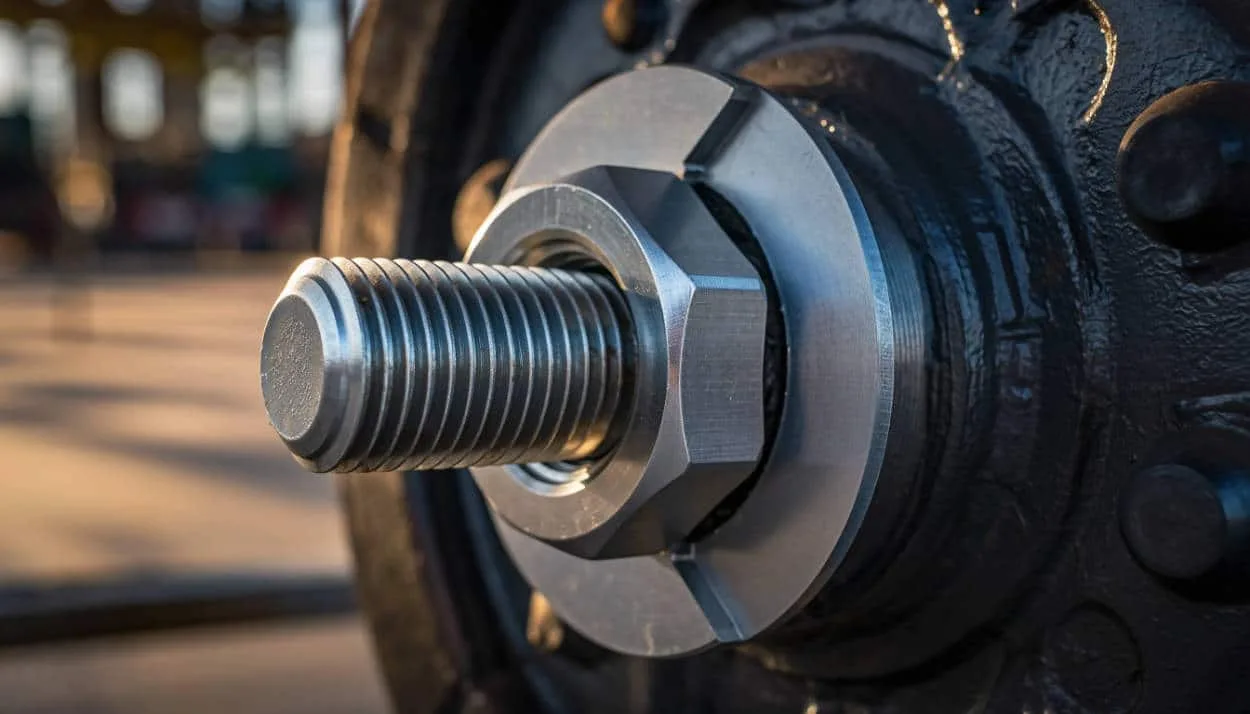
Fastener compatibility is not just about fit; it is about force distribution and chemical interaction. When you tighten a bolt, you are creating a clamp. The nut anchors that clamp, and the washer distributes the load.
If the nut is softer than the bolt, the bolt threads will strip the nut threads under load. If the washer is too soft, it will crush or “dish,” causing the bolt to loosen. If the materials are chemically dissimilar, galvanic corrosion will weld them together or eat them away.
The Risks of Mismatch
-
Thread Stripping: The nut fails before the bolt reaches its proof load.
-
Embedment: The washer collapses, leading to a loss of clamping force.
-
Galling: Incompatible metals seize during installation.
-
Hydrogen Embrittlement: Incorrect material processing leads to sudden cracking.
The Golden Rule of Nut Grades
The most fundamental rule in fastening is simple: The nut must be at least as strong as the bolt.
Ideally, you want the bolt to break before the nut strips. A broken bolt is obvious and easy to identify. A stripped nut inside a joint is invisible and dangerous.
Matching ASTM Grades
For general heavy industry, we often look at ASTM standards. Here is a quick compatibility breakdown:
-
Low Strength (ASTM A307): Pair with ASTM A563 Grade A nuts.
-
Medium Strength (SAE Grade 5 / ASTM A449): Pair with ASTM A563 Grade B or Grade DH nuts.
-
High Strength (SAE Grade 8 / ASTM A354 BD): Pair with ASTM A563 Grade DH or ASTM A194 Grade 2H nuts.
The Role of ASTM A194
In the oil and gas industry, ASTM A194 is the dominant standard for nuts.
-
Grade 2H: Quenched and tempered carbon steel. This is the “go-to” nut for high-pressure, high-temperature service. It mates well with ASTM A193 B7 bolts.
-
Grade 7: Alloy steel, quenched and tempered. Used for high-strength applications where 2H isn’t enough.
-
Grade 8: Stainless steel (AISI 304). Used with ASTM A193 B8 bolts.
Washer Selection: More Than Just a Spacer
Washers are often treated as an afterthought, but they play two vital roles: they provide a smooth bearing surface and they distribute the clamping load.
Hardness is Key
For high-strength bolting (like API 20E BSL-3), you cannot use a standard hardware store washer. Soft steel washers will deform under the high tension required for these joints.
-
ASTM F436: This is the standard specification for hardened steel washers. They are heat-treated to prevent crushing under high loads. Always use F436 washers with A325, A490, and high-strength API bolts.
API 20E/20F Washer Requirements
Under API 20E and API 20F, washers aren’t just stamped metal. They undergo rigorous testing.
-
Surface Finish: Must be smooth to ensure consistent torque-tension relationships.
-
Hardness Testing: Verifies the washer won’t yield under load.
-
Traceability: Like the bolts, every washer must be traceable to a specific heat lot of steel.
Material Compatibility and Corrosion
In the Gulf Coast region, humidity and saltwater are constant threats. Mixing metals is a recipe for disaster due to galvanic corrosion.
Understanding the Galvanic Series
When two different metals are in contact in the presence of an electrolyte (like saltwater), the “less noble” metal will corrode to protect the “more noble” metal.
-
Example of Bad Practice: Using a Stainless Steel bolt with a Carbon Steel nut. The Carbon Steel nut (anodic) will rust rapidly to protect the Stainless bolt (cathodic).
-
Example of Good Practice: Using materials that are close on the galvanic scale, or using insulating washers/sleeves.
API 20F: The Solution for Corrosion
For extreme environments, we recommend API 20F certified bolting. These are manufactured from Corrosion Resistant Alloys (CRAs) like:
-
ASTM A453 Grade 660: A stainless superalloy often used in offshore applications.
-
Inconel 718 (API 6A 718): Provides exceptional strength and corrosion resistance in sour gas (H2S) environments.
When using these exotic alloys, the nut and washer must match the alloy family. Using a standard carbon steel washer with an Inconel bolt defeats the purpose and invites failure.
The Importance of Coatings
Sometimes, you need the strength of carbon steel but the corrosion resistance of a CRA. This is where coatings come in. However, coatings affect compatibility too.
Thread Fit and Oversizing
Hot-dip galvanizing adds thickness to the bolt threads. To compensate, the mating nut must be “tapped oversize.” If you try to force a standard nut onto a galvanized bolt, the threads will seize (gall) immediately.
-
Cyclone Bolt Tip: Always order galvanized bolts and nuts as a matched set. We ensure the nut is tapped correctly to accommodate the coating thickness without compromising thread engagement strength.
Coating Compatibility
Ensure the coating on the washer matches the bolt and nut. A zinc-plated washer used with a plain steel bolt creates a localized galvanic cell. Uniformity is your friend.
Cyclone Bolt: Your Compatibility Experts
Navigating the matrix of grades, materials, and coatings can be overwhelming. That is why Cyclone Bolt exists.
Quality and Tech
Our Quality and Tech team doesn’t just read specs; we live them. We operate under an ISO 9001:2015 Quality System Certificate and API Spec Q1 quality management system. This means every nut and washer we supply is vetted for:
-
Dimensional Accuracy: Ensuring threads fit perfectly.
-
Material Integrity: Verifying the chemical composition matches the MTR (Mill Test Report).
-
Hardness Verification: Ensuring the heat treatment was successful.
Technical Standards
We adhere to strict Technical Standards. Whether you need a BSL-1 nut for a standard flange or a BSL-3 washer for a critical subsea riser, we have the manufacturing capability and the documentation to back it up.
Frequently Asked Questions (FAQ)
Q: Can I use a Grade 8 nut on a Grade 5 bolt? A: Yes. You can always use a stronger nut on a weaker bolt. The nut will simply be stronger than necessary, which is safe. However, you can never use a Grade 5 nut on a Grade 8 bolt, as the nut threads will strip.
Q: Do I really need hardened washers? A: For any structural or high-stress application (Grade 5/8 or A325/A490), yes. A standard “cut washer” is too soft and will compress, leading to loose bolts and potential joint failure.
Q: What is the correct nut for an ASTM A193 B7 bolt? A: The standard compatible nut is ASTM A194 Grade 2H. This is the industry standard for high-pressure/high-temperature bolting.
Q: Does Cyclone Bolt sell matched sets? A: Yes. We can supply fully assembled kits including the stud/bolt, compatible nuts, and hardened washers, all with matching coating and traceability documentation.
Don’t let a $2 nut destroy a $2 million piece of equipment. Compatibility is the silent guardian of structural integrity. By understanding the relationship between grades, materials, and coatings, you ensure your projects stand the test of time and stress.
Located in Houston, Texas, Cyclone Bolt is ready to be your technical partner. We don’t just sell parts; we provide solutions backed by the highest standards in the industry.
Need help matching your materials? Contact Cyclone Bolt Today for a consultation or a quote. Let us ensure your assembly is secure from the first thread to the final torque.