
Originally published 2025-11-19 · Cyclone Bolt
The Heart of the Power Plant
If the boiler is the stomach of a power plant or refinery, the Boiler Feed Pump (BFP) is the heart. It drives water into the system against immense back pressure. Without it, steam generation stops. Production halts. Profits evaporate.
Yet, the integrity of this massive, high-velocity machine often relies on its smallest components: the bolts.
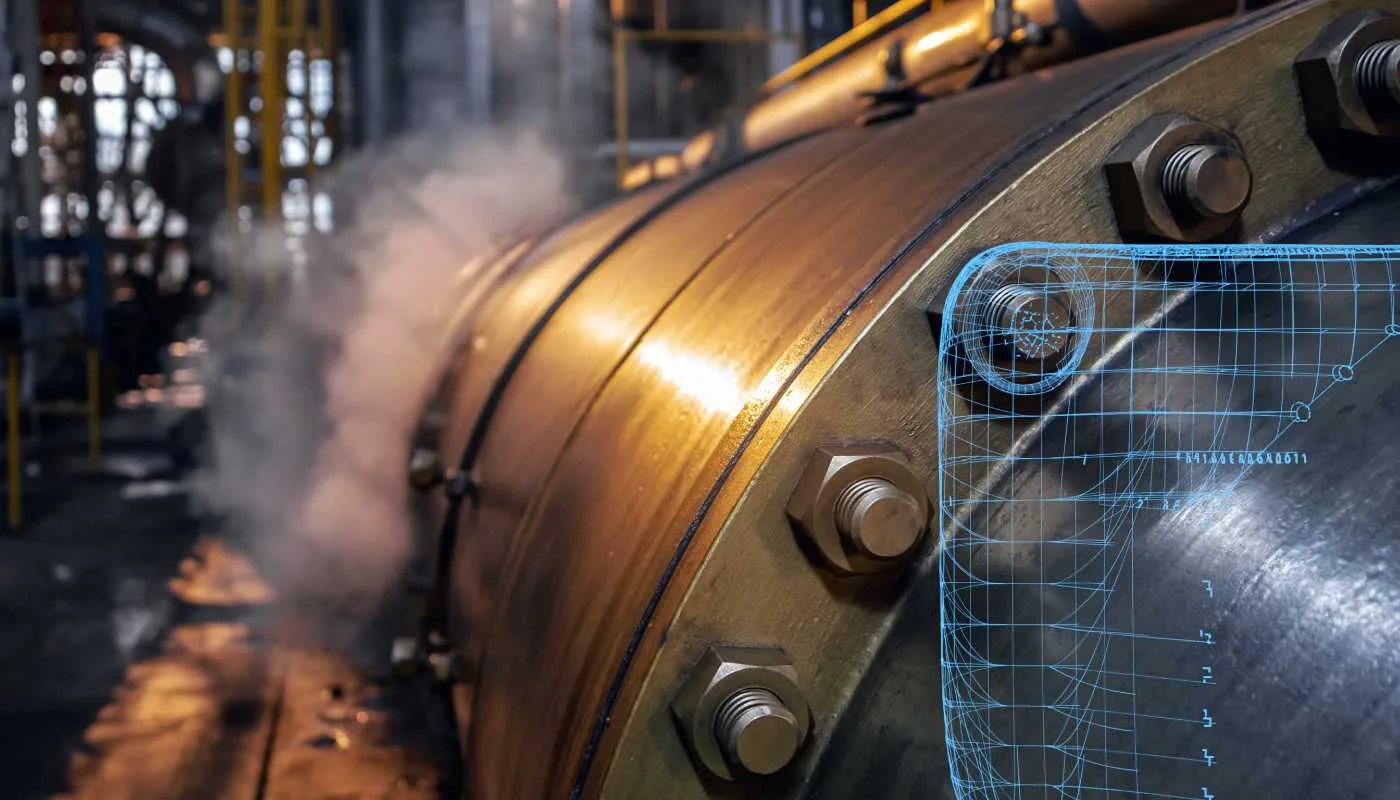
The casing bolts on a BFP are not just fasteners. They are critical engineering components. They must hold the pump casing together against internal pressures that can exceed 5,000 psi and temperatures that cause rapid metal expansion.
At Cyclone Bolt, located in Houston, Texas, we understand the physics of these demands. We know that when a bolt fails on a feed pump, it isn’t just a maintenance ticket—it’s a safety hazard and a catastrophic operational loss.
Here is why your BFP casings demand nothing less than high-strength, fully traceable bolting.
The Brutal Environment of a Boiler Feed Pump
To understand the bolt, you must understand the battlefield. A Boiler Feed Pump does not operate in a static environment. It exists in a state of controlled chaos.
1. Extreme Internal Pressure
The BFP must force water into the boiler. To do this, it must generate pressure higher than the boiler itself.
-
The Risk: This internal pressure actively tries to separate the upper and lower halves of the pump casing.
-
The Bolt’s Job: The studs must exert a clamping force (preload) greater than the separating force of the water pressure. If the bolts stretch or yield, the seal breaks. High-pressure water cuts through the gasket like a laser.
2. Thermal Shock and Cycling
Pumps cycle on and off. Load demands change.
-
The Risk: As the pump heats up, the casing expands. The bolts expand too, but often at a different rate than the casing material. This is called Differential Thermal Expansion.
-
The Consequence: This creates massive stress fluctuations. If the bolt material isn’t matched correctly to the application, the bolt can permanently stretch (yield) when hot, leaving it loose when the pump cools down.
3. High-Frequency Vibration
BFPs spin at incredibly high speeds, often between 3,000 and 6,000 RPM.
-
The Risk: Even perfectly balanced pumps vibrate. Over time, this vibration attacks the friction holding the nut in place.
-
The Reality: Standard fasteners will back off. High-strength, properly torqued fasteners designed with the right thread engagement are essential to resist self-loosening.
The Science of Failure: Creep and Fatigue
Why do bolts fail even if they look fine? In BFP applications, the two main enemies are Creep and Fatigue.
Understanding Bolt Creep
Creep is the tendency of a solid material to move slowly or deform permanently under the influence of mechanical stresses. It happens more severeley when materials are subjected to heat for long periods.
-
In a BFP, the bolts are under constant high tension and high heat.
-
Over months of operation, a standard bolt effectively “relaxes.”
-
As it relaxes, clamping force drops.
-
Eventually, the internal pressure overcomes the clamp, and a leak begins.
Fatigue Failure
Fatigue is caused by repeated loading and unloading. Every time the pump pressure fluctuates, the bolt stretches and relaxes slightly.
-
Imagine bending a paperclip back and forth. Eventually, it snaps.
-
This happens to bolts at a microscopic level.
-
Without high-grade materials tested for toughness, a bolt can snap suddenly without warning.
Why “Hardware Store” Bolts Don’t Cut It
You cannot fix a Boiler Feed Pump with a generic bolt from a bin. The margins for error are too slim.
In the industrial sector, we often see “counterfeit” or low-quality fasteners entering the supply chain. These bolts may be stamped with a grade like “B7,” but they lack the metallurgical properties to back it up.
Common issues with generic bolts include:
-
Inconsistent Heat Treatment: Leads to soft spots or brittleness.
-
Poor Thread Quality: Causes galling (seizing) during installation.
-
Micro-Cracking: Invisible defects that propagate under load.
At Cyclone Bolt, we eliminate this risk. We manufacture to strict specifications to ensure every stud and nut performs exactly as engineered.
Click here to view our Machining Capabilities and Quality Assurance
The Importance of Traceability (MTRs)
In a mission-critical environment, “guessing” is not a strategy. You need proof. This is where Traceability comes in.
When you buy BFP casing bolts from Cyclone Bolt, you aren’t just buying steel; you are buying the pedigree of that steel.
What is an MTR? A Material Test Report (MTR) documents the chemical composition and physical properties of the metal. It traces the bolt back to the mill where the steel was melted.
Why Traceability Matters:
-
Root Cause Analysis: If a bolt fails, you check the “Heat Number.”
-
Containment: You can immediately identify every other bolt made from that same batch of steel and replace them before they fail.
-
Compliance: Federal agencies and insurance auditors require proof that the installed materials meet the engineering design.
We adhere to rigorous standards to ensure full traceability.
Learn more about our Material Specifications here
API Specifications: The Gold Standard
For the Oil & Gas and Power Generation sectors, standard fasteners are often insufficient. This is why the American Petroleum Institute (API) created specific standards for critical bolting.
Cyclone Bolt is at the forefront of these standards.
API 20E (Alloy and Carbon Steel Bolting)
This specification defines the requirements for low-alloy and carbon steel bolting. It dictates strictly controlled manufacturing processes, heat treatment, and testing. It ensures the bolt is not just strong, but consistent.
Read more about our API 20E Capabilities
API 20F (Corrosion Resistant Bolting)
If your BFP operates in a corrosive environment or uses aggressive water treatment chemicals, standard steel may rust and pit. API 20F covers corrosion-resistant and high-temperature alloys. These bolts resist environmental attack, preventing the corrosion that leads to cracking.
Read more about our API 20F Capabilities
Quality Management: Our Military Precision
Cyclone Bolt is a Service-Disabled Veteran-Owned Small Business (SDVOSB). The military teaches that attention to detail saves lives. We apply that same philosophy to manufacturing fasteners.
Our quality management system is not just a plaque on the wall; it is the operating system of our business.
ISO 9001:2015
We are certified to ISO 9001:2015. This international standard demonstrates our ability to consistently provide products that meet customer and regulatory requirements. It governs everything from how we calibrate our tools to how we inspect final threads.
View our ISO 9001:2015 Certification info
API Spec Q1 (9th Edition)
This is the standard for quality management in the petroleum and natural gas industry. It goes beyond ISO. It requires stringent risk assessment, contingency planning, and supply chain controls. When you order from us, you are ordering from a facility that operates at the highest level of industrial quality control.
Learn about API Spec Q1 9th Edition standards
Installation: The Final Variable
Even the perfect bolt will fail if installed incorrectly. Boiler Feed Pump casings are notoriously difficult to seal because of their size and the number of bolts involved.
Three Keys to Success:
-
Lubrication: You must use a high-quality lubricant with a known K-Factor (friction coefficient). Without it, up to 90% of your torque effort is used just to overcome friction, not to stretch the bolt.
-
Torque Pattern: You must follow a “star” or “cross” pattern when tightening casing bolts. Tightening in a circle will pinch the gasket and warp the casing.
-
Calibrated Tools: Never rely on “feeling it.” Use calibrated torque wrenches or hydraulic tensioners.
Tip: For large BFP casings, hydraulic tensioning is often preferred over torquing because it eliminates friction variables and provides a pure axial load.
For detailed guidelines on bolting procedures, organizations like ASME provide excellent codes and standards. Check out ASME’s Bolting Standards here.
Why Houston Chooses Cyclone Bolt
We are located in Houston, Texas—the energy capital of the world. We understand the urgency of a shutdown.
When a Boiler Feed Pump goes down at 2:00 AM on a Saturday, you cannot wait for a shipment from overseas. You need a manufacturer who can cut, thread, treat, and test studs immediately.
We offer:
-
Rapid Response Manufacturing: We can produce non-standard lengths and diameters on demand.
-
Wide Material Inventory: We stock the alloys required for high-temperature service.
-
Technical Expertise: We don’t just sell parts; we understand the specifications.
For more insights on pump maintenance and reliability, Pumps & Systems Magazine is a leading authority. Visit Pumps & Systems here.
Conclusion: Don’t Compromise the Core
Your Boiler Feed Pump is too important to risk on questionable hardware. The cost of a high-quality, traceable, API-compliant bolt is a fraction of the cost of a single hour of unplanned downtime.
By choosing fasteners that are engineered for the heat, pressure, and vibration of a BFP, you are investing in the reliability of your entire plant.
At Cyclone Bolt, we combine military discipline with advanced manufacturing standards to deliver fasteners you can trust.