
Originally published 2025-12-18 · Cyclone Bolt
The Devil is in the Pitch
You are speccing out a new flange connection. You know the grade of steel. You know the diameter. But then comes the question that trips up even experienced engineers: UNC or UNF?
It seems like a small detail. A bolt is a bolt, right? Wrong.
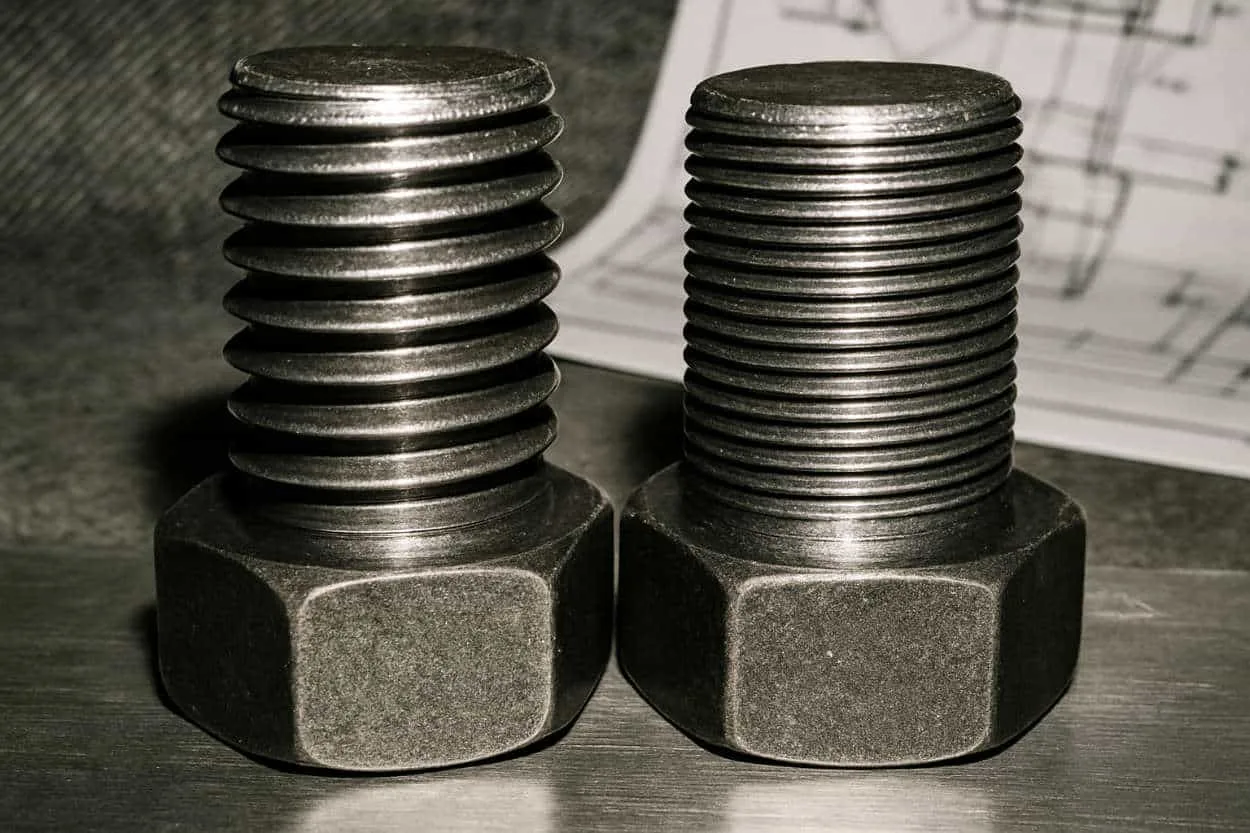
The difference between Coarse Thread (Unified National Coarse – UNC) and Fine Thread (Unified National Fine – UNF) is not just aesthetic. It changes the physics of the joint. It affects assembly speed, vibration resistance, and load-bearing capacity.
Choosing the wrong thread pitch in a high-pressure environment—like the offshore rigs we service here in Houston—can lead to stripped threads, loosened fasteners, or catastrophic failure.
At Cyclone Bolt, we live and breathe fastener specs. Whether it is API 20E or standard B7 studs, we ensure you get the right hardware for the job. Let’s break down the science of thread pitch so you never have to guess again.
What Does “Thread Pitch” Actually Mean?
Before comparing the two, we need to define the terms.
Thread pitch is the distance between threads. In the metric system, this is measured in millimeters. In the Imperial system (which we use for UNC/UNF), it is measured in Threads Per Inch (TPI).
-
UNC (Coarse): Fewer threads per inch. The threads are deeper and spaced further apart.
-
UNF (Fine): More threads per inch. The threads are shallower and packed closer together.
For example, take a 1/2-inch diameter bolt:
-
1/2″ – 13 UNC: Has 13 threads per inch.
-
1/2″ – 20 UNF: Has 20 threads per inch.
That 1/2-inch bolt looks the same from a distance, but those extra 7 threads make a massive difference in performance.
UNC (Coarse Thread): The Industrial Workhorse
Unified National Coarse is the default choice for most construction and general engineering applications. If you walk into a hardware store, almost everything you see is UNC.
The Advantages of Coarse Threads
1. Faster Assembly Because there are fewer threads per inch, a coarse bolt travels further with each rotation. You can tighten a UNC bolt much faster than a UNF bolt. When you are installing hundreds of fasteners on a pipeline, that time adds up.
2. Tolerance for Abuse This is the biggest selling point. Coarse threads are rugged. They are deeper, which makes them less susceptible to damage during handling.
-
Cross-Threading: It is much harder to cross-thread a coarse bolt.
-
Debris: If your job site is dirty (and they always are), UNC threads handle grit, rust, and plating buildup much better. The extra space between threads allows debris to clear out rather than jamming the nut.
3. Easier Disassembly In industries where corrosion is a factor, coarse threads are less likely to seize. If a bolt gets slightly nicked or rusty, you can usually still back a coarse nut off. A fine thread nut would likely bind and strip.
Where to Use UNC
-
General Construction: Steel framing, timber connections.
-
Maintenance Applications: Where bolts are removed and replaced often.
-
Soft Materials: If you are threading into aluminum, cast iron, or copper, use UNC. The deeper threads bite harder into the soft material, preventing the hole from stripping out.
UNF (Fine Thread): The High-Precision Specialist
Unified National Fine threads are the precision instruments of the fastener world. You see them heavily used in automotive, aerospace, and high-pressure oil and gas applications.
The Advantages of Fine Threads
1. Higher Tensile Strength This comes down to geometry. Because UNF threads are shallower, they cut less deeply into the shank of the bolt. This leaves a larger “tensile stress area” (the solid metal core of the bolt).
More metal means more strength. A fine thread bolt generally has a higher load-carrying capacity than a coarse thread bolt of the same diameter.
2. Better Vibration Resistance This is critical for rotating machinery. Fine threads have a shallower “helix angle.”
-
Think of it like walking up a hill. A steep hill (coarse thread) is easy to slide down. A shallow, gradual hill (fine thread) provides more friction.
-
This natural friction makes UNF fasteners much less likely to vibrate loose. This is why you almost always see fine threads on engine parts and suspension components.
3. Precise Tensioning Because the nut moves a shorter distance with each turn, you can make finer adjustments to the torque. This allows for extremely accurate pre-loading of the bolt, which is essential for critical flange connections.
Where to Use UNF
-
High-Vibration Areas: Pumps, motors, engines.
-
High-Strength Applications: Where you need maximum tensile strength from a specific diameter.
-
Hard Materials: Fine threads engage well with hard steels but should be avoided in soft metals like aluminum (they will strip the hole).
-
Thin Walls: If you are threading into a thin sheet of metal, fine threads ensure you get enough thread engagement to hold tight.
The 8-Pitch Series (8UN): The Oil & Gas Exception
If you work in the energy sector in Houston, you will encounter the 8-Pitch Series.
Standard UNC/UNF rules change when bolts get large (usually over 1 inch in diameter).
-
Standard UNC pitch gets very coarse as diameter increases.
-
Standard UNF pitch gets very fine.
To solve this, the ASTM A193 B7 specification (the bible for pressure vessels and flanges) often defaults to 8 Threads Per Inch (8UN) for all diameters over 1 inch.
Whether it is a 1-1/2″ bolt or a 2-1/2″ bolt, it will have exactly 8 threads per inch. This creates a balance between assembly speed and strength. It is the industry standard for high-temperature, high-pressure service.
Plating and Coating Considerations
At Cyclone Bolt, we apply a lot of coatings. From PTFE (Teflon) to Zinc Nickel, coatings add thickness to the bolt.
Coarse Threads (UNC) are forgiving. They have enough clearance to accept a heavy dip-spin coating or hot-dip galvanizing without interfering with the nut fit.
Fine Threads (UNF) are picky. Because the tolerance is so tight, a thick coating can make it impossible to spin the nut on. If you need a heavy corrosion-resistant coating on a fine thread bolt, you often have to “oversize” the threads before coating, which adds cost and complexity.
-
External Resource: Read more about thread fit classes and plating allowances to see how coatings affect assembly.
Quality and Tech: The Cyclone Standard
It doesn’t matter if you choose UNC or UNF if the manufacturing quality is poor. A poorly machined thread will fail regardless of the pitch.
This is why Cyclone Bolt adheres to the strictest standards in the industry.
-
API 20E & 20F: We are certified to manufacture critical bolting for the petroleum and natural gas industries.
-
ISO 9001:2015 Quality System Certificate: Our quality management system ensures traceability from the raw bar stock to the final shipment.
We inspect thread geometry, pitch diameter, and root radius. When you order a 1/2″-20 UNF bolt from us, you know it will gauge perfectly every time.
Summary Checklist: How to Decide
Still unsure? Use this quick checklist to make your decision.
Choose UNC (Coarse) if:
-
You are threading into soft materials (Aluminum, Iron).
-
Rapid assembly/disassembly is a priority.
-
The environment is dirty or prone to corrosion.
-
You are using thick coatings like Hot Dip Galvanizing.
-
You are worried about cross-threading.
Choose UNF (Fine) if:
-
You need maximum tensile strength.
-
The application is subject to heavy vibration.
-
You need precise torque adjustments.
-
You are threading into a thin wall or hard steel.
-
Space is limited (fine thread nuts are sometimes smaller).
Don’t Guess on Critical Joints
In our line of work, a fastener failure isn’t just an inconvenience; it is a liability. Whether you are building a subsea manifold or a structural skyscrape, the thread pitch matters.
You need a partner who understands the metallurgy, the specs, and the application.
Cyclone Bolt is that partner. Based in Houston, we serve the global industrial market with high-performance fasteners that meet the most rigorous technical standards.
Do not risk your project on generic hardware. Get the right spec, the right pitch, and the right coating.
Contact Cyclone Bolt today. Let’s build something that holds.
External Links for Further Reading
-
Machinery’s Handbook: The definitive guide for mechanical specifications and thread standards.
-
American Society of Mechanical Engineers (ASME): Explore the specific standards for Unified Inch Screw Threads (ASME B1.1).