
Originally published 2025-11-17 · Cyclone Bolt
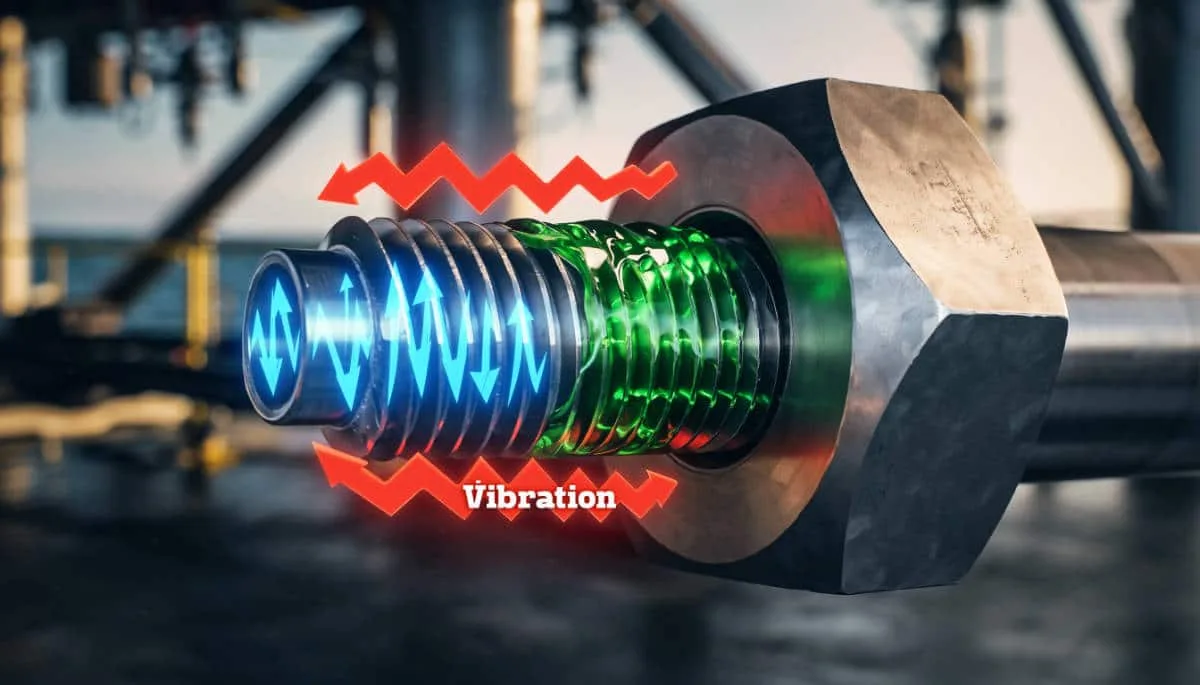
In the critical industries that power our world—from offshore platforms in the Gulf to sprawling chemical plants along the Houston ship channel—failure is not an option. Yet, one of the most persistent and dangerous threats to structural integrity isn’t a single catastrophic event. It’s a silent, relentless force: vibration.
A bolted joint can be perfectly designed, but if it’s installed incorrectly in a high-vibration environment, it’s a ticking time bomb. The slow, transverse loosening caused by pumps, engines, compressors, or heavy machinery can lead to leaks, downtime, and catastrophic failure.
The good news? This failure is almost entirely preventable.
The secret isn’t just in the bolt; it’s in the process. This guide provides the best practices for bolt installation in high-vibration environments, ensuring your critical assets remain secure, safe, and operational.
Part 1: The “Why” – Understanding Vibration’s Attack on Bolted Joints
Before you can fight an enemy, you must understand it. Vibration causes bolts to loosen through a specific, mechanical process. It’s not that the nut simply “spins off.”
It happens in tiny, incremental stages:
-
Micro-Slips: Vibration, especially transverse (sideways) vibration, causes the clamped surfaces and the bolt threads to slip against each other.
-
Preload Reduction: Each micro-slip momentarily unloads the bolt, fractionally reducing its “preload”—the tension or clamping force holding the joint together.
-
Self-Rotation: With each cycle of vibration, the nut or bolt head can “walk” loose in a fractional, backward rotation. Over thousands or millions of cycles, this incremental loosening results in a complete loss of preload.
Once preload is lost, the bolt is no longer clamping the joint; it’s just sitting in a hole. At this point, it’s only a matter of time before it shears or falls out.
Common sources of this destructive vibration include:
-
Engines and motors
-
Pumps and compressors
-
Heavy rotating equipment
-
Impact tools and processes
-
Fluid flow in pipes
Part 2: The Foundation – Pre-Installation Best Practices
You can’t achieve joint integrity with a poor foundation. The battle against vibration is often won or lost before a single wrench is turned.
1. Select the Right Materials
Not all bolts are created equal. Using a generic, off-the-shelf bolt in a critical application is a recipe for disaster. Material selection is your first line of defense.
-
Match the Grade to the Load: Ensure the bolt’s tensile strength (e.g., ASTM A193 B7, A320 L7) is engineered to handle the maximum operational loads.
-
Consider the Environment: Will the bolt be exposed to high temperatures, corrosive chemicals, or saltwater? This dictates the material (e.g., carbon alloy, stainless steel 316, B8M) and any required coatings (e.g., PTFE, Hot-Dip Galvanized).
-
Use Certified Materials: For critical applications, especially in oil and gas, material traceability is mandatory. This is where Cyclone Bolt’s commitment to API 20E and API 20F specifications becomes vital. These aren’t just bolts; they are fully traceable, tested, and certified bolting components designed for the industry’s most demanding jobs.
For a full overview of available materials, see our materials and specifications page.
2. Prioritize Verifiable Quality
The “cheapest” bolt is almost always the most expensive one in the long run. A single failure can cost millions in downtime or damages.
Your quality assurance program is what protects you. Insist on a supplier that provides:
-
Full Traceability: Material Test Reports (MTRs) that trace the fastener from the raw material mill to your facility.
-
Certified Processes: A quality management system (QMS) registered to standards like ISO 9001:2015 Quality System Certificate and API Spec Q1. This proves the process for manufacturing and testing is consistent and reliable.
3. Prepare the Joint Surfaces
A bolt’s job is to clamp two surfaces together. If those surfaces are compromised, the clamp will fail.
-
Clean and Dry: Remove all dirt, rust, oil (other than the specified lubricant), and paint from the joint faces and threads.
-
Flat and Smooth: Ensure the joint faces are flat and free of burrs or gouges. High spots will create false torque readings and will flatten under vibration, leading to a loss of preload.
-
Check Hole Alignment: Misaligned holes will cause the bolt to bend, applying uneven stress and making it highly susceptible to fatigue failure.
Part 3: The “How” – Core Installation Practices
This is the main event. A high-quality bolt can still fail if installed improperly.
1. The #1 Goal: Achieve Correct Preload
If you remember one thing, make it this: Preload is everything.
Preload is the tension created in a bolt when it is tightened. Think of it as stretching the bolt like a very stiff spring. This “spring” force is what clamps the joint members together.
The Golden Rule: The preload (clamping force) must be high enough to overcome any external forces (like vibration) trying to separate the joint.
If the preload is higher than the vibrating load, the joint members will never slip, and the nut will never loosen. Most failures in high-vibration environments are, at their core, a failure to achieve and maintain correct preload.
2. The K-Factor: Lubrication is Non-Negotiable
How do you know you’ve hit the right preload? You measure it. The most common way is by applying a specific amount of torque.
But torque is just a measurement of turning resistance. It doesn’t directly measure preload. A huge portion of your torque (often 80-90%!) is consumed just to overcome friction:
-
~50% of torque is lost to friction under the nut/bolt head.
-
~40% is lost to friction in the threads.
-
Only ~10% of the torque you apply actually becomes preload (stretch).
This friction value is called the “nut factor” or “K-factor.” And this is why lubrication is critical.
A high-quality lubricant doesn’t just prevent galling; it creates a consistent and predictable K-factor. Using the wrong lube, no lube, or a contaminated lube means your torque wrench is lying to you. You could be hitting your target torque value while achieving only 50% (or less) of the required preload.
Always use the exact lubricant specified by the engineer for the stated K-factor and torque values. For an authoritative look at how friction is calculated in bolting, standards bodies like the American Society of Mechanical Engineers (ASME) provide detailed guidelines.
3. Tightening Methods and Patterns
Don’t just tighten bolts in a circle. This will create uneven loading, warp the joint (especially on flanges), and lead to failure.
Step-Tightening (for flanges and multi-bolt patterns):
-
Hand-Tighten: Snug all bolts by hand.
-
Star Pattern (Pass 1): Tighten bolts in a star or cross pattern (e.g., 1, 3, 2, 4) to ~30% of the final torque.
-
Star Pattern (Pass 2): Repeat the star pattern to ~70% of the final torque.
-
Star Pattern (Pass 3): Repeat the star pattern to 100% of the final torque.
-
Final Pass (Rotational): Do one final pass, moving clockwise from bolt to bolt, to ensure all are at 100% torque.
Turn-of-Nut Method: This is a more accurate method that is less dependent on friction.
-
Tighten the bolt to a “snug-tight” condition (the point where the joint is fully compacted).
-
Mark the nut, bolt, and joint surface with a “witness mark.”
-
Apply an additional, specified turn (e.g., 1/3 turn, 1/2 turn) to the nut. This turn imparts the final, correct stretch (preload).
Part 4: The Defense – Vibration-Resistant Fastening Solutions
In extreme environments, you may need a secondary defense. These solutions work by either preventing the nut from rotating or by actively maintaining preload.
Passive Solutions (Prevent Rotation)
These stop the nut from physically turning loose.
-
Locknuts (All-Metal): These have deformed threads or serrated flanges that “bite” into the mating surface. They are excellent for high-temperatures where nylon would fail.
-
Locknuts (Nylon Insert): A nylon ring at the top of the nut creates a tight, frictional grip on the bolt threads. Very common and effective, but have temperature and re-usability limits.
-
Double Nuts (Jam Nuts): A thin “jam nut” is tightened first, followed by a standard-height nut tightened against it. This creates a locking action. Warning: This method requires precise installation and is often done incorrectly.
-
Chemical Locking (Threadlockers): Anaerobic adhesives (like Loctite) fill the microscopic gaps in the threads and cure to form a hard, vibration-proof polymer. This is extremely effective but makes disassembly difficult.
-
Ineffective “Solutions”: Many studies have shown that traditional split-ring (spring) washers and tooth (star) washers are ineffective against vibration. They flatten under load and provide no locking action, offering a false sense of security.
Active Solutions (Maintain Preload)
These are superior as they attack the root cause (preload loss), not the symptom (nut rotation).
-
Wedge-Locking Washers: These systems (like Nord-Lock) use a pair of washers with cams on one side and radial teeth on the other. The cam angle is greater than the thread pitch, meaning any loosening rotation causes the washers to “climb” each other, increasing the preload and locking the joint.
-
Load-Indicating (DTI) Washers: These washers have small bumps that flatten as you tighten. You can measure the remaining gap with a feeler gauge to verify you have achieved the correct preload. They ensure the installation is correct from the start.
Part 5: Post-Installation and Maintenance
The job isn’t done after the final torque. In high-vibration applications, a “set it and forget it” mindset is dangerous.
-
Visual Inspection: Use witness marks (a line of paint across the nut and joint surface). A quick visual check can instantly reveal if any rotation has occurred.
-
Scheduled Re-Torquing: Establish a maintenance schedule to check the torque on critical joints, especially after the first few run cycles. Note: Re-torquing can be complex, as the “breakaway” torque is different from the initial tightening torque.
-
Vibration Analysis: Use predictive maintenance tools to monitor the vibration frequency and amplitude of your equipment. A change in the vibration signature can often be the first warning sign of a failing component or a loosening joint.
Your Partner in Joint Integrity
Preventing bolt failure in high-vibration environments is a technical discipline. It requires a holistic approach that starts with certified, traceable materials, follows a precise, non-negotiable installation process, and is backed by a proactive maintenance plan.
There are no shortcuts. The integrity of your most critical assets relies on the quality of your components and the expertise of your team.
From our API Q1 and ISO 9001-certified facility in Houston, Texas, Cyclone Bolt provides more than just fasteners. We provide the certified quality, material traceability, and technical expertise you need to ensure joint integrity in the world’s most demanding environments. When you use API 20E and API 20F certified bolting, you are using components built for the job.
Don’t let vibration be your single point of failure. Contact the Cyclone Bolt technical team today to discuss your high-vibration applications.