
Originally published 2025-11-17 · Cyclone Bolt
The Invisible Force: How Bolt Preload Science Stops Boiler Steam Leaks
The hiss of a steam leak from a boiler gasket joint is more than just an annoyance. It’s the sound of lost energy, wasted money, escalating inefficiency, and a potential safety hazard. In high-pressure, high-temperature environments like power plants, refineries, and large-scale manufacturing, the integrity of a flanged joint is paramount.
The solution isn’t just “tighter bolts.” The solution is a precise, calculated, and invisible force: bolt preload.
Understanding the science behind this clamping force is the single most important factor in preventing gasket failure and ensuring your boiler operates safely and efficiently. This article explores the complex science of bolt preload, the forces working against your joints, and how specifying the right components is the foundation of a reliable seal.
What Is Bolt Preload? The “Clamping Force” Explained
At its simplest, bolt preload (or “preload”) is the tension created in a bolt or stud when it is first tightened.
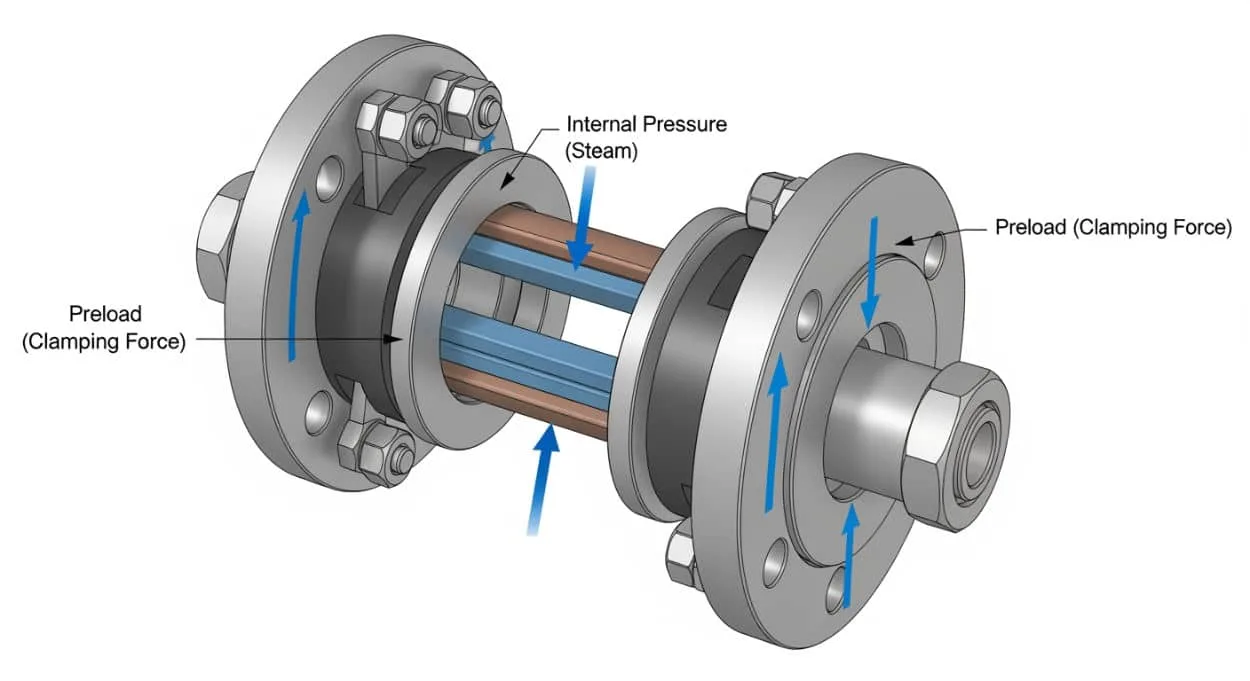
Think of a bolt as a very, very stiff spring. When you tighten the nut, you are stretching the bolt, elongating it by a tiny, precise amount. This stretch creates a powerful clamping force that compresses the two flanges of a joint together.
This force is the working load of the fastener before the boiler is even turned on.
The Joint: A System of Three Parts
A boiler gasket joint isn’t just a bolt. It’s a complex system of three components that must work in perfect harmony:
-
The Flanges: These are the faces that must be sealed.
-
The Gasket: This is the sealing element, designed to be compressed to fill the microscopic imperfections on the flange faces.
-
The Studs/Bolts: These are the “springs” that provide the clamping force to compress the gasket.
The primary job of bolt preload is to compress the gasket with enough force to create an initial, leak-proof seal. But its most important job is to maintain enough “residual” clamping force to keep that seal, even when the boiler is at full temperature and pressure.
The fundamental rule is simple: The clamping force from the bolts must always be greater than the forces trying to pull the joint apart.
The Villains: Why Boiler Gasket Joints Fail
A joint doesn’t just fail; it’s forced to fail. In a boiler, the joint is under constant attack from a combination of powerful forces. The goal of preload is to overcome all of them.
1. Internal Pressure (Hydrostatic End Force)
This is the most obvious enemy. The high-pressure steam inside the boiler (e.g., 600, 1500, or even 2200 psi) pushes outward on everything, including the flanges. This “hydrostatic end force” directly counteracts the clamping force of the bolts. If the internal pressure force exceeds the residual bolt load, a leak path is created.
2. Thermal Cycles and Differential Expansion
This is the most deceptive and powerful villain in boiler applications.
-
Heat-Up: As the boiler comes online, all components get hot—but they don’t heat up at the same rate or expand by the same amount.
-
Differential Expansion: The flanges are often massive and heat slowly. The bolts are thinner and heat quickly. Furthermore, the bolts (e.g., ASTM A193 B16 alloy steel) may have a different coefficient of thermal expansion than the flanges (e.g., carbon steel).
This mismatch in expansion changes the tension on the bolt. If the bolt expands more than the flange, preload decreases, potentially leading to a leak.
3. Gasket Creep and Relaxation
Under the immense and constant pressure of heat and clamping force, the gasket material itself begins to change.
-
Creep: This is the tendency of a material to slowly deform over time under a constant load, especially at high temperatures. The gasket literally gets thinner.
-
Relaxation: This is a reduction in the compressive stress of the gasket material as it “settles” into its new, compressed shape.
Both creep and relaxation cause the same problem: the gasket pushes back with less force, which reduces the tension (preload) in the bolt.
4. Vibration
In any industrial setting, mechanical vibration from pumps, turbines, and flow can introduce cyclic loads. While less of a factor on massive boiler flanges than in other machinery, this vibration can contribute to a gradual loss of bolt tension over thousands of cycles if the preload is insufficient.
A leak occurs when the sum of all these forces becomes greater than the residual preload in the studs.
The Science: How to Calculate the “Right” Amount of Preload
Achieving the correct preload isn’t guesswork; it’s a precise engineering calculation. Tightening a boiler stud to the wrong specification is just as bad as using the wrong bolt.
The goal is to stretch the bolt to a specific percentage of its minimum yield strength—the point at which it will permanently deform. We want to get close to this point to maximize clamping force, but never at or beyond it. This is known as keeping the bolt in its “elastic region.”
The “Sweet Spot”: Target Preload
A common target for critical joints is to tighten the bolt to 50% to 70% of its yield strength.
-
Why not 100%? You must leave a safety factor. This remaining strength is what handles the additionaloperational loads (like internal pressure and thermal expansion) without permanently damaging the bolt.
-
Why not 20%? This would provide insufficient preload. After thermal cycles and gasket relaxation, the residual load would be too low to contain the steam pressure.
The ASME Code: The Bible for Boiler Joints
For any pressure vessel, including boilers, these calculations are governed by strict standards. The most critical is the ASME Boiler and Pressure Vessel Code (BPVC). This code provides the engineering formulas for calculating the required bolt load, considering:
-
-
Gasket Seating (“y” factor): The minimum compressive stress (in psi) required to make the gasket “flow” and fill the flange’s imperfections to create an initial seal.
-
Operating Conditions (“m” factor): A multiplier that determines how much additional compressive stress is needed to maintain the seal against the boiler’s internal pressure.
-
Application: How “Torque” Lies and “Tension” Tells the Truth
You’ve done the math. You know the exact preload target. Now, how do you achieve it in the field? This is where most preload strategies fail.
The Problem with Torque
The most common method for tightening a bolt is using a torque wrench. Torque is a measurement of rotational force (in ft-lbs or N-m).
The problem? Torque is an indirect and highly inaccurate measure of preload.
Research shows that up to 90% of the torque you apply with a wrench is consumed simply by friction:
-
50% is lost to friction under the nut or bolt head.
-
40% is lost to friction in the threads.
This means only 10% of the force you exert actually contributes to stretching the bolt and creating preload.
Worse, this 90% friction value is wildly unpredictable. It changes based on:
-
Surface finish
-
Rust or dirt
-
Damaged threads
-
The type of lubricant used (or not used)
Using a torque wrench gives you a torque value, not a preload value. The resulting preload can be off by +/- 35% or more, even with experienced technicians. For a critical boiler joint, this level of inaccuracy is unacceptable.
The Gold Standard: Hydraulic Stud Tensioning
The most accurate and reliable method for achieving preload in critical joints is direct stud tensioning.
This method abandons torque completely. Instead, a hydraulic stud tensioner is attached to the end of the stud. It grips the stud and pulls it axially (stretches it in a straight line), like a high-tech hydraulic ram.
-
The tool stretches the stud to the exact calculated preload target.
-
With friction completely eliminated from the equation, the bolt is held at this precise elongation.
-
The technician then simply spins the nut down by hand until it’s snug against the flange.
-
The hydraulic pressure is released, and the bolt’s “spring” force is transferred to the flange and gasket.
The result is a highly accurate, measurable, and consistent preload across all studs in the flange—a critical factor for achieving a uniform gasket seal.
The Foundation: Why Material Quality is Non-Negotiable
All the precise calculations and advanced tensioning tools in the world are useless if the bolt itself is not up to the task.
A boiler stud is not a simple commodity. It is a safety-critical, high-performance engineered component. If it’s made from the wrong material, has an internal flaw, or lacks proper traceability, it represents a single point of failure for the entire system.
This is where a commitment to verifiable quality becomes the cornerstone of joint integrity.
1. The Right Material for the Job
Boilers operate at extreme temperatures, which can cause standard steels to become brittle or “creep” (permanently stretch). You must use alloys specifically designed for high-temperature, high-pressure service. Materials like ASTM A193 Grade B16 (a chromium-molybdenum-vanadium steel) or B7 (chromium-molybdenum) are chosen for their superior strength and resistance to creep at high temperatures. (You can explore more material specifications here: [Link to Cyclone Bolt materials page]).
2. The Power of API and ISO Certification
How do you know the bolt you’re holding is actually Grade B16? This is where quality management systems are essential.
-
ISO 9001:2015: This certification ensures a manufacturer has a robust, repeatable, and documented quality management system. It’s the baseline for quality.
-
API Spec Q1: This is the next level, specifically for the petroleum and natural gas industry, demanding even more rigorous process control, traceability, and risk management.
-
API 20E & 20F: These are the “proof.” These certifications (like those held by Cyclone Bolt) are not for systems; they are for the bolting itself.
These API monograms are a guarantee of full, auditable traceability from the original steel mill to the final product. They confirm that the material chemistry, heat treatment, and mechanical properties (like yield strength) are exactly what they claim to be. When you specify an API-certified bolt, you are removing the single biggest variable from your joint integrity equation.
3. Manufacturing That Matters
Even with the right material, how a bolt is made impacts its strength. High-quality studs use rolled threads, not cut threads. Rolling the threads compresses the grain of the steel, making them significantly stronger and more resistant to fatigue failure—a critical factor in a cyclically-loaded environment like a boiler.
Don’t Let a Small Bolt Become a Big Problem
The integrity of a multi-million dollar boiler relies on a component that costs a tiny fraction of the total. But as we’ve seen, the science of that component is deeply complex.
Preventing steam leaks is not about “cranking down” on a nut. It’s a holistic process:
-
Engineering: Calculating the precise preload target based on ASME standards.
-
Application: Using accurate methods like hydraulic tensioning to achieve that target.
-
Procurement: Sourcing high-quality, fully-certified studs and nuts from a supplier that understands this science.
As a Houston, Texas-based leader in manufacturing and supplying API-certified, safety-critical bolting, Cyclone Bolt & Gasket lives this science every day. We know that the safety of your people and the efficiency of your plant depend on the provable quality of the components holding it all together.
Need technical data on bolt load? Our expert team can help. Contact us today.