
Originally published 2026-01-02 · Cyclone Bolt
Every mechanic, engineer, or assembly technician knows the feeling. You are tightening a critical fastener. Suddenly, the resistance disappears. The wrench spins freely. You have just stripped a nut.
It is a frustrating, expensive, and potentially dangerous failure. In high-stakes industrial environments, a single stripped nut can mean shutting down a pipeline, halting production, or compromising structural integrity.
Understanding why nut stripping happens is the first step toward stopping it. At Cyclone Bolt, based in Houston, Texas, we specialize in high-integrity fasteners designed to prevent these types of failures. We believe that knowledge is just as important as the hardware itself.
What Exactly Is “Nut Stripping”?
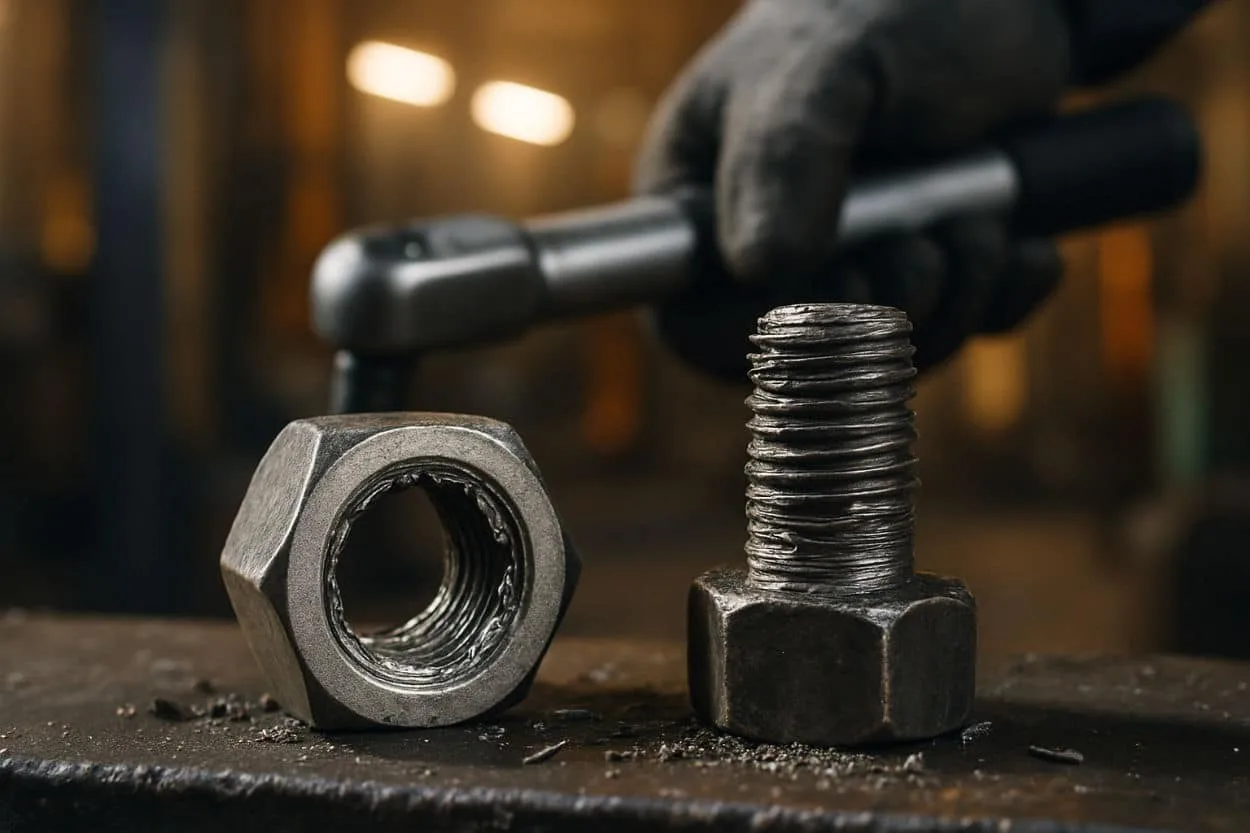
Nut stripping is a specific type of mechanical failure. It occurs when the internal threads of the nut shear off under load.
Think of the threads on a bolt and nut like two interlocking mountain ranges. When you tighten the assembly, these “mountains” press against each other. This creates the tension that holds the joint together.
If the force applied exceeds the shear strength of the nut’s material, those internal “mountains” crumble. The metal threads are literally torn away from the body of the nut. The bolt threads might remain intact, but the nut is ruined and provides no clamping force.
It is distinct from a bolt breaking. When a bolt breaks, it usually snaps across its cross-section due to excessive tension. When a nut strips, the failure is parallel to the axis of the bolt along the thread interface.
The Primary Causes of Nut Stripping
Stripping is rarely just bad luck. It is almost always the result of a specific error in application, material selection, or manufacturing quality.
1. Excessive Torque (Over-Tightening)
This is the most common cause of thread failure. Many people mistakenly believe that “tighter is always better.” This is false.
Every bolted joint has a specific torque requirement designed to achieve the correct clamping force (tension). If you apply too much torque, you overload the threads.
When you exceed the designed proof load of the nut, the threads begin to yield (deform permanently). If you continue tightening, they will shear off completely. Using calibrated torque wrenches and following engineering specifications is vital.
2. Material Mismatch and Strength Differences
Bolting assemblies are systems. The bolt and nut must be engineered to work together.
Generally, standard engineering practice dictates that the nut should be slightly lower in strength than the bolt. This is a safety consideration. A stripped nut is usually obvious and less catastrophic than a bolt snapping suddenly under high tension.
However, if the nut is significantly softer or weaker than the bolt it is paired with, it will strip prematurely. Using a low-grade consumer nut on a high-strength industrial bolt is a recipe for failure.
You must ensure your fasteners meet the correct materials specifications for the application.
3. Poor Thread Quality and Manufacturing Defects
You cannot achieve a secure joint with poorly made parts. If thread tolerances are loose due to cheap manufacturing, there is less engagement between the bolt and nut threads.
Less metal-to-metal contact means the load is concentrated on a smaller area. This causes those areas to fail faster. Threads that are torn, rough, or improperly formed during manufacturing will also strip easily.
This is why adherence to rigorous technical standards is non-negotiable in critical industries. At Cyclone Bolt, our commitment to quality systems like API Spec Q1 9th Edition ensures thread geometry is precise and consistent.
4. The Role of Lubrication (and Galling)
Friction is a major factor in bolting. Without proper lubrication, much of the torque you apply is just overcoming friction, not creating tension.
Lack of lubrication can lead to a severe form of stripping called “galling,” especially with stainless steel or aluminum fasteners. Galling is essentially cold welding. The pressure and heat of tightening cause the high spots on the thread surfaces to fuse together.
If you keep turning, these fused spots tear away, destroying the threads instantly. Proper lubrication reduces friction, prevents galling, and ensures a more accurate torque-to-tension ratio.
For more information on surface treatments that help prevent these issues, review our coating and plating technical guide.
5. Cross-Threading During Installation
This is an installation error. If the nut is not started straight onto the bolt, the threads cut across each other instead of interlocking.
The very first turn is critical. If you force a cross-threaded nut with a wrench, you are actively destroying the threads with every rotation. Once cross-threaded, the fastener assembly is usually ruined.
6. Thread Contamination
Industrial environments are dirty. Sand, grit, metal shavings, or heavy rust on the bolt threads act like an abrasive paste.
When you tighten the nut over this debris, it grinds away the thread surfaces. It also increases friction, leading to inaccurate torque readings. Always clean male threads before installing a nut.
The High Cost of Stripped Nuts
A stripped nut seems like a small problem until it happens in a critical application.
-
Safety Hazards: A joint that loses clamping force can leak hazardous fluids or cause structural components to detach.
-
Operational Downtime: Removing a stripped nut is difficult. It often requires cutting torches or nut splitters. This turns a five-minute maintenance task into a multi-hour shutdown.
-
Equipment Damage: The act of removing a seized or stripped nut can damage the expensive flange or equipment housing it was meant to secure.
Prevention Strategies: The Professional Approach
Preventing thread stripping requires a combination of good engineering, quality parts, and proper procedures.
Follow Precise Torque Specifications
Never guess. Engineers calculate torque values for a reason. Use a calibrated torque wrench. Ensure the person installing the fasteners is trained on proper tightening sequences (like a star pattern on a flange) to ensure even loading.
The Industrial Fasteners Institute (IFI) provides extensive resources and standards regarding proper torque and clamping force calculations.
Match Your Materials Correctly
Ensure the grade of the nut is compatible with the grade of the bolt. They must be able to handle the same loads.
Refer to material grade guides to ensure compatibility. In high-pressure or high-temperature environments, using arbitrary hardware is dangerous.
Demand Manufacturing Quality
In critical sectors like oil and gas, heavy construction, or water treatment, generic fasteners are a risk. You need certified quality.
Look for suppliers who adhere to high-level quality management systems. Our adherence to ISO 9001:2015 Quality System Certificatedemonstrates our commitment to consistent quality control.
Furthermore, specific industries require specific standards. For critical bolting, standards like API 20E (for carbon and alloy steel) and API 20F (for corrosion-resistant bolting) ensure that the manufacturing process is rigorously controlled from raw material to final inspection.
Inspect Before Installation
Take a second to look at the threads. Are they clean? Are they free of dings and burrs? Does the nut spin freely by hand for the first few turns? If it resists immediately, stop. You might be cross-threading, or the thread fit might be incorrect.
A competent quality and tech team at your supplier should catch bad parts before they reach your dock.
Use Appropriate Lubrication
Unless the engineering specification explicitly states “dry torque,” use a high-quality lubricant appropriate for the service temperature and materials. This is the cheapest insurance against galling and ensures accurate tightening.
ASM International, a leading materials information society, offers deep technical data on tribology (the study of friction and lubrication) and how it affects fastener performance.
Secure Your Operations with Cyclone Bolt
A stripped nut is a symptom of a larger problem in the supply chain or assembly process. It is a preventable failure.
At Cyclone Bolt in Houston, we understand the demands of heavy industry. We don’t just sell parts; we provide assurance. By focusing on rigorous specifications like API 20E and 20F, and maintaining strict quality control, we ensure that the nuts you receive have the thread integrity to hold the load they were designed for.
Don’t let a fifty-cent part cause a fifty-thousand-dollar shutdown.
Are you unsure if you are using the right grade of nut for your bolts?
Contact Cyclone Bolt today for technical assistance and high-integrity fastening solutions.