Originally published 2025-12-14 · Cyclone Bolt
The Metal That Survives Hell
In the heavy industry world, standard steel has limits. When temperatures hit 1800°F or when sulfuric acid is splashing onto a flange, carbon steel dissolves. Stainless steel might hold for a while, but eventually, it cracks.
This is where Nickel Alloys come in.
These are the “superalloys.” They are the materials you call when failure is not an option. They hold up jet engines. They sit at the bottom of the deepest oil wells. They line the reactors in chemical plants.
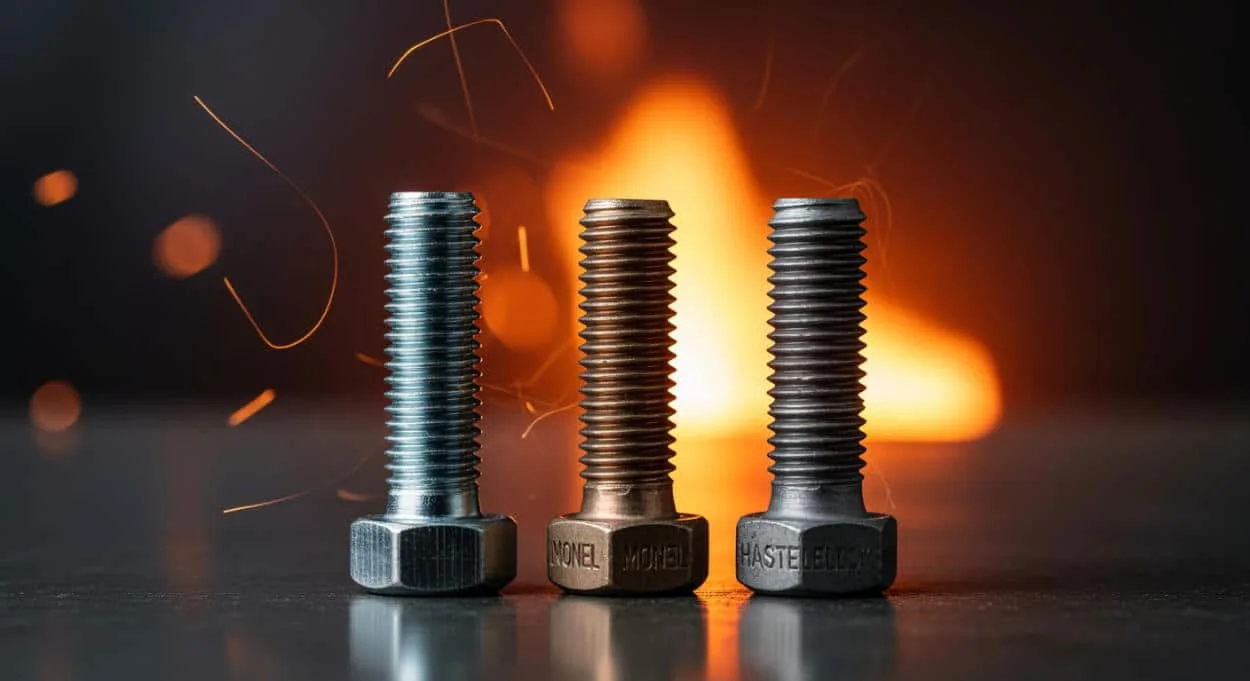
But for procurement managers, buying Nickel Alloys is complicated. The names are trademarked (Inconel®, Monel®, Hastelloy®). The prices are volatile. And the specifications—like API 20F—are rigorous.
At Cyclone Bolt, we specialize in the hard-to-find. We manufacture fasteners from these exotic materials right here in Houston. This guide will strip away the confusion and help you buy the right alloy for the right job.
What Makes Nickel So Special?
Why do we pay a premium for Nickel? It comes down to atomic structure. Nickel mixes incredibly well with other metals like chromium, molybdenum, and iron. It acts as a stabilizer.
When you create a Nickel Alloy, you get a material with three “superpowers”:
-
Heat Resistance: It stays strong when red-hot.
-
Corrosion Resistance: It ignores acids, seawater, and sour gas.
-
Thermal Expansion Stability: It doesn’t warp massively when heated.
The “Big Three” Families of Nickel Alloys
You will likely encounter three main trade names. While many companies make generic versions (often called by their UNS number), the industry still uses the classic names.
1. Inconel® (Nickel-Chromium)
This is the king of high heat.
-
Common Grades: Inconel 600, 625, 718.
-
The Application: Jet engine turbine blades, heat exchangers, and drilling tools.
-
Why use it: It creates a “passivating oxide layer” when heated. This means it forms a protective skin that stops further attack. Inconel 718 is the workhorse of the oil patch because it is precipitation-hardened for massive strength.
2. Monel® (Nickel-Copper)
This is the king of the sea.
-
Common Grades: Monel 400, K-500.
-
The Application: Marine propeller shafts, pump shafts, and offshore rig fasteners.
-
Why use it: It is almost immune to saltwater corrosion. It is stronger than pure nickel and resists bio-fouling (barnacles don’t like it).
3. Hastelloy® (Nickel-Molybdenum)
This is the king of acid.
-
Common Grades: Hastelloy C-276, C-22.
-
The Application: Chemical processing plants, scrubbers, and paper mills.
-
Why use it: If you are pumping hydrochloric or sulfuric acid, Hastelloy is one of the few metals that won’t dissolve.
Procurement Pitfall: The UNS Number Game
Here is a trap many buyers fall into. You ask for “Inconel 625.” The quote comes back listing “UNS N06625.”
Is it the same thing? Yes.
-
Inconel 625 is a trademark of Special Metals Corporation.
-
UNS N06625 is the Unified Numbering System code for the chemical composition.
As long as the Material Test Reports (MTRs) match the UNS chemical standard, the material is valid. Buying by UNS number often opens up more supply options and better pricing than restricting yourself to a specific brand name.
The Nickel Institute is a global association that provides free technical guides on the uses of nickel in society.
Critical Specifications: API 20F
If you are buying bolts for a subsea blowout preventer (BOP), you can’t just buy “Nickel Alloy.” You need proven integrity.
The American Petroleum Institute (API) created API Spec 20F specifically for corrosion-resistant bolting. This standard dictates:
-
Forging reduction ratios: How much the metal was worked.
-
Heat treatment: The exact temperatures used.
-
Microstructure analysis: Proving there are no hidden inclusions.
Cyclone Bolt is an API 20E and 20F certified manufacturer. We don’t just buy bolts and resell them. We manufacture them in Houston under a license that guarantees the metallurgy meets the strictest requirements in the energy sector.
The Cost Factor: Why is the Price So Volatile?
Nickel is a commodity traded on the London Metal Exchange (LME). Its price fluctuates based on global supply, mining strikes, and demand from the EV battery sector (which also uses nickel).
When you get a quote for Nickel Alloy fasteners, the validity period might be short—sometimes only 24 hours.
-
Tip: If you have a long-term project, ask about “locking in” metal pricing or buying the raw bar stock upfront. Cyclone Bolt can help you strategize to avoid market spikes.
Machining Challenges (Why You Need Experts)
You cannot machine Inconel like you machine standard steel. It “work hardens.” This means if you cut it too slowly, the metal gets harder while you are cutting it. It destroys tools. It generates massive heat.
If a machine shop doesn’t know what they are doing, they will overheat the bolt during production. This ruins the heat treatment and makes the bolt brittle. At Cyclone Bolt, our facility is set up specifically for these exotic alloys. We know the feed rates, the coolants, and the tooling required to cut Monel and Inconel without compromising the molecular integrity of the fastener.
Traceability is Everything
In heavy industry, if you can’t trace it, you can’t use it. Every Nickel Alloy fastener we ship comes with full documentation.
-
MTR (Material Test Report): Showing the chemistry from the mill.
-
Heat Treatment Charts: Proving the baking cycle.
-
Coating Certs: If you apply Xylan or PTFE.
Our ISO 9001:2015 Quality System Certificate and API Spec Q1 quality management systems ensure that the paperwork is as solid as the metal.
For current pricing trends and data on nickel, London Metal Exchange (LME) is the definitive source.
Buy with Confidence
Sourcing Nickel Alloys doesn’t have to be a gamble. Whether you need the acid resistance of Hastelloy or the subsea durability of Monel, the rules are the same:
-
Know the environment.
-
Know the UNS number.
-
Demand API compliance where necessary.
-
Trust a manufacturer who understands exotics.
Cyclone Bolt is your Houston-based partner for high-performance fasteners. We turn exotic bars into critical bolts that hold your world together.
Ready to quote your exotic alloy list? Contact Cyclone Bolt today for rapid response and technical expertise.