
Originally published 2026-02-03 · Cyclone Bolt
The aerospace and defense industries operate on a zero-margin-for-error basis. When an aircraft is cruising at thirty thousand feet or a satellite is orbiting the earth, every single component must perform exactly as intended. This level of reliability is not accidental. It is the result of thousands of pages of technical specifications designed to ensure that even the smallest screw can withstand extreme stress.
For procurement managers and engineers, navigating the world of MIL-SPEC (Military Specification) fasteners can feel like learning a new language. You aren’t just buying hardware; you are buying documented performance. Understanding the nuances of these standards is the difference between a successful project and a catastrophic failure. At Cyclone Bolt in Houston, Texas, we provide the high-integrity solutions that these critical missions demand.
What Exactly is a MIL-SPEC Fastener?
A fastener earns the “MIL-SPEC” label only when it meets the strict standards set by the U.S. Department of Defense (DOD). These standards cover everything from the raw material’s chemical makeup to the precise dimensions of the threads. While a commercial bolt might look identical to its military cousin, the internal reality is very different.
Commercial fasteners are built for general industrial use. They follow industry-wide standards but lack the rigorous testing and traceability of military-grade hardware. A MIL-SPEC fastener, however, must pass through an gauntlet of inspections. These include tensile strength tests, hardness evaluations, and dimensional verifications that ensure interoperability across various military and aerospace platforms.
The Power of Standardized Nomenclature
One of the first things you will notice in aerospace procurement is the prefix system. These abbreviations tell you exactly which governing body is responsible for the specification.
-
AN (Army-Navy): This is one of the oldest standards, dating back to World War II. While many AN parts have been superseded, they are still widely used in general aviation and for specialized aircraft repairs.
-
MS (Military Standard): These are the modern workhorses of the defense industry. MS fasteners cover a vast array of machine screws, bolts, and nuts used in everything from ground vehicles to fighter jets.
-
NAS (National Aerospace Standard): Managed by the Aerospace Industries Association (AIA), NAS parts represent the state-of-the-art in high-strength precision fasteners. If a joint requires extreme fatigue resistance or a unique head style, it likely falls under an NAS specification.
-
NASM (National Aerospace Standard, Metric): These are the metric equivalents of NAS standards. As aerospace becomes increasingly global, the transition to metric measurements has led to the conversion of many older military specs into NASM equivalents.
Why Aerospace Procurement Demands Precision
In the drone, UAV, and commercial aircraft manufacturing sectors, the environment is your biggest adversary. Fasteners in these applications face three primary threats: vibration, temperature fluctuations, and corrosion.
Fighting the Vibration War
Vibration is a silent killer of structural integrity. A drone’s high-RPM motors or an aircraft’s jet engine create constant harmonic frequencies. These frequencies can cause standard fasteners to “creep” or back off. MIL-SPEC fasteners often feature unique thread designs or locking mechanisms—like nylon inserts or safety wire holes—specifically engineered to stay secure under intense vibration.
Temperature and Thermal Cycling
Aerospace components must move from the heat of a desert runway to the sub-zero temperatures of high altitude in minutes. This rapid thermal cycling causes materials to expand and contract. If a fastener and the material it is securing don’t have compatible thermal properties, the joint can weaken. Military-grade alloys are tested to ensure they maintain their tensile strength and “grip” across these wide temperature ranges.
Corrosion Resistance in Extreme Environments
Whether it is salt spray on a naval carrier or humidity in a tropical hangar, corrosion is a constant threat. Aerospace fasteners utilize specialized platings and coatings to create a barrier against the elements. If you choose the wrong coating, you risk galvanic corrosion, where two different metals react and literally eat each other away.
The Role of Material Selection
The material is the soul of the fastener. In aerospace, “standard” steel rarely makes the cut. Procurement teams must be familiar with a range of specialty alloys that offer superior strength-to-weight ratios.
-
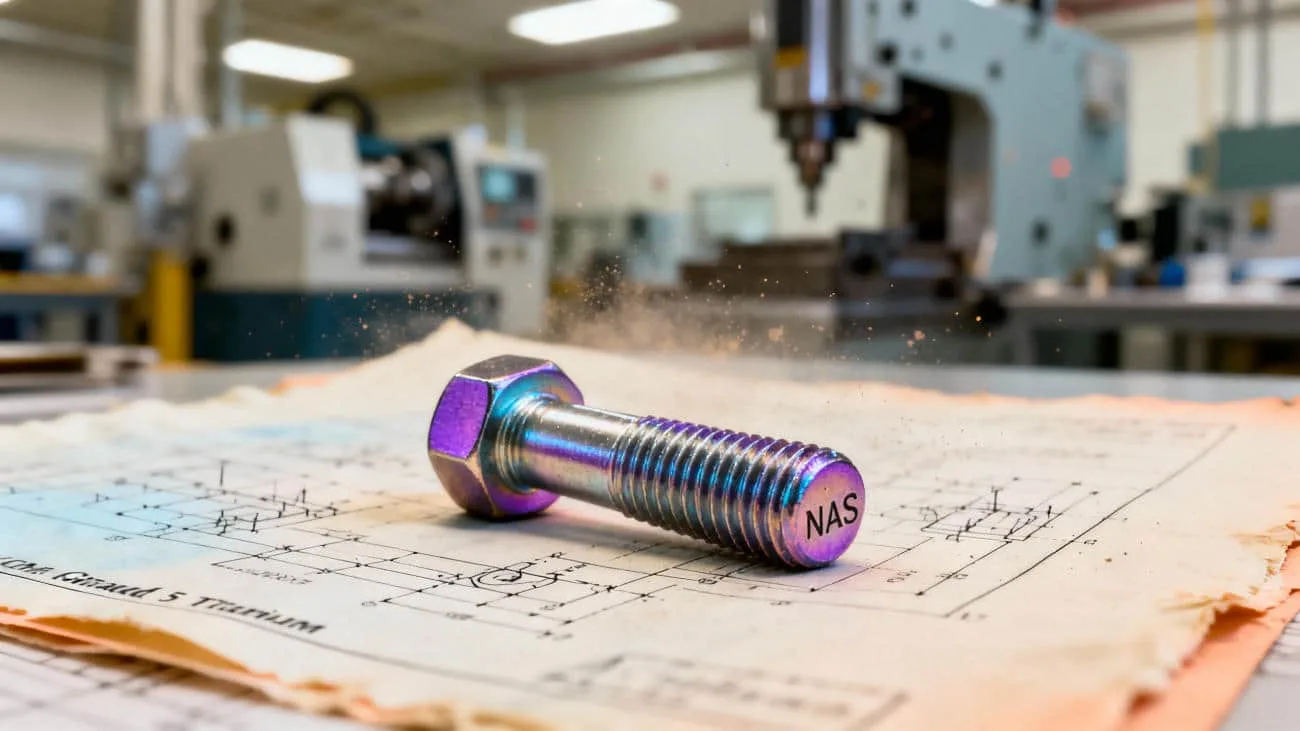
Titanium (Grade 5): Titanium is legendary in aerospace for a reason. It is roughly 45% lighter than steel but offers comparable strength. It is also naturally resistant to corrosion and high heat.
-
A286 Superalloy: This iron-base superalloy is a favorite for high-temperature applications up to 1,300°F. It is commonly found in engine components and exhaust systems.
-
Inconel 718: When the environment is both corrosive and incredibly hot, Inconel is the solution. It maintains its mechanical properties where other metals would simply fail.
-
Stainless Steel (300 and 400 Series): While 300-series (like 304 or 316) is excellent for corrosion resistance, 400-series stainless can be heat-treated for higher strength.
At Cyclone Bolt, our Material Grade Guides help engineers navigate these choices to find the perfect balance for their specific airframe or engine design.
Coatings and Plating: The Final Defense
Choosing the material is only half the battle. The finish applied to the fastener determines how it survives in the field and how it behaves during installation.
-
Cadmium Plating: Historically, cadmium has been the go-to for aerospace because of its excellent corrosion resistance and natural lubricity. It prevents “galling” during installation, which is a common problem with stainless steel.
-
Zinc Plating: A common alternative for less critical areas, though it lacks the lubricity of cadmium.
-
Passivation: This is a chemical treatment for stainless steel that removes surface iron and enhances the natural chromium-oxide layer. It is essential for preventing “tea staining” and surface rust.
-
Dry Film Lubricants: Often used on high-strength bolts to ensure consistent torque-tension relationships during assembly.
For more technical details on how these finishes impact your design, see our Coating & Plating Technical Guide.
Navigating the Procurement Journey: Documentation and Traceability
In aerospace, the paperwork is just as important as the part. If you cannot prove where a bolt came from or what it is made of, it cannot be used. This is why traceability is the cornerstone of military and aerospace procurement.
The Certificate of Conformance (CoC)
This is the manufacturer’s promise that the part meets every requirement of the specification. It lists the part number, the lot number, and the specific standards (like MS24693) that were followed.
Material Test Reports (MTR)
An MTR provides the actual chemical and physical breakdown of the raw material used. It proves that the steel or titanium meets the “melt” requirements. This is vital for ensuring that there are no “tramp” elements or impurities that could lead to premature failure.
The QSLM and QPL Lists
The government maintains the Qualified Suppliers List for Manufacturers (QSLM). This is a list of factories that have been audited and approved by the DOD to produce MIL-SPEC hardware. Sourcing from a QSLM-approved facility ensures that the quality management system is up to the highest standards.
Understanding DFARS Compliance
If you are working on a U.S. government defense contract, you will inevitably run into DFARS (Defense Federal Acquisition Regulation Supplement). Specifically, DFARS Clause 252.225-7014.
This regulation requires that “specialty metals” used in defense hardware must be melted or manufactured in the United States or a “qualifying country.” This is a matter of national security and supply chain resilience. Procurement managers must verify that their fasteners are DFARS compliant before they are integrated into a defense system. Failure to do so can result in rejected shipments and lost contracts.
Why Cyclone Bolt in Houston is Your Strategic Partner
Fastener procurement isn’t just about moving boxes; it’s about engineering expertise. Cyclone Bolt, located in Houston, Texas, operates at the intersection of aerospace precision and industrial strength. Our facility is built on the foundation of the most rigorous quality standards in the world.
API Spec Q1 and ISO 9001:2015
Our API Spec Q1 9th Edition and ISO 9001:2015 Quality System Certificate certifications mean that every process in our building is controlled, audited, and optimized. For aerospace buyers, this provides a level of quality assurance that “budget” suppliers simply cannot match. We understand the necessity of full traceability and lot control.
API 20E and 20F Expertise
While these standards are often associated with the oil and gas sector, they represent the highest level of bolting qualification. API 20E (for alloy steel) and API 20F (for corrosion-resistant bolting) ensure that the metallurgy and heat treatment of the fasteners are perfect. This level of technical scrutiny is exactly what is needed for the high-stress environments found in modern UAV and aircraft manufacturing.
The Cost of Non-Compliance
It is tempting for project managers to look for ways to cut costs by using commercial equivalents. However, the “savings” are often an illusion. The FAA (Federal Aviation Administration) frequently issues bulletins regarding non-conforming or “bogus” parts.
The true cost of non-compliance includes:
-
Catastrophic Failure: Mid-air structural failures that put lives at risk.
-
Project Delays: Having an entire lot of fasteners rejected by inspectors during final assembly.
-
Legal Liability: The massive financial and reputational damage that follows a failure involving non-certified hardware.
When failure is not an option, the certified choice is the only choice.
Building a Future-Proof Supply Chain
As we move through 2026, the demand for high-performance fasteners is only growing. The rise of private space exploration and advanced drone delivery systems requires hardware that can go further and last longer.
By choosing a partner who understands the deep technical requirements of MIL-SPEC, NAS, and AN hardware, you ensure that your brand remains at the forefront of innovation. Cyclone Bolt is proud to be that partner for Houston and the global aerospace community. We combine over a century of industry knowledge with state-of-the-art manufacturing to deliver safety, one bolt at a time.
Article Recap: MIL-SPEC Fastener Essentials
-
MIL-SPEC Definition: Hardware that meets specific DOD standards for dimensions, materials, and performance.
-
Nomenclature: AN (Army-Navy), MS (Military Standard), and NAS (National Aerospace Standard) are the primary prefixes for procurement.
-
Material Strength: Titanium, A286, and Inconel are vital for the weight-to-strength ratios required in flight.
-
Finishing: Coatings like Cadmium and Passivation are essential for preventing corrosion and galling.
-
Traceability: Full documentation, including CoCs and MTRs, is a non-negotiable requirement for aerospace parts.
-
DFARS Compliance: US government contracts require specialty metals to be sourced from approved countries.
-
Houston Expertise: Cyclone Bolt provides API and ISO-certified fasteners that meet the most demanding aerospace specs.
Don’t gamble with your procurement. Ensure your mission-critical projects are secured with the highest-spec fasteners on the market. Whether you need MIL-SPEC machine screws or custom API-certified bolting, Cyclone Bolt has the expertise and inventory to keep you moving. Visit Cyclone Bolt today to request a quote or browse our technical guides. Let’s reach new heights together!