
Originally published 2026-03-13 · Cyclone Bolt
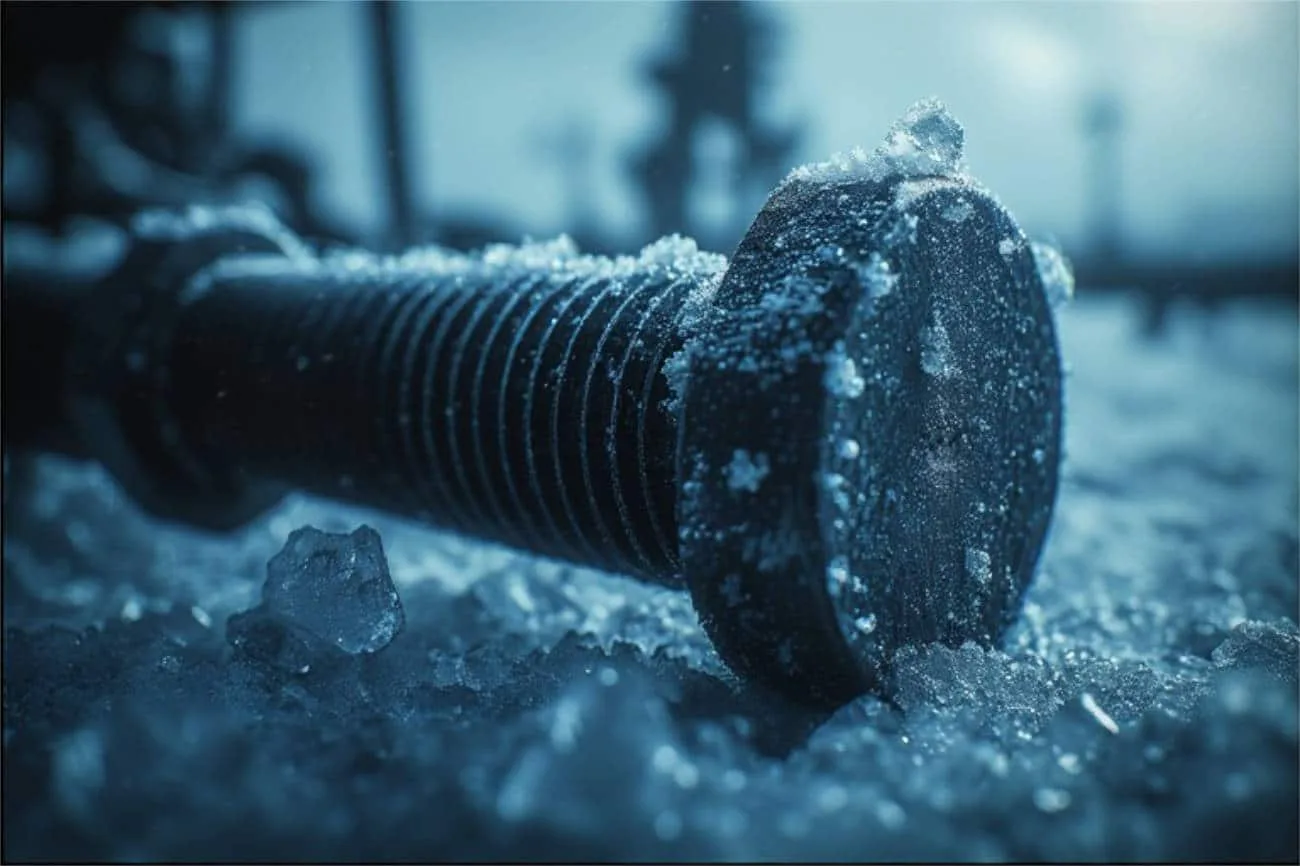
Temperature is one of the most critical factors in fastener performance. When the thermometer drops, the physical properties of steel undergo a significant transformation. For industries operating in cold climates or subsea environments, understanding this change is not just about maintenance—it is about preventing catastrophic structural failure.
At Cyclone Bolt in Houston, Texas, we specialize in high-strength bolting that meets the world’s most demanding standards. From API Spec Q1 9th Edition quality management to specialized API 20E and API 20F certifications, we ensure your fasteners survive the freeze.
The Science of Cold and Steel
Most high-strength bolts are made from carbon or alloy steels. These materials are prized for their tensile strength and durability at room temperature. However, as the temperature falls, the internal structure of the steel changes.
In cold weather, steel experiences a decrease in ductility. Ductility is the material’s ability to deform under stress without breaking. When ductility is lost, the material becomes “brittle.” A brittle bolt may appear perfectly fine under a static load, but it can snap like glass if subjected to a sudden shock or impact.
Understanding the Ductile-to-Brittle Transition
Every steel alloy has a specific point known as the Ductile-to-Brittle Transition Temperature (DBTT). Above this temperature, the steel is tough and can absorb energy. Below this temperature, the risk of “brittle fracture” increases exponentially.
Brittle fracture is dangerous because it happens without warning. There is no stretching or visible yielding before the bolt fails. In high-pressure oil and gas applications or heavy infrastructure, this type of failure can lead to leaks, collapses, or worse.
Impact Toughness: The Charpy V-Notch Test
To combat brittleness, engineers look at “impact toughness.” This is measured using the Charpy V-Notch (CVN) test. This test involves hitting a notched specimen of the material with a swinging pendulum to see how much energy it absorbs.
Standard bolts, like the common ASTM A193 B7, are designed for high-temperature and high-pressure service. While they are strong, they are not typically tested for low-temperature toughness. For cold-weather environments, a different grade is required.
-
ASTM A320 Grade L7: This is essentially the low-temperature equivalent of B7. It undergoes mandatory Charpy impact testing at -150°F (-101°C) to ensure it remains ductile in the cold.
-
API 20E Requirements: Our API 20E fasteners follow strict heat-treatment protocols to ensure a refined grain structure, which is essential for cold-weather resilience.
Why High-Strength Bolts are More Susceptible
There is a common misconception that “stronger is always better.” In cold weather, the opposite can be true. Very high-strength bolts (those with high hardness levels) are naturally more brittle than lower-strength fasteners.
When you combine high hardness with freezing temperatures, the risk of failure rises. This is why specifications like API 20F for corrosion-resistant bolting are so important. They balance strength with the material’s ability to withstand harsh environmental stressors without cracking.
The Role of Material Selection
Choosing the right material is the first line of defense against cold-weather brittleness. Our material grade guidesprovide a detailed look at which alloys are suited for specific environments.
For extreme cold, nickel-based alloys and specific stainless steels are often preferred. Nickel improves the low-temperature toughness of steel, allowing it to maintain ductility at temperatures that would shatter standard carbon steel.
Thermal Contraction and Preload
Cold weather doesn’t just change the material’s brittleness; it also causes physical shrinkage. This is known as thermal contraction.
When a bolt and the materials it fastens together contract at different rates, the “preload” or tension on the bolt can change. If a bolt shrinks significantly, it can increase the tension beyond its yield point, leading to failure. Conversely, if the joint material shrinks more than the bolt, the fastener may become loose, leading to vibration failure or leaks.
Coatings and Corrosion in the Cold
Winter weather often brings moisture, ice, and road salts. These elements accelerate corrosion. However, many standard coatings can become brittle and peel off in extreme cold.
At Cyclone Bolt, our coating and plating technical guide helps you choose finishes that stay flexible and protective even when the temperature drops. Options like PTFE (Teflon) or specific zinc platings are often used to provide a barrier against the elements without sacrificing performance.
The Importance of Quality Certification
In Houston’s energy corridor, we know that a single bolt failure can shut down an entire operation. That is why we adhere to ISO 9001:2015 Quality System Certificate and API Spec Q1 standards.
These certifications mean that every step of our manufacturing process is documented and tested. When you order a low-temperature bolt from us, you get the peace of mind that it has been heat-treated, machined, and tested to perform exactly as specified.
Best Practices for Cold-Weather Bolting
If your project involves exposure to freezing temperatures, follow these industry best practices:
-
Verify the Design Temperature: Ensure you know the minimum possible temperature the fasteners will face.
-
Specify Impact Testing: Don’t just ask for high strength; ask for Charpy V-Notch results at your service temperature.
-
Consult the Experts: Use resources like the American Society of Mechanical Engineers (ASME) or the American Petroleum Institute (API) to verify that your material choice meets safety codes.
-
Check Your Coatings: Ensure your plating can handle the thermal expansion and contraction cycles of your environment.
Cyclone Bolt: Your Houston Partner for Critical Fasteners
Based in the heart of the global energy industry, Cyclone Bolt provides high-performance solutions for the toughest environments on Earth. Whether you are dealing with the sub-zero temperatures of the North Sea or the specialized needs of cryogenic storage, our team has the expertise to help.
We combine decades of experience with state-of-the-art manufacturing to deliver bolts that don’t just meet standards—they set them.
Article Recap
-
Cold temperatures reduce the ductility of steel, making high-strength bolts brittle.
-
Brittle fracture is a catastrophic failure that occurs without visible warning.
-
The Charpy V-Notch test is the industry standard for measuring a bolt’s impact toughness in the cold.
-
Higher-strength materials are often more susceptible to brittleness than lower-grade alloys.
-
Proper material selection (like ASTM A320 L7) and heat treatment are vital for cold-weather safety.
-
Thermal contraction in the cold can alter bolt preload, leading to joint failure.
-
API 20E and 20F certifications ensure fasteners are qualified for these extreme conditions.
Don’t let the cold compromise your project’s integrity. Contact the experts at Cyclone Bolt today to discuss your low-temperature bolting needs. We provide the precision and quality Houston trusts.