
Originally published 2026-01-29 · Cyclone Bolt
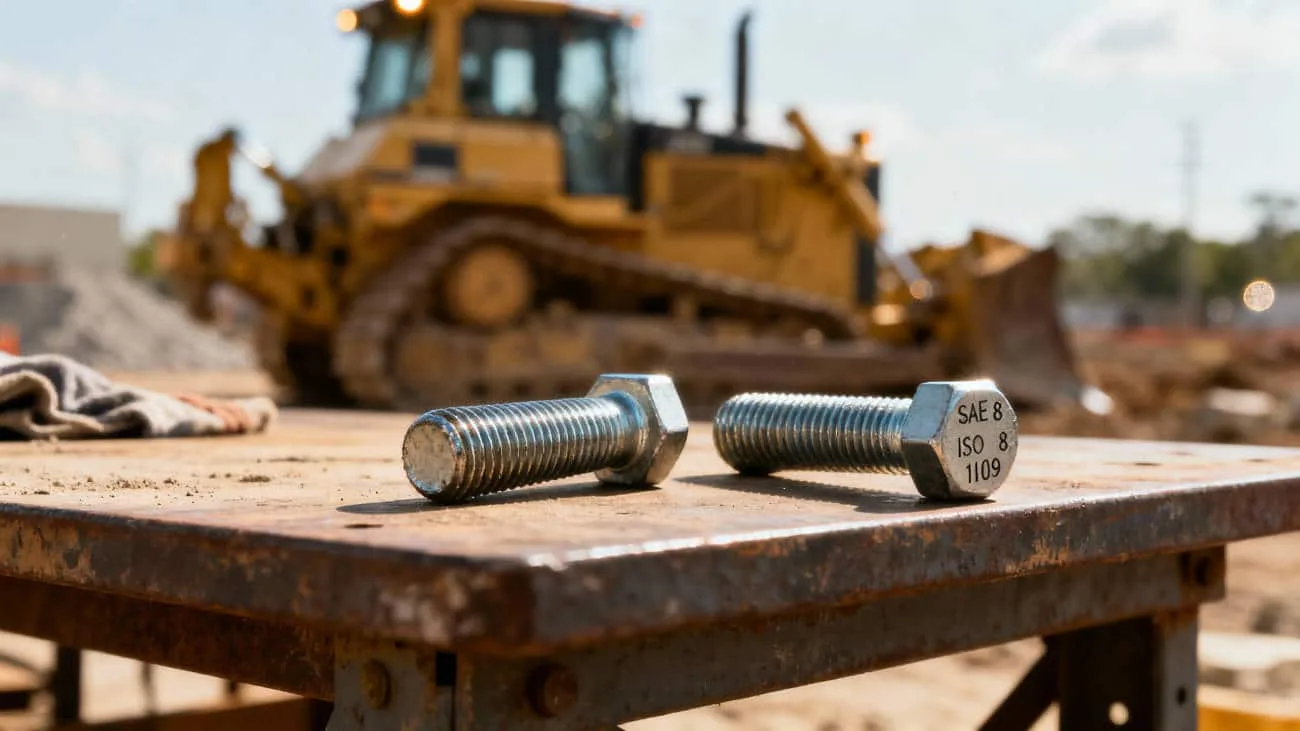
When you are staring at a multi-million dollar piece of earthmoving equipment, the last thing you want to worry about is a bolt. Yet, in the world of heavy machinery, those small threaded fasteners are the only things standing between operational success and a catastrophic mechanical failure. Excavators, bulldozers, and graders operate in environments that define the word “extreme.” They face massive dynamic loads, constant vibration, and abrasive debris.
For maintenance managers and engineers in the field, the choice often comes down to two heavy hitters: SAE Grade 8 and Metric Grade 10.9. While they are often treated as interchangeable, understanding the nuances of these specifications is vital for equipment longevity. Cyclone Bolt, based in Houston, Texas, understands that in heavy industry, “close enough” is never good enough. Whether you are following API Spec Q1 9th Edition standards or looking for ISO 9001:2015 Quality System Certificate certified quality, the fastener you choose determines the safety of your entire site.
Decoding the Grading Systems
The first hurdle in choosing the right bolt is understanding the language of the standards. Grade 8 belongs to the SAE J429 standard, which is the primary system used for imperial (inch-based) fasteners in North America. Grade 10.9, on the other hand, belongs to the ISO 898-1 metric property class system.
The two systems use different markings to communicate strength. A Grade 8 bolt is easily identified by six radial lines stamped onto its head. A Metric 10.9 bolt is simpler to spot because the numbers “10.9” are typically embossed directly on the head. While their markings differ, their performance profiles are remarkably similar. Both are considered high-strength fasteners designed for safety-critical applications.
Technical Specifications of SAE Grade 8
SAE Grade 8 bolts are manufactured from medium-carbon alloy steel. They undergo a rigorous heat-treatment process that includes quenching and tempering. This process is what gives the steel its characteristic hardness and tensile strength.
In terms of raw numbers, a Grade 8 bolt offers a minimum tensile strength of 150,000 psi. Its proof load—the amount of stress it can handle without permanent deformation—is 120,000 psi. These bolts are built to be tough but not so brittle that they snap under sudden shock loads. This balance of strength and ductility is why they are the standard for heavy machinery frames and suspension components. You can find more details on these requirements in our material grade guides.
Technical Specifications of Metric Grade 10.9
Metric Class 10.9 bolts are essentially the international equivalent of the Grade 8. They are also made from alloy steel and are quenched and tempered. The “10.9” name itself is a code for its strength. The “10” indicates a nominal tensile strength of 1,000 MPa (actually 1,040 MPa), which translates to approximately 150,800 psi. The “.9” indicates that the yield strength is 90% of the tensile strength.
This means a 10.9 bolt is slightly stronger than a standard SAE Grade 8 by a tiny margin, but for all practical engineering purposes, they occupy the same performance tier. The primary reason a fleet manager would choose one over the other is usually dictated by the origin of the machinery. European or Asian-made equipment like Komatsu or Volvo will almost exclusively use 10.9, while older or US-specific Caterpillar or John Deere units may still utilize Grade 8.
Why Heavy Machinery Demands High Strength
Earthmoving machinery isn’t just heavy; it is violent. A bulldozer pushing a massive load of rock creates immense shear forces on every chassis bolt. An excavator bucket digging into frozen ground sends vibrations through the entire boom. Standard Grade 2 or Grade 5 bolts would shear or stretch almost instantly under these conditions.
High-strength bolts are required because they provide the necessary “clamping force.” When you torque a bolt, you are essentially turning it into a very stiff spring. This tension creates friction between the connected parts. In heavy machinery, it is often this friction, rather than the physical body of the bolt, that prevents the parts from sliding. If a bolt isn’t strong enough to maintain that tension, the joint will “slip,” leading to hole elongation and eventual failure.
The Role of Yield Strength and Ductility
In the dirt and mud of a construction site, fasteners face unpredictable “overload” events. Maybe an operator hits a buried boulder or drops a heavy load too quickly. This is where yield strength matters. Yield strength is the point at which a bolt will stretch and not return to its original shape.
While we want high yield strength, we also need ductility. A bolt that is too hard becomes brittle. Brittle bolts fail without warning, snapping like glass under impact. Both Grade 8 and 10.9 are designed to offer a “safety zone.” They are hard enough to handle the work but have enough internal “give” to survive a sudden shock without a catastrophic break.
Environmental Challenges: Corrosion and Wear
Fasteners on earthmoving equipment are rarely clean. They are pelted with rocks, submerged in mud, and exposed to rain and salt. Corrosion doesn’t just look bad; it creates “pitting” on the surface of the bolt. These pits act as stress concentrators where cracks can begin to form.
Cyclone Bolt offers specialized solutions to combat these issues. Our coating and plating technical guide highlights the options available for heavy-duty hardware. For Grade 8 and 10.9 bolts, zinc plating is common, but many heavy equipment applications prefer yellow zinc dichromate for better salt spray resistance.
In particularly aggressive environments, some managers opt for specialized coatings like Xylan or Geomet. These provide a much higher level of protection against chemicals and moisture while maintaining consistent torque-tension relationships during installation.
Hydrogen Embrittlement Risks
A critical note for any manager choosing high-strength bolts is the risk of hydrogen embrittlement. This occurs when hydrogen atoms are trapped in the steel during the plating or pickling process. For bolts as hard as Grade 8 or 10.9, this can lead to sudden, spontaneous failure under load.
This is why Cyclone Bolt emphasizes strict adherence to API 20E and API 20F standards. These specifications include rigorous baking requirements after plating to drive out hydrogen. When you are buying bolts for a machine that costs as much as a house, you want the peace of mind that comes from certified, low-risk manufacturing.
Installation: The Often-Overlooked Step
You can buy the best Grade 10.9 bolt in the world, but if your technician tightens it with a “calibrated elbow” instead of a torque wrench, it is likely to fail. Proper installation is just as important as the material grade.
Most heavy machinery manuals provide specific torque values. These values change depending on whether the bolt is “dry” or “lubricated.” A bolt that is lubricated requires significantly less torque to reach the same clamping force. If a technician applies dry-torque values to a lubricated bolt, they can easily over-stretch the fastener, essentially ruining it before the machine even leaves the shop.
The Importance of Washers and Nuts
A high-strength bolt is only half of a fastening system. You must use matching hardware. A Grade 8 bolt must be paired with a Grade 8 nut. If you use a lower-grade nut, the threads will likely “strip” or shear under the high loads required by the application.
Similarly, hardened washers are mandatory. Soft washers will “compress” under the head of a high-strength bolt, causing a loss of preload over time. For heavy earthmoving machinery, using a complete, high-strength system is the only way to ensure the joint remains secure throughout the maintenance cycle.
Sourcing and Traceability
In the 2026 industrial landscape, traceability is a non-negotiable requirement. If a bolt fails on a job site, you need to know where it came from and what it was made of. “Mystery bolts” from unverified sources are a massive liability.
Cyclone Bolt provides full traceability for our products. By maintaining API Spec Q1 9th Edition and ISO 9001:2015 Quality System Certificatecertifications, we ensure that every lot of Grade 8 or 10.9 fasteners we sell is backed by a Mill Test Report (MTR). This document verifies the chemical composition, hardness, and tensile strength of the specific batch of steel used.
For maintenance managers in the oilfield, mining, or construction industries, this level of documentation is essential for safety audits and insurance compliance. You can learn more about these standards through high-authority resources like the American Society of Mechanical Engineers (ASME) or the International Organization for Standardization (ISO).
Making the Final Decision
So, which one should you choose? In the Grade 8 vs. Grade 10.9 debate, the answer is almost always determined by the equipment’s original design. If your machine uses imperial threads, stick with Grade 8. If it uses metric, go with 10.9.
Never try to force a metric bolt into an imperial hole, or vice versa, even if the sizes seem close. Cross-threading or improper thread engagement will lead to a joint that feels tight but lacks any real clamping power.
If you are upgrading a component or designing a new attachment, Grade 8/10.9 is usually the baseline for heavy-duty work. If the application is even more extreme—such as specialized mining equipment—you might even step up to Class 12.9 or specialized API-rated bolting.
Article Recap: Key Points
-
Standard Differences: Grade 8 is the US SAE imperial standard; Grade 10.9 is the international metric ISO standard.
-
Performance Parity: Both grades offer approximately 150,000 psi tensile strength and are designed for high-stress applications.
-
Clamping Force: These bolts work by creating massive friction between parts, preventing joint slip under dynamic loads.
-
Material Integrity: Both are made from quenched and tempered alloy steel to balance hardness with ductility.
-
Environmental Protection: Proper coatings (like yellow zinc or PTFE) are essential for machinery operating in mud and salt.
-
Traceability Matters: Always source bolts with MTRs and certifications (API/ISO) to ensure safety and liability protection.
-
System Approach: Always pair high-strength bolts with matching hardened nuts and washers to prevent system failure.
Keep your fleet moving with the strongest fasteners in the industry. Contact Cyclone Bolt today to source certified Grade 8 and Grade 10.9 bolting solutions tailored for your heavy machinery needs!