
Originally published 2026-02-06 · Cyclone Bolt
Mastering Gasket Compression in High-Pressure Flange Joints
High-pressure flange joints are the backbone of the oil and gas industry. These joints exist in refineries, offshore platforms, and midstream pipelines. Their primary job is simple but critical: contain pressure and prevent leaks. When a flange joint fails, the results are often catastrophic. You face environmental damage, massive financial losses, and safety risks.
The secret to a successful seal is not just the gasket. It is the interaction between the flange, the gasket, and the fasteners. This combination is often called the “flange trinity.” Specifically, the mechanics of gasket compression determine the life of the joint. At Cyclone Bolt in Houston, we see how proper bolting impacts this mechanical balance every day.
The Physics of the Flange Joint
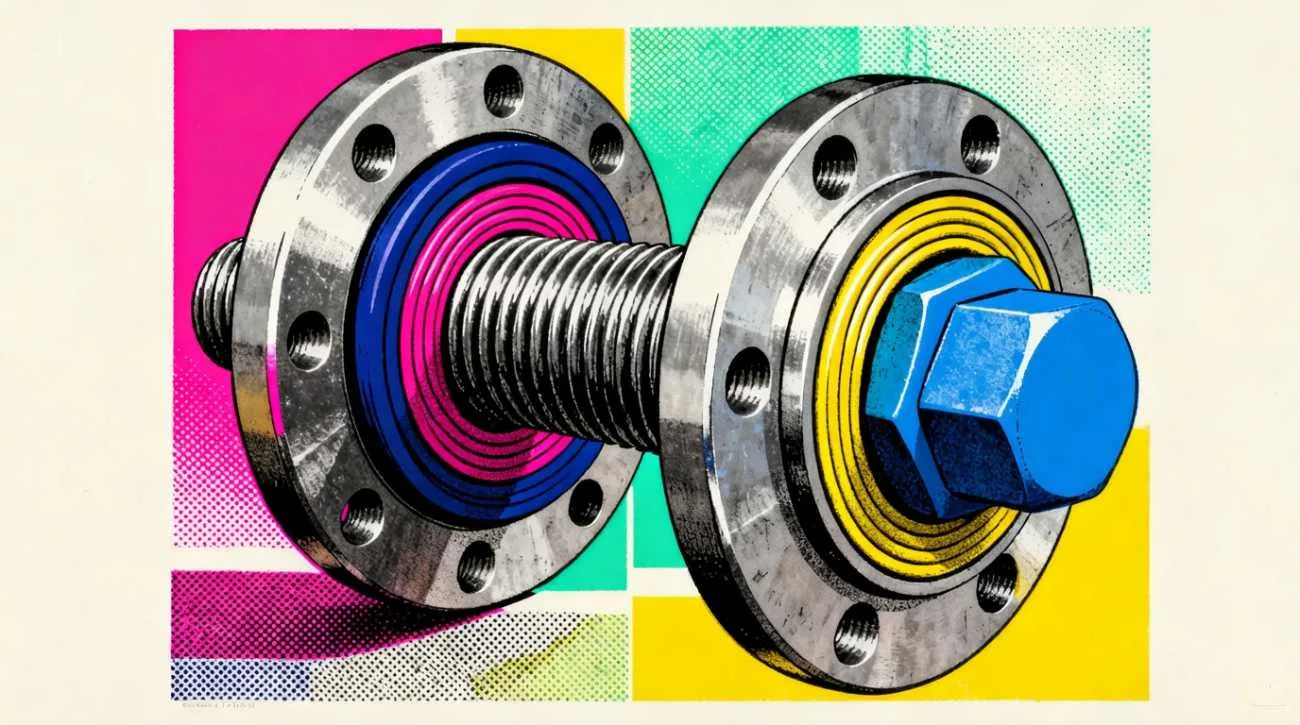
To understand compression, you must view the flange joint as a mechanical system. A joint is essentially a giant spring. The bolts are the springs. When you tighten a bolt, it stretches. This stretch creates a clamping force.
That clamping force is what compresses the gasket. The gasket must be “crushed” into the micro-imperfections of the flange faces. This creates a seal that prevents gas or liquid from escaping. However, this is not a static process. It is a dynamic battle against internal pressure.
The Force Balance
Internal pressure tries to push the flanges apart. This is called “hydrostatic end force.” For the joint to remain sealed, the clamping force of the bolts must exceed the hydrostatic end force plus the force required to keep the gasket seated.
-
Clamping Force: Provided by the bolts.
-
Hydrostatic End Force: Provided by the internal pressure.
-
Gasket Sealing Stress: The minimum pressure needed on the gasket to stop leaks.
If your bolts lose tension, the internal pressure wins. The flanges separate slightly, and the gasket “blows out.”
The Mechanics of Gasket Compression
Gasket compression is not about squeezing a material until it is flat. It is about controlled deformation. Most gaskets are designed to flow into the flange grooves.
Seating Stress vs. Operating Stress
There are two stages of gasket compression.
-
Seating Stress: This is the initial force applied during installation. It must be high enough to deform the gasket material.
-
Operating Stress: This is the force remaining on the gasket after the system is pressurized.
Internal pressure unloads the gasket. As pressure goes up, the force on the gasket goes down. If the operating stress drops below a certain threshold, a leak occurs. This is why fasteners must be manufactured to precise standards like API 20E and API 20F. These standards ensure the bolts can maintain tension over long periods.
The Role of Elasticity
Fasteners must be elastic. Think of a bolt as a very stiff rubber band. If a bolt is too brittle, it will snap rather than stretch. If it is too soft, it will stretch permanently (yield) and lose its ability to pull the flanges back together. This is why material grade guides are so important. Selecting a B7, L7, or B8M stud depends entirely on the temperature and pressure of your specific application.
Factors That Kill Gasket Compression
Several variables can ruin your seal. Understanding these helps you prevent premature failure.
1. Bolt Relaxation and Creep
Bolts can relax over time. This is common in high-temperature environments. The metal molecules actually shift, and the “spring” loses its tension. High-quality fasteners tested under ISO 9001:2015 Quality System Certificate protocols are designed to minimize this effect.
2. Thermal Expansion
In a refinery, temperatures fluctuate. The bolts, flanges, and gaskets all expand at different rates. If the bolts expand faster than the flanges, the clamping force drops. If the flanges expand faster, they might crush the gasket beyond its recovery point.
3. Friction (The Silent Enemy)
Most people use torque to measure how tight a bolt is. However, torque is a lie. Up to 90% of the torque you apply is used just to overcome friction between the nut, the bolt threads, and the flange face. Only 10% actually stretches the bolt.
This is why coatings are vital. A coating and plating technical guide will show you how PTFE or Xylan coatings reduce friction. Lower friction means more of your torque is converted into actual gasket compression.
Why Fastener Quality Rules the Seal
You cannot have reliable gasket compression with sub-par fasteners. In Houston, the heart of the energy corridor, we follow API Spec Q1 9th Edition standards. This ensures every stud and nut is traceable and tested.
API 20E vs. API 20F
-
API 20E: Covers carbon and alloy steel bolting. This is the standard for most high-pressure oil and gas applications. It requires rigorous testing for hardness and microstructure.
-
API 20F: Covers corrosion-resistant alloys. If your flange joint is submerged in saltwater or handles sour gas, you need 20F bolting.
These specifications prevent “Hydrogen Embrittlement” and “Stress Corrosion Cracking.” If a bolt suffers from these issues, gasket compression will fail, often without warning.
Proper Tightening Procedures
How you tighten the bolts is as important as the bolts themselves. Uneven tightening creates a “cocked” flange. One side of the gasket is crushed too much, while the other side is too loose.
The Star Pattern
Always use a cross-bolt or “star” pattern. This ensures the flange moves toward the gasket evenly.
-
Hand tighten all nuts.
-
Tighten to 30% of target torque.
-
Tighten to 60% of target torque.
-
Tighten to 100% of target torque.
-
Perform a final circular pass to ensure uniformity.
Verification
In critical high-pressure joints, torque is not enough. Engineers often use ultrasonic bolt tension monitoring. This measures the actual stretch of the bolt. It is the only way to be 100% sure the gasket is compressed correctly.
Gasket Recovery: The Forgotten Metric
A gasket must be able to “spring back.” When pressure surges or temperatures change, the joint moves. A good gasket has high recovery. It follows the flange faces as they move.
If a gasket has “zero recovery,” it stays flat after the first compression. The moment the flanges move, a gap forms. High-pressure joints usually require semi-metallic gaskets, such as spiral-wound or Ring Type Joints (RTJ). These rely on the incredible strength of API-standard bolting to maintain their shape.
The Houston Advantage
Cyclone Bolt is located in Houston, Texas. Why does this matter? Houston is the global hub for subsea and pressure-containment engineering. Our proximity to major operators allows us to stay at the leading edge of fastener technology. We understand the specific soil and saltwater conditions of the Gulf Coast. We know the heat of the Permian Basin.
When you buy fasteners from a Houston-based manufacturer, you are buying expertise. You are getting products designed for the harshest environments on earth. For technical insights into these standards, you can visit the American Petroleum Institute (API) or the American Society of Mechanical Engineers (ASME). Both provide the foundational science used in modern flange design.
Environmental and Safety Impact
A leaking flange is more than an eyesore. It is a violation of environmental regulations. Fugitive emissions are a major focus for global regulators. Proper gasket compression is the first line of defense against these emissions.
By using fasteners that meet API 20E and ISO 9001:2015 Quality System Certificate standards, you reduce the risk of a “leak-to-atmosphere” event. This keeps your facility compliant and your workers safe.
Engineering for the Long Term
Don’t treat bolting as an afterthought. It is a primary engineering component. When you design a high-pressure system, calculate your gasket stress. Select your fasteners based on the environment. And always, always use a reputable supplier who understands the mechanics of the joint.
The science of gasket compression is about control. You are controlling force, friction, and material deformation. When these elements are in harmony, the joint stays silent and secure.
Key Takeaways for Gasket Compression
-
Spring Effect: Bolts act as springs; their stretch creates the clamping force required for a seal.
-
Seating Stress: Initial compression must be high enough to force the gasket into flange imperfections.
-
Torque vs. Tension: Friction consumes most torque; use coatings to ensure more energy goes into bolt stretch.
-
API Standards: Use API 20E for carbon/alloy and API 20F for corrosion-resistant needs to prevent brittle failure.
-
Tightening Pattern: Always use a star pattern to avoid uneven compression and flange rotation.
-
Traceability: ISO 9001 and API Q1 certifications ensure your fasteners won’t fail due to material defects.
Ensure your high-pressure joints are secured with the best in the industry. Cyclone Bolt provides fully traceable, API-certified fasteners tailored for the oil and gas sector. Whether you need specialized coatings or heavy hex studs in B7 or L7 grades, we have the Houston-based expertise to deliver. Contact Cyclone Bolt today for a technical consultation or a quote on your next project.