
Originally published 2025-11-21 · Cyclone Bolt
When Standard Alloy Bolts Won’t Cut It
In the world of oil and gas, petrochemicals, and chemical processing, a valve is often the only barrier between personnel and highly aggressive, corrosive media. Acids, caustics, high-chloride solutions, and extreme temperatures can chew through standard steel bolts in a matter of hours, not years. When a fastener fails in a critical valve or flange assembly, the consequences range from massive process downtime to severe safety and environmental incidents.
Choosing the correct fastener material is arguably the most critical decision in securing a corrosive media valve.
It’s a balance of three factors:
-
Corrosion Resistance: The primary defense against the operating environment.
-
Mechanical Strength: The ability to handle the required bolt-up torque and service pressure.
-
Cost: Balancing the material’s price against the total cost of potential failure.
At Cyclone Bolt in Houston, Texas, we specialize in engineering and manufacturing high-performance fasteners for these exact high-stakes applications. We adhere to stringent standards like API 20E and API 20F, ensuring every bolt we supply is matched precisely to the harsh environment it will face.
This guide breaks down the essential choices—from the workhorse Stainless Steel grades to the high-performance exotic alloys—to help engineers and procurement teams specify the right bolting for long-term valve reliability in corrosive service.
Understanding the Corrosive Challenge
Before selecting any material, you must fully understand the corrosion mechanism at play. Corrosion isn’t a single threat; it’s a family of destructive processes.
Common Corrosion Types in Valves and Flanges
-
Pitting Corrosion: Localized attack that forms small holes. This is particularly dangerous for fasteners as it can be hard to spot until the bolt fails catastrophically. Highly prevalent in chloride environments.
-
Crevice Corrosion: Occurs in tight gaps, like the space between the nut and the flange face. Chloride ions concentrate here, accelerating failure.
-
Stress Corrosion Cracking (SCC): A deadly combination of tensile stress and a specific corrosive environment (often chlorides). It causes brittle failure below the material’s yield strength.
-
High-Temperature Oxidation: Common in elevated temperature service where the material reacts with oxygen, forming scale and losing structural integrity.
The selection process is about finding a material that resists the most aggressive of these threats while maintaining its strength.
Tier 1: The Stainless Steel Workhorses
Stainless steel fasteners are the most common solution for mild to moderately corrosive service. They offer excellent general corrosion resistance due to the formation of a stable, passive chromium oxide layer on the surface.
A. ASTM A193 Grade B8 (304 Stainless Steel)
-
Composition: Primarily Iron, 18% Chromium, and 8% Nickel (the 18-8 standard).
-
Corrosion Use: Excellent resistance to basic water, mild chemicals, and atmospheric corrosion.
-
Limitations: Highly susceptible to Stress Corrosion Cracking (SCC) in environments with chlorides, especially above 140°F (60°C). It is generally avoided for high-chloride or strong acid service.
B. ASTM A193 Grade B8M (316 Stainless Steel)
-
Composition: Primarily Iron, 16% Chromium, 10% Nickel, and crucially, 2% to 3% Molybdenum (Mo).
-
Corrosion Use: The addition of Molybdenum is a game-changer. It significantly enhances resistance to pittingand crevice corrosion in chloride environments. It is the go-to fastener material for marine, coastal, and mild chemical processing applications.
-
Strength: While slightly stronger than B8, its main benefit is improved corrosion resistance.
The choice between B8 and B8M often hinges on the presence of chlorides. For a chemical processing plant, B8M is almost always the minimum starting point due to its superior localized corrosion resistance.
Tier 2: Specialized and High-Performance Alloys
When the service environment involves high concentrations of acids (like sulfuric, hydrochloric, or hydrofluoric), high chlorides, elevated temperatures, or a combination of all three, stainless steel will fail rapidly. This is the domain of exotic, nickel-based alloys.
These alloys maintain their structural integrity and passive corrosion layer even under extreme duress.
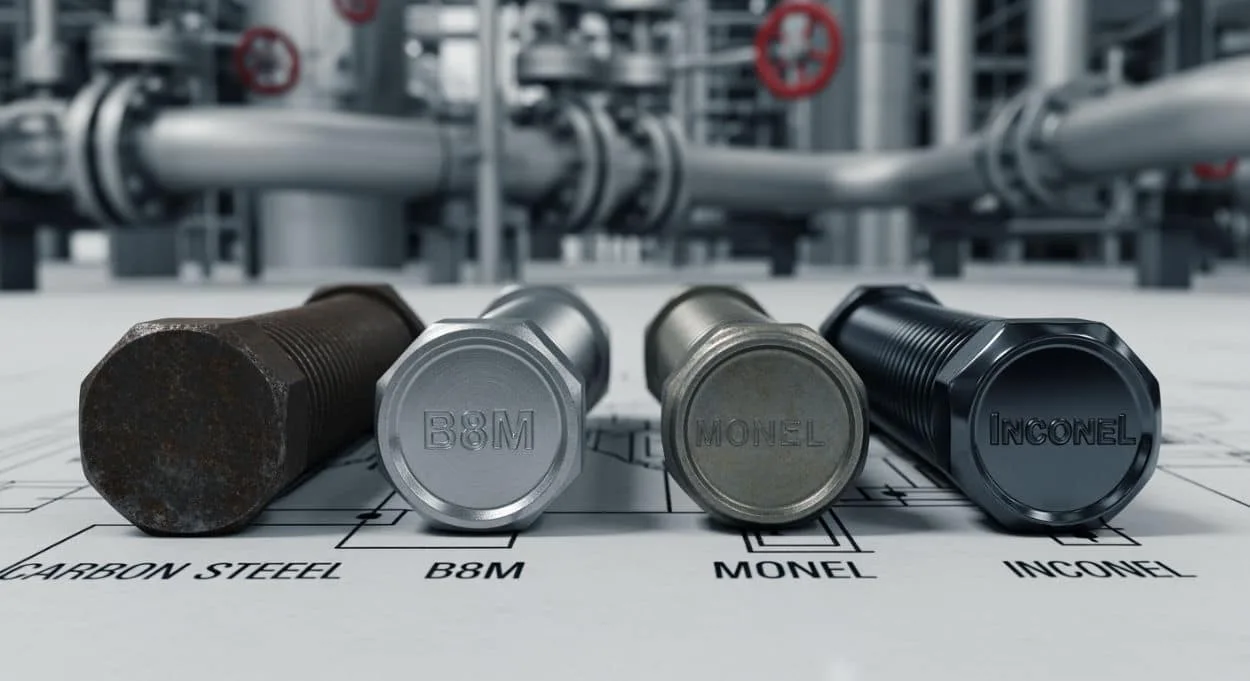
A. Nickel-Copper Alloys (Monel)
-
Common Grade: Monel 400 (ASTM B164).
-
Composition: Approximately 63% Nickel and 28% Copper.
-
Corrosion Use: Exceptional resistance to rapidly flowing seawater, hydrofluoric acid, and sulfuric acid. It maintains good strength up to 1000°F (538°C).
-
Typical Applications: Offshore marine services, specialized acid alkylation units.
B. Nickel-Chromium-Molybdenum Alloys (Hastelloy & Inconel)
These are the heavy hitters for the harshest chemical environments. The combination of high Nickel, Chromium, and Molybdenum provides defense against nearly every form of chemical attack.
1. Hastelloy (C-276, C-22, B-3)
-
Focus: C-276 is the most common chemical plant alloy. It boasts high Nickel and Molybdenum content.
-
Corrosion Use: Unrivaled resistance to a vast range of corrosive media, including highly oxidizing and reducing acids. It is often used in flue gas desulfurization (FGD) systems and chemical reactors.
-
Key Advantage: Excellent resistance to localized corrosion and stress corrosion cracking (SCC) in virtually all process environments.
2. Inconel (600, 625, 718)
-
Focus: Inconel 625 (ASTM B446) is frequently used for bolting. It is high in Nickel and Chromium.
-
Corrosion Use: Known for its phenomenal strength and resistance to high temperatures and oxidation. It resists chlorides, pitting, and crevice corrosion well.
-
Typical Applications: High-temperature furnace components, jet engine parts, and specialized bolting in extremely high-temperature chemical processing. Inconel 718 is often selected for its superior high-temperature tensile strength.
C. Duplex and Super Duplex Stainless Steels (F51, F55)
-
Focus: Alloys like UNS S31803 (Duplex) and UNS S32760 (Super Duplex).
-
Composition: Balanced Ferritic and Austenitic microstructure, offering the best of both worlds.
-
Corrosion Use: Delivers mechanical strength roughly double that of 316 Stainless, coupled with excellent resistance to SCC, pitting, and general corrosion in chloride environments.
-
Typical Applications: Highly prevalent in offshore oil platforms and pipelines where high strength and chloride resistance are mandatory.
Specification Best Practices: Choosing the Right Bolt
Choosing the right bolt requires a systematic approach that balances the technical demands with compliance and cost-effectiveness.
1. Analyze the Media and Temperature
Engineers must identify the three most critical parameters:
-
Corrosive Agents: Is it a chloride solution? Is it a sulfuric acid bath? Is it wet hydrogen sulfide (H₂S, which requires NACE MR0175/ISO 15156 compliance)?
-
Concentration: A dilute acid may tolerate 316SS, but a highly concentrated acid may mandate Hastelloy.
-
Temperature: Corrosion rates increase exponentially with temperature. If the service is above 150°F (65°C) and contains chlorides, 316SS (B8M) becomes a risky choice for SCC.
2. Consult Industry Standards
For critical applications, compliance is not negotiable. Cyclone Bolt works diligently to meet or exceed these regulatory frameworks:
-
API 20F: The specification for Corrosion-Resistant Bolting for use in the petroleum and natural gas industries. This governs the manufacturing, testing, and quality of exotic alloy fasteners.
-
NACE/ISO 15156: Critical for sour service (H₂S environments). This strictly limits the hardness and material choices (often favoring Duplex or specific Inconel grades) to prevent hydrogen embrittlement.
3. Prioritize Lifecycle Cost
Exotic alloy fasteners—Hastelloy, Monel, Inconel—are significantly more expensive than Stainless Steel. However, they provide an unmatched lifecycle value.
-
Initial Cost vs. Replacement Cost: The cost of replacing a failed bolt, including labor, specialized equipment, and plant downtime, quickly dwarfs the initial cost of a premium alloy.
-
Safety Factor: Investing in a material that offers a 20% safety margin in corrosion resistance is cheap insurance against a catastrophic failure.
Cyclone Bolt’s Quality Commitment
Manufacturing fasteners from exotic alloys is far more challenging than working with standard carbon steel. These materials are tougher to machine, require specialized heat treatment, and demand precise quality control.
At Cyclone Bolt, our ISO 9001:2015 certified Quality Management System ensures this complexity is handled with control and precision.
-
Material Traceability: We provide complete, unbroken traceability on all exotic materials. Every fastener is traceable back to the mill’s heat number and the original Material Test Reports (MTRs). This is a crucial requirement under API Spec Q1.
-
Specialized Machining: Our team is trained and equipped to handle the unique mechanical properties of nickel alloys, ensuring thread integrity and dimensional accuracy.
-
Testing and Verification: We perform in-house non-destructive testing (NDT) and mechanical property checks to verify that the final product meets the stringent specifications of API 20F and the customer’s purchase order.
When you specify a corrosion-resistant fastener from our Houston, Texas facility, you are not just getting a bolt—you are getting a fully certified component backed by a world-class QMS. Contact Cyclone Bolt Today!
10 People Also Ask (PAA) Questions and Answers
1. What is the most common stainless steel fastener material used in chemical processing valves?
Answer: The most common stainless steel fastener material used for valves in chemical processing environments is ASTM A193 Grade B8M (316 Stainless Steel). The crucial addition of Molybdenum (Mo) in B8M significantly enhances its resistance to localized attacks like pitting and crevice corrosion compared to standard B8 (304 Stainless Steel).
2. What is Stress Corrosion Cracking (SCC), and which fastener materials are most susceptible?
Answer: Stress Corrosion Cracking (SCC) is a brittle failure mechanism caused by the simultaneous combination of tensile stress (from bolt tightening) and a specific corrosive environment (most often chlorides). Austenitic stainless steels, particularly Grade B8 (304SS), are highly susceptible to SCC, especially when temperatures exceed 140∘F(60∘C).
3. Why are Nickel-based alloys like Inconel and Hastelloy required for highly corrosive media?
Answer: Nickel-based alloys like Inconel and Hastelloy are required because they maintain a stable chemical structure and corrosion resistance layer even in environments with high temperatures, high chloride concentrations, and strong acids (oxidizing and reducing). Standard stainless steel fails rapidly under this aggressive combination due to high susceptibility to SCC and rapid pitting.
4. What is the key advantage of Duplex Stainless Steel fasteners (e.g., F51) over 316 Stainless Steel (B8M)?
Answer: The key advantage of Duplex Stainless Steel fasteners is their superior mechanical strength and much higher resistance to Stress Corrosion Cracking (SCC) and pitting compared to 316SS. Duplex alloys feature a balanced Ferritic-Austenitic microstructure that makes them ideal for offshore and challenging chloride environments where both strength and corrosion resistance are paramount.
5. What is the NACE MR0175/ISO 15156 standard, and how does it affect fastener material selection?
Answer: The NACE MR0175/ISO 15156 standard specifies requirements for materials used in equipment exposed to sour service (environments containing Hydrogen Sulfide, or H2S). This standard is critical because it mandates specific material compositions and severely restricts the maximum allowable hardness of fasteners to prevent Sulfide Stress Cracking (SSC), often requiring special heat treatments or limiting the use of high-strength carbon and alloy steels.
6. Do I need to use B8M fasteners if my valve is handling only water?
Answer: If your valve is handling only pure, de-ionized water at room temperature, B8 fasteners might suffice. However, if the water is brackish, contains chlorine/chlorides, or is heated, you should upgrade to B8M as a minimum. The low added cost provides significant insurance against localized pitting corrosion caused by residual chlorides found in many industrial water sources.
7. What is the purpose of Molybdenum in 316 Stainless Steel (B8M)?
Answer: Molybdenum is added to 316 Stainless Steel primarily to enhance resistance to localized corrosion. The addition of 2% to 3% Molybdenum helps stabilize the passive chromium oxide layer and makes the steel significantly more resistant to pitting and crevice corrosion in environments containing halides, especially chlorides.
8. What is the difference between a bolt’s strength and its corrosion resistance?
Answer: A bolt’s strength (measured by tensile strength and yield strength) is its ability to withstand mechanical force and bolt-up torque without yielding or breaking. Corrosion resistance is the material’s ability to resist chemical attack and degradation. Many alloys are chosen to maintain both properties at the required operating temperature, as high strength does not inherently guarantee corrosion resistance.
9. Which fastener alloy is best for service involving strong hydrofluoric acid?
Answer: The fastener alloy best known for excellent resistance to strong **hydrofluoric acid (HF) ** is the Nickel-Copper alloy, commonly known as Monel 400 (ASTM B164). Monel is specifically utilized in applications involving hydrofluoric acid and concentrated sulfuric acid (H2SO4).
10. Why is fastener hardness critical for sour service applications?
Answer: Fastener hardness is critical for sour service because high hardness increases a material’s susceptibility to Sulfide Stress Cracking (SSC), a form of brittle failure that occurs when Hydrogen Sulfide (H2S) is present. The NACE MR0175 standard strictly limits the maximum allowable hardness of fasteners used in H2S environments (typically to 22 HRC or less) to ensure safety.