
Originally published 2025-11-03 · Cyclone Bolt
In the precise world of aerospace, defense, and advanced manufacturing, the engineering drawing is king. It is the definitive source of truth for a component’s geometry, tolerances, and material. A well-executed drawing is the foundation of any successful manufacturing project. But for custom fasteners, it’s only half the story.
Procurement professionals and engineers often assume that sending a drawing is all that’s needed to get an accurate quote. In reality, a drawing tells a manufacturer what to make, but it rarely tells them everything they need to know to make it successfully, compliantly, and on time. The missing pieces—the information that lives outside the title block—are what separate a smooth, efficient procurement process from one plagued by delays, re-quotes, and frustration.
This “meta-information” provides the commercial, quality, and logistical context that transforms a simple RFQ into a complete manufacturing package. Providing it upfront doesn’t just get you a faster, more accurate quote; it builds the foundation for a true manufacturing partnership. This guide covers the critical information you must include with your drawing to ensure your project is a success from the very first quote.
The Commercial Framework: Custom Fasteners
Before a single piece of metal is cut, your supplier needs to understand the commercial scope of your request. This information directly influences pricing, material sourcing, and production scheduling.
- Quantity with Strategic Price Breaks
Simply asking for a price on “100 pieces” limits both you and your supplier. Manufacturing custom fasteners involves significant setup costs for CNC programming, tooling, and first-article inspection. These costs are amortized over the production run, meaning the per-piece price drops significantly as quantity increases.
Instead of a single quantity, request pricing at strategic tiers that align with your production forecasts.
- Weak RFQ: “Price for 250 pcs.”
- Strong RFQ: “Please quote for quantities of 100 (prototype), 500, and 2,500 pieces for our first production run. We anticipate an annual usage of 10,000 pieces.”
This approach allows you to see the direct impact of volume on your unit cost and helps the supplier offer the most competitive pricing by planning for larger material buys.
- Required Delivery Date & Production Cadence
“ASAP” is not a helpful delivery date. Your supplier needs a specific date to determine if they can meet your timeline within their existing production schedule. Be clear about the nature of your deadline:
- Is it a hard “line down” deadline? If so, state it. This signals that an expedite may be necessary, allowing the supplier to quote for it accurately.
- Is it a “dock date” for a planned project? This allows for standard lead times.
- Will you need parts on a recurring schedule? If you plan to issue a blanket PO with monthly releases, provide that schedule. This allows the supplier to manage their capacity and material flow, often resulting in better pricing and guaranteed availability for you.
The Quality & Compliance Ecosystem: The Paperwork is Part of the Part
For any critical fastener, especially in aerospace and defense, the accompanying documentation is as important as the physical part itself. These requirements are rarely detailed on the drawing and must be explicitly stated in your RFQ.
- The “Cert Package”: Specify Every Document
Never assume a standard “cert package” will meet your needs. List every required document to avoid post-order charges or compliance failures.
- Material Test Reports (MTRs): Full chemical and physical analysis from the originating mill, ensuring complete raw material traceability.
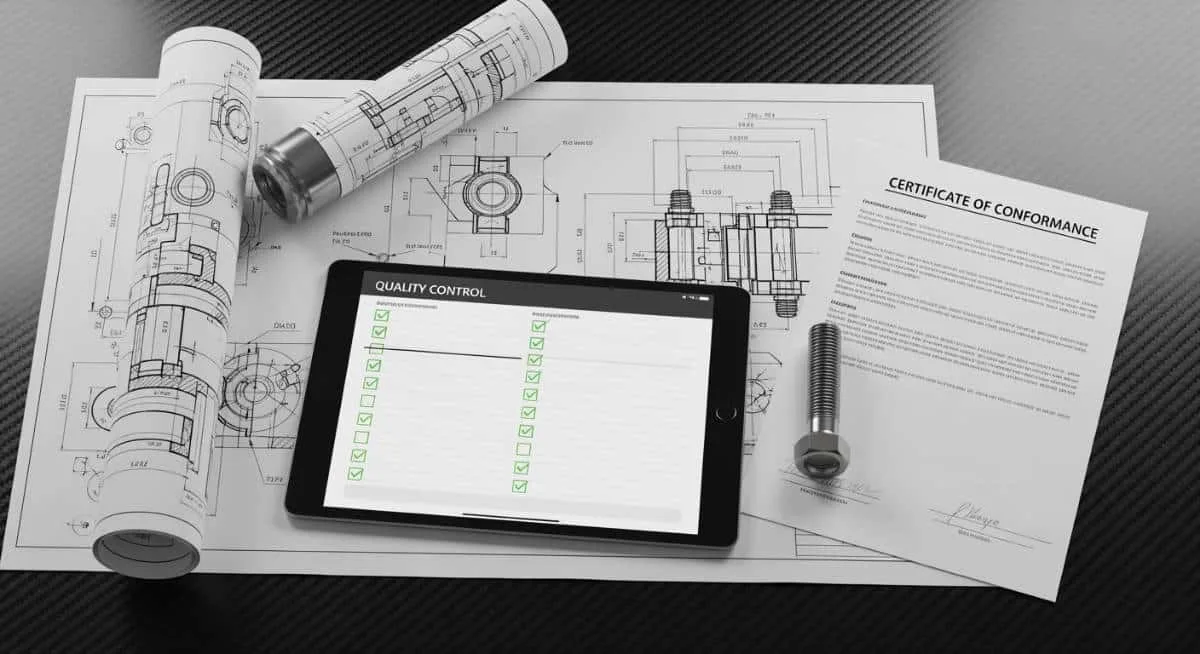
- Certificate of Conformance (CofC): The manufacturer’s signed statement that the parts conform to all drawing and PO requirements.
- Testing & Inspection Reports: If your drawing calls for Non-Destructive Testing (NDT) like Magnetic Particle Inspection (MPI) or Liquid Penetrant (LPI), you must also request the certified report from that test. The same applies to reports for hardness testing, tensile testing, or plating thickness verification (e.g., X-ray fluorescence reports).
- First Article Inspection Report (FAIR): If you need a FAIR, specify the required format (e.g., AS9102). This is a detailed report verifying that every dimension and feature on the drawing has been measured and conforms to specification.
- Overarching Compliance Standards
Your company or your end customer may be subject to broad regulatory standards that are not tied to a specific part but are critical for the order.
- DFARS (Defense Federal Acquisition Regulation Supplement): If your parts are for a Department of Defense contract, you must specify DFARS compliance, which restricts the sourcing of specialty metals to domestic or qualifying countries.
- ITAR (International Traffic in Arms Regulations): If the fastener is for a military application on the U.S. Munitions List, you must inform the supplier so they can implement the necessary security and export controls.
- RoHS/REACH: For products sold in Europe or other regions, compliance with these environmental regulations restricting hazardous substances is mandatory.
The Logistical Details: From Their Dock to Your Assembly Line
How your parts are handled after they are manufactured is crucial for efficiency in your own facility.
- Packaging, Labeling, and Kitting
Default packaging is often bulk-packed in a single box. If you have specific needs to streamline your receiving or assembly process, detail them in the RFQ.
- Packaging: Do you need parts individually bagged? Do you require specific anti-corrosion paper or desiccants?
- Labeling: Do you need custom labels with your internal part number, PO number, quantity, and a barcode? Providing a label template is the best way to ensure accuracy.
- Kitting: Do you want the custom bolt kitted with a specific nut and washer? A supplier that offers this service can save your assembly team significant time.
The “Tribal Knowledge”: Providing Context for a Superior Outcome
This is the information that separates a transactional supplier from a true manufacturing partner. By sharing the “why” behind the “what,” you enable your supplier’s engineering team to apply their expertise to your benefit.
- Application & End-Use
Knowing how a part is used is invaluable. A manufacturer might suggest a better material, a more effective threadlocking feature, or a slight design tweak to improve performance or reduce cost if they understand the application.
- Vague: “See drawing.”
- Helpful Context: “This is a high-tensile bolt for a helicopter rotor assembly. It is subject to extreme vibration and routine inspection.” This context immediately highlights the need for fatigue resistance, perfect thread quality, and features that facilitate inspection.
- Highlighting Critical-to-Function Features
While all dimensions on a drawing are important, some are more critical than others. Point them out.
- “The tolerance on the shank diameter is critical for a press-fit application.”
- “The head height must be strictly controlled to provide clearance for a mating part.”
- “The surface finish under the head is critical for a sealing application.”
This allows the manufacturer to focus their quality control efforts where they matter most, ensuring you get parts that perform flawlessly in their intended function.
Build a Better Partnership Through Better Information
An engineering drawing is the starting point, not the finish line, of your RFQ. By supplementing it with a complete package of commercial, quality, logistical, and contextual information, you fundamentally change the procurement process. You eliminate ambiguity, reduce the risk of errors, and shorten the entire cycle from quote to delivery.
More importantly, you invite your supplier to be more than just an order-taker. You empower them to be a proactive partner, using their specialized knowledge to validate your design, optimize for manufacturability, and ensure a successful outcome. This collaborative approach is the hallmark of a robust and resilient supply chain.
At Cyclone Bolt, we thrive on detail. Our team is built to partner with you, translating your complete requirements into precision-manufactured fasteners that meet the most demanding specifications.
Ready to see how a complete RFQ package can transform your procurement experience? Contact our technical sales team and let’s build something great together.
FAQs from Cyclone Bolt
Q1: Why is an engineering drawing alone often insufficient for a successful custom fastener order? A1: An engineering drawing, while defining geometry and tolerances, is often insufficient because it only tells a manufacturer what to make, not everything needed to make it successfully, compliantly, and on time. It typically lacks crucial commercial, quality, and logistical context (e.g., quantities, delivery dates, required certifications, packaging details, and end-use application) that lives outside the blueprint, leading to delays and re-quotes.
Q2: What “commercial framework” information should be included with a custom fastener RFQ to prevent delays and improve pricing? A2: To establish a clear commercial framework, a custom fastener RFQ should include quantities with strategic price breaks (e.g., prototyping, production, and annual usage volumes) rather than a single quantity. It should also specify the required delivery date (hard deadline or planned dock date) and the expected production cadence (e.g., recurring schedule or blanket PO with releases) to allow the supplier to offer competitive pricing and manage capacity.
Q3: What specific “quality and compliance” documentation should procurement professionals explicitly request for critical custom fasteners? A3: For critical custom fasteners, procurement professionals must explicitly request all required documentation, known as the “cert package.” This includes Material Test Reports (MTRs) for raw material traceability, a Certificate of Conformance (CofC), specific Testing & Inspection Reports (e.g., NDT, hardness, plating thickness), and a First Article Inspection Report (FAIR) in a specified format (e.g., AS9102).
Q4: What overarching compliance standards are crucial to mention to a custom fastener supplier, especially for defense or international orders? A4: For defense or international orders, it’s crucial to inform the supplier about overarching compliance standards such as DFARS (Defense Federal Acquisition Regulation Supplement) for specialty metal sourcing restrictions, ITAR (International Traffic in Arms Regulations) for military application security and export controls, and RoHS/REACH for environmental regulations restricting hazardous substances for products sold in certain regions.
Q5: How can providing “logistical details” and “application/end-use context” improve the custom fastener procurement process? A5: Providing logistical details like specific packaging, labeling (e.g., with internal part numbers and barcodes), and kitting requirements streamlines your receiving and assembly, saving your team time. Sharing application and end-use context (e.g., “high-tensile bolt for a helicopter rotor assembly subject to extreme vibration”) enables the supplier’s engineering team to proactively suggest optimal materials, thread-locking features, or design tweaks for improved performance, fostering a stronger partnership.
Q6: What is the result of poor selection of fastener in an assembly? A6: The result of poor fastener selection can be significant, including delays, re-quotes, frustration, and compromised performance. It can lead to a fastener that does not meet the necessary cost, availability, or performance characteristics, causing production halts while clarification is sought or resulting in a part that is unusable scrap if tolerances are not met.
Q7: Why is engineering drawing hard? A7: The article implies engineering drawings can be challenging because they are “a document of details” and can contain conflicting or missing information, particularly regarding tolerances and secondary processes. Translating a complex design into a manufacturable part requires extreme precision and unambiguous details, making the creation and interpretation of drawings demanding.
Q8: What is fastening in engineering drawing? A8: In the context of an engineering drawing, “fastening” refers to the representation and specification of how components are mechanically joined together using fasteners. The drawing details the type, size, material, tolerances, and installation requirements of the fasteners to ensure the assembly’s integrity.
Q9: What factors should be considered when choosing fasteners? A9: When choosing fasteners, it’s crucial to consider factors beyond just the drawing. These include the quantity needed with strategic price breaks, the required delivery date and production cadence, the full suite of quality and compliance certifications (MTRs, CofCs, NDT reports, FAIR, DFARS, ITAR, RoHS/REACH), logistical details (packaging, labeling, kitting), the application and end-use of the fastener, and highlighting its critical-to-function features.
Q10: What is the common point of fastener failure? A10: The article mentions that sharp corners, undefined edge breaks, and issues at thread roots can be stress points leading to failure. It also implies that fasteners failing to meet precise dimensions or having compromised pre/post-plate requirements can lead to “catastrophic part failure in the field.”
Q11: What are the failure of fasteners? A11: The article highlights that forgetting crucial post-plating requirements, such as hydrogen embrittlement relief bake, can lead to “catastrophic part failure in the field,” especially for high-strength steels. This implies embrittlement and subsequent fracture are a failure mode. Additionally, vague or conflicting specifications can lead to parts that are “completely unusable scrap,” indicating functional failure.
Q12: What is a fastener in engineering? A12: In engineering, a fastener is a component used to mechanically join or affix two or more objects together. For custom fasteners, as discussed in the article, they are critical components designed to precise specifications, forming a “complex design” that translates into a “manufacturable part” to hold assemblies securely.
Q13: What is required for fastening a drawing sheet to a drawing board? A13: The article does not discuss physical drawing sheets or drawing boards, but rather the digital specifications and documentation required for custom fastener orders in modern manufacturing.
Q14: What is the importance of fastening? A14: The importance of fastening is to hold structures and components together, ensuring their integrity and enabling them to perform their intended function successfully and compliantly. For custom fasteners, it is a critical process that, if done correctly with clear specifications, “empower[s] your manufacturing partner to do what they do best: make your parts correctly, efficiently, and on time.”
Q15: What is the basic knowledge of fasteners? A15: The article implies that basic knowledge of fasteners for procurement and engineering involves understanding the need for unambiguous material specifications (grade, standard, condition), precise and consistent tolerances (dimensional, geometric, form), clear plating/coating instructions (pre/post-dimensions, post-processing), defined edge breaks and radii, and comprehensive certification requirements.
Q16: What are the four phases of fastening? A16: The article does not explicitly outline “four phases of fastening.” Its focus is on the specification and procurement process for custom fasteners.
Q17: Which two tools can be used for fastening? A17: The article does not specify types of tools for physically applying fasteners. It focuses on the documentation and information needed for their custom manufacturing and procurement.