
Originally published 2026-03-01 · Cyclone Bolt
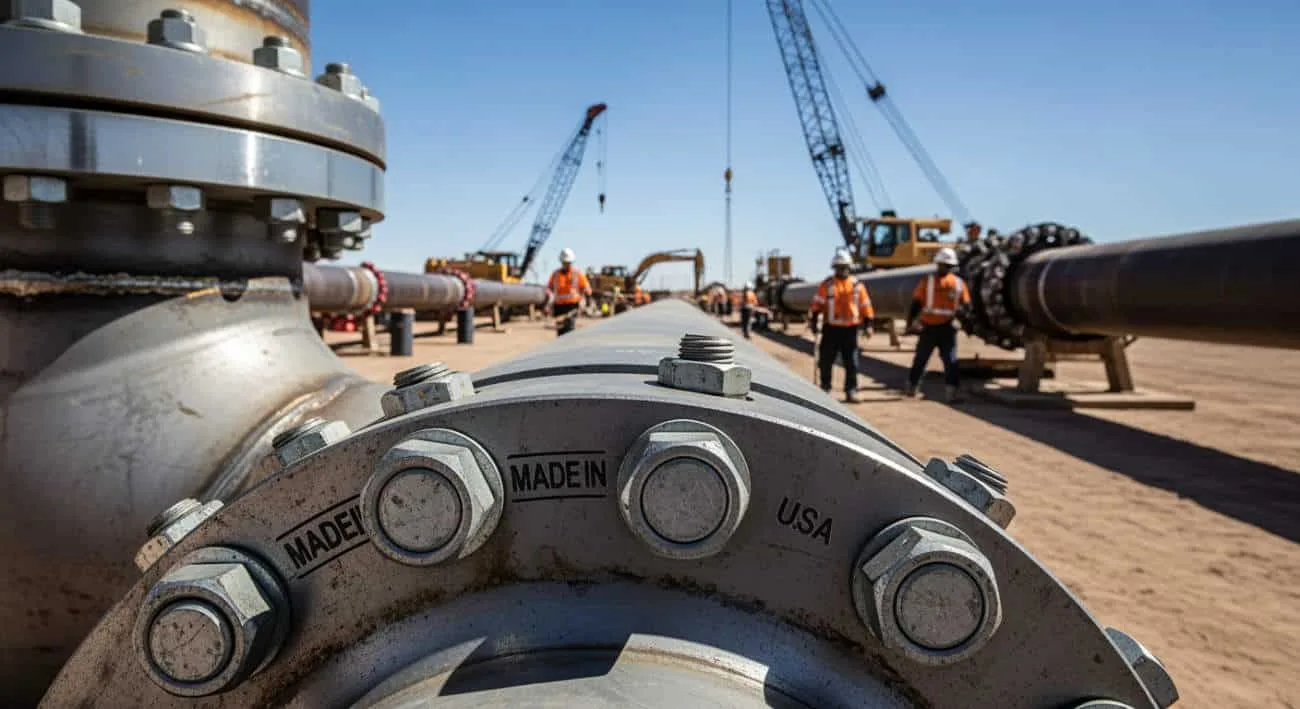
Building a pipeline in the United States used to be about pressure ratings and soil pH. Today, it is just as much about geography—specifically, where your bolts were born. If you are managing a federally funded infrastructure project in 2026, you are likely navigating the “Build America, Buy America” (BABA) Act.
This isn’t just a suggestion. It is a strict mandate that governs every component of a project, from the massive steel pipe sections to the smallest structural fasteners holding the valves in place. At Cyclone Bolt in Houston, we see the shift in real-time. Our customers aren’t just asking for Grade B7 studs; they are asking for domestic heat-treat lot numbers and melt-in-USA certifications.
Understanding these requirements is the difference between a project that moves forward and one that gets buried in red tape.
Buy America vs. Buy American: Know the Difference
It is easy to get these two confused. They sound the same, but they apply to different things.
-
The Buy American Act (1933): This applies to the federal government buying products for its own use (like equipment for a federal building).
-
Buy America (and BABA): This applies to federal financial assistance for infrastructure projects. If a state or local entity receives a federal grant to build a water pipeline or a transit bridge, “Buy America” rules apply.
The Build America, Buy America Act (BABA), enacted as part of the 2021 Infrastructure Investment and Jobs Act, expanded these rules significantly. It now covers not just iron and steel, but also manufactured products and construction materials.
The “Iron and Steel” Rule for Pipeline Fasteners
For pipeline projects, fasteners—like bolts, nuts, and studs—usually fall under the “Iron and Steel” category. The FAA and other federal agencies have very clear lines here. If an item is “predominantly” iron or steel (meaning the cost of the iron or steel content is more than 50% of the total component cost), it must be 100% domestic.
What does “100% domestic” actually mean?
-
The Melt: The initial melting and pouring of the steel must happen in a U.S. furnace.
-
Manufacturing: All processes, including rolling, drawing, machining, and heat-treating, must occur in the United States.
-
Coating: Even the final finish, like galvanizing or Xylan coating, must be applied at a domestic facility.
At Cyclone Bolt, our API 20E and API 20F fasteners often meet these rigorous standards because the energy sector already demands high-level traceability that mirrors BABA requirements.
Why Fastener Traceability is Non-Negotiable
In a pipeline project, a single unapproved bolt can trigger a “Suspected Unapproved Part” (SUP) investigation or jeopardize federal funding. Traceability is the only way to prove compliance.
When you source from a supplier, you need a Mill Test Report (MTR). This document is the “birth certificate” of the fastener. It tells you exactly where the steel was melted and provides the chemical and physical analysis to prove it meets ASTM standards.
For projects following API Spec Q1, this level of documentation is standard. We ensure that our fasteners are linked to their specific heat lots so that when an auditor asks for proof of domestic origin, you have it in seconds.
Navigating the Three Main BABA Categories
The Office of Management and Budget (OMB) classifies project inputs into three buckets. Each has different rules:
1. Iron and Steel Products
As mentioned, these must be 100% produced in the U.S. This includes items like:
-
Pipeline segments and casings.
-
Flanges and valves.
-
Structural bolting and fasteners.
2. Manufactured Products
These must be “produced in the United States.” This means the final manufacturing happens here, and the cost of U.S. components exceeds a certain percentage (currently 55%, though this is scheduled to increase in the coming years).
3. Construction Materials
This includes things like non-ferrous metals, plastic, and glass. These must have all manufacturing processes occur in the U.S.
The Role of Quality Management Systems (QMS)
How do you maintain compliance across thousands of parts? You rely on a robust QMS. Our ISO 9001:2015 certification at Cyclone Bolt isn’t just a plaque on the wall. It is the system we use to prevent non-compliant materials from entering the supply chain.
A good QMS ensures:
-
Supplier Qualification: We only buy from mills that can prove domestic origin.
-
Material Segregation: Keeping domestic and imported stock separate to avoid accidental mixing.
-
Internal Audits: Regularly checking our own paperwork to ensure MTRs match the physical inventory.
Common Challenges in Pipeline Compliance
Navigating Buy America isn’t always smooth sailing. Project managers often run into “Non-Availability” issues. Sometimes, a specific high-strength alloy or a niche coating isn’t available from a U.S. source in the quantities needed.
The Waiver Process
If a product isn’t available domestically, you must apply for a waiver. This is a public process handled through the Made in America Office (MIAO).
-
Public Interest Waivers: Used when domestic preference is inconsistent with the public interest.
-
Non-Availability Waivers: Used when the part simply isn’t made in the U.S.
-
Unreasonable Cost Waivers: Used if buying domestic increases the total project cost by more than 25%.
Be warned: waivers are not easy to get. They are a last resort, not a shortcut.
Coatings and Plating: The Final Compliance Step
Many pipeline fasteners require specialized coatings to prevent corrosion in harsh environments. Whether it is zinc plating, hot-dip galvanizing, or proprietary coatings mentioned in our Coating and Plating Technical Guide, the application must happen domestically.
If you send a U.S.-made bolt to an offshore facility for coating and then bring it back, it may lose its “Buy America” status. We handle these processes right here in the U.S. to ensure the chain of compliance remains unbroken.
Material Grade Selection for Infrastructure
Choosing the right material is vital for safety and compliance. Our Material Grade Guides help engineers select the best alloys for the job.
For federal infrastructure, we frequently see:
-
ASTM A325/A490: For structural steel connections.
-
ASTM A193 Grade B7: The workhorse of the pipeline industry, often used for high-pressure valves and flanges.
-
Stainless Steel (304/316): For corrosive environments where longevity is a priority.
Every one of these grades is available in a “Melted and Manufactured in USA” version. You just have to know to ask for it.
Why Location Matters: The Houston Advantage
Cyclone Bolt is located in Houston, Texas—the heart of the global energy and infrastructure supply chain. This location allows us to work closely with domestic mills and testing laboratories. We understand the pressure of a deadline. When a project is stalled because of a missing BABA-compliant fastener, we have the local resources to get the right parts on a truck and out to the site.
The Future of Buy America Requirements
The trend is clear: the U.S. government wants more domestic content in our infrastructure. Requirements for manufactured products are likely to tighten further by 2029.
Staying ahead of these changes requires a partnership with a supplier who understands the law as well as they understand the metallurgy. At Cyclone Bolt, we are constantly updating our inventory and our processes to match the latest FAA and federal infrastructure guidelines.
Summary of Pipeline Compliance
-
BABA Expansion: The Build America, Buy America Act now covers iron, steel, manufactured products, and construction materials.
-
Iron & Steel Focus: Fasteners must be 100% domestic—melted, manufactured, and coated in the U.S.
-
Documentation: Mill Test Reports (MTRs) are the essential proof of compliance.
-
Traceability: Use an ISO 9001:2015 certified supplier to ensure parts are tracked from the mill to the project site.
-
Waivers: These are available but difficult to obtain; sourcing domestic from the start is the best strategy.
Article Recap:
-
Regulation: Buy America applies to federally funded state/local infrastructure; BABA expanded this scope.
-
Fastener Standards: Most pipeline fasteners must be 100% domestic (melted/manufactured in the USA).
-
Proof: Traceability via MTRs and heat lots is mandatory for audit compliance.
-
Quality Control: ISO 9001 and API Spec Q1 systems are vital for managing compliant inventory.
-
Coatings: Final finishes must also be applied domestically to maintain compliance.
Don’t let compliance issues stall your next infrastructure project. Get the BABA-compliant fasteners you need from a name you can trust. Contact Cyclone Bolt in Houston today for a quote on domestic fasteners!