Originally published 2025-12-27 · Cyclone Bolt
Have you ever looked at a bolt that’s been sitting in a harsh environment for a few years? It isn’t just “rusty.” It looks tired. The metal starts to flake away. It loses its sharp edges. Eventually, that sturdy piece of hardware looks more like a crumbling piece of orange chalk than a structural fastener.
In the oil and gas industry, especially here in Houston, we deal with “sour” or acidic environments all the time. When you’re dealing with high levels of acidity, like hydrogen sulfide (H2S) or sulfuric acid, the stakes are high. One failed bolt can mean a leak, a shutdown, or something even worse.
Choosing the right coating isn’t just a checkbox on a procurement form. It’s about ensuring the safety of your crew and the longevity of your equipment. Let’s talk about how to keep your fasteners from falling victim to the acid.
Why Acid is the Ultimate Enemy of Metal
Acid doesn’t just sit on the surface of a bolt. It’s aggressive. It searches for any tiny microscopic crack or imperfection in the metal and starts to eat away. This isn’t just a slow change. In the right (or wrong) conditions, acid can turn a high-strength bolt into a safety hazard in a matter of weeks.
You might have heard of “Hydrogen Embrittlement.” This is a scary sensation for engineers. The metal looks fine on the outside, but the acid has forced hydrogen atoms into the crystalline structure of the steel. The bolt becomes brittle. Under pressure, it doesn’t bend; it snaps like a dry twig.
At Cyclone Bolt, we’ve spent years studying these reactions. We know that the first line of defense is always the coating. You need a barrier that doesn’t just resist the acid but stays bonded to the metal even under extreme pressure.
The Power of PTFE: Xylan and Teflon
When you’re talking about acidic environments, PTFE (Polytetrafluoroethylene) is usually the star of the show. You might know it as Teflon, but in the industrial world, brands like Xylan are the heavy hitters.
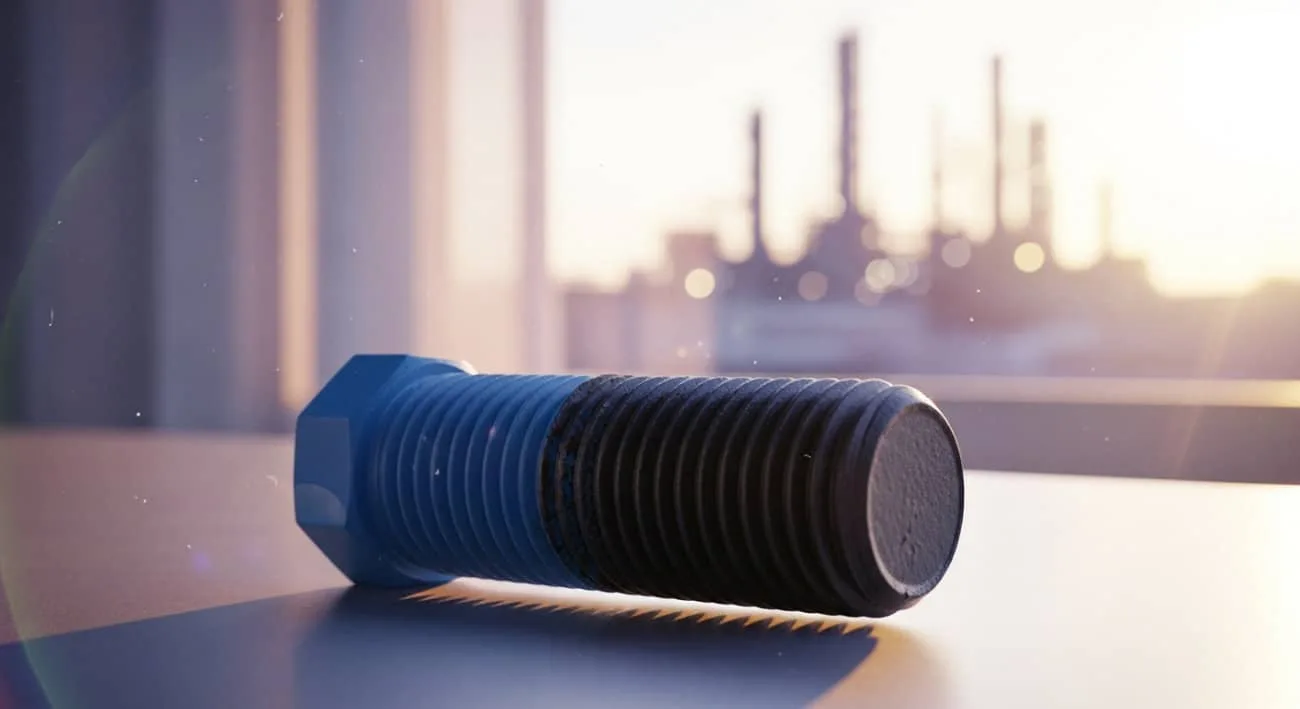
PTFE is a fluoropolymer. Think of it as a plastic “skin” for your bolt. It is chemically inert, meaning it doesn’t like to react with much of anything—especially acid.
-
Low Friction: PTFE is incredibly slippery. This makes it easy to install the bolts and, more importantly, easy to remove them later.
-
Chemical Barrier: It acts as a physical shield. The acid simply can’t find a path through the polymer to reach the steel underneath.
-
Temperature Resistance: Good PTFE coatings can handle temperatures up to 260°C (500°F).
When you touch a PTFE-coated bolt, it feels smooth and almost soft. But don’t let that fool you. It’s a rugged defense against some of the most corrosive chemicals on the planet. We often recommend these for offshore rigs where saltwater and sour gas are a constant threat.
Zinc Coatings: When to Use Them
Zinc is the most common coating you’ll see. It’s usually applied through “Hot-Dip Galvanizing” or electroplating. It works through a process called “sacrificial protection.” The zinc literally dies so the steel can live.
However, we have to be careful with zinc in highly acidic environments. Acid loves to eat zinc even faster than it eats steel.
-
Hot-Dip Galvanizing: This gives you a thick, rugged layer of zinc. It feels rough and industrial. It’s great for outdoor bridges or structural beams.
-
Zinc Plating: This is a much thinner layer. It looks shiny and silver (or yellow if it has a chromate finish). It’s perfect for indoor use but doesn’t hold up long against a concentrated acid mist.
If your environment is only mildly acidic or if you have a high risk of “galvanic corrosion” (where two different metals touch), zinc is a great choice. But for a high-acid chemical plant? You’ll likely want something beefier.
Ceramic and Metallic: The High-End Choice
Sometimes, a plastic skin like PTFE isn’t enough. If you have a combination of high heat, high pressure, and intense acid, you might need a ceramic-metallic coating like Xylar.
Xylar coatings are incredibly hard. They feel like a fine ceramic glaze on a piece of pottery. They are often used as a base coat for PTFE. This “double-decker” approach gives you the hardness of ceramic with the chemical resistance of the polymer.
These coatings are designed for the toughest jobs. We’re talking about components inside subsea wellheads or deep within a refinery. It’s the “armor” of the fastener world.
Understanding the Standards: API 20E and 20F
Quality isn’t just a buzzword for us. At Cyclone Bolt, we live by the standards set by the American Petroleum Institute (API). These aren’t suggestions; they are the rules that keep people safe.
-
API 20E: This covers alloy and carbon steel bolting. It focuses on how the bolts are heat-treated and tested to ensure they won’t fail in high-pressure service.
-
API 20F: This is for corrosion-resistant bolting. If you are using stainless steel or nickel alloys, this is the standard you need to know.
We are proud to be API 20E and API 20F compliant. When you order a bolt from us, you aren’t just getting a piece of metal. You’re getting a documented, traceable piece of hardware that has been verified at every step.
The Importance of Traceability and ISO 9001
Imagine you’re on a rig 100 miles offshore. You’re about to torque down a critical flange. You need to know that the bolt in your hand is exactly what it says it is.
That’s where ISO 9001:2015 Quality System Certificate and API Spec Q1 come in. These quality management systems ensure that we can track a bolt back to the very batch of steel it was made from.
We keep rigorous records of:
-
Heat Numbers: Knowing exactly when the steel was poured.
-
Hardness Testing: Ensuring the bolt isn’t too soft or, more dangerously, too brittle.
-
Coating Thickness: Using specialized tools to make sure the acid barrier is thick enough to do its job.
You can learn more about our commitment to these standards on our Quality and Tech page.
Selecting the Right Material Grade
Sometimes, the coating is only half the battle. If the acid is strong enough, you might need to change the base metal itself.
-
B7 Bolts: The industry standard for high-pressure service. They are strong and dependable, but they require a good coating to survive acid.
-
B8 and B8M: These are stainless steel grades. B8M contains molybdenum, which makes it much more resistant to pits and cracks in acidic environments.
-
Nickel Alloys: If you have the budget and a truly extreme environment, alloys like Inconel or Monel are virtually untouchable by acid.
We have a detailed Material Grade Guide that breaks down the chemistry and strengths of each option. It’s a great resource to keep on your desk when you’re planning a project.
Maintenance and Inspection in Acidic Environments
Even the best coating won’t last forever. Acid is patient. Over time, it will find a way through. This is why regular inspections are vital.
When you’re inspecting your fasteners, don’t just look for “rust.” Look for “blistering” in the coating. If you see bubbles forming under a PTFE coat, it means acid has found a pinhole and is starting to attack the steel underneath.
At that point, the bolt is compromised. It’s better to replace a $20 bolt today than to deal with a $200,000 leak tomorrow.
Working with a Partner Who Knows the Houston Heat
We love being based in Houston. We understand the unique challenges of the Gulf Coast. We’ve seen the humidity, the heat, and the heavy industrial environments that can eat a standard bolt for breakfast.
Our Coating and Plating Technical Guide is built from years of real-world experience. We don’t just sell you what’s on the shelf. We talk to you about your specific project. Is it subsea? Is it near a cooling tower? Is it exposed to direct sunlight?
These details matter. They are the difference between a project that stays on schedule and one that becomes a maintenance nightmare.
Practical Advice for Your Next Order
When you’re ready to place your next order for an acidic environment, keep these three things in mind:
-
Ask for the COA: Always get a Certificate of Analysis. If a supplier can’t prove what the bolt is, don’t use it.
-
Think Long-Term: A PTFE coating might cost more upfront than zinc, but the labor cost of replacing a rusted bolt is much higher.
-
Check the Specs: Make sure the coating you choose is compatible with the temperature of your application.
If you have questions, just reach out. We’re your neighbors here in Houston, and we love talking shop. You can find more about our team and our history on our website.
Why Quality Standards Matter to the Bottom Line
According to the National Association of Corrosion Engineers (NACE), the global cost of corrosion is estimated to be over $2.5 trillion. That is a staggering number. By following standards like API 20E and API 20F, we aren’t just checking boxes. We are part of the solution to reduce that massive economic waste.
Using the Technical Standards published by organizations like ASTM and API ensures that every component in your system is pulling its weight. This is especially true for fasteners. They might be small, but they hold the entire world together.
Ready to Secure Your Project?
Choosing the right coating for an acidic environment doesn’t have to be a guessing game. Whether you need the chemical resistance of Xylan, the sacrificial protection of zinc, or the sheer strength of a specialized nickel alloy, we have you covered.
At Cyclone Bolt, we combine Houston’s industrial grit with world-class engineering standards. We’re ready to help you find the perfect fastener for your toughest challenges.
Give us a call or visit our office. Let’s make sure your project is built to last.
Disclaimer: This article is for informational purposes only. The selection of materials and coatings for industrial applications should always be performed by a qualified engineer who understands the specific pressures, temperatures, and chemical exposures of the environment. Always adhere to local safety regulations and industry standards.