
Originally published 2026-01-22 · Cyclone Bolt
Turbine engines are marvels of modern engineering. They power massive aircraft and provide electricity for entire cities. Inside these machines, components face extreme environments. Temperatures reach incredible heights. Pressures fluctuate rapidly. Rotational speeds generate immense centrifugal forces.
In this high-stakes environment, every single component must perform perfectly. This includes the fasteners that hold the assembly together. A single bolt failure in a turbine engine is not a minor inconvenience. It is a catastrophic event. This is why zero-defect tolerance is the only acceptable standard for turbine engine bolting.
The Reality of Turbine Environments
To understand why zero-defect tolerance matters, you must understand the stress these bolts endure. A gas turbine operates by compressing air, mixing it with fuel, and igniting it. The resulting hot gas expands through turbine blades, spinning a shaft.
Fasteners in the hot section of the engine face thermal expansion and contraction. As the engine starts and stops, the metal grows and shrinks. This creates thermal fatigue. If a bolt has even a microscopic crack or a slight material impurity, these cycles will cause that flaw to grow.
Vibration is another constant factor. High-frequency vibrations can lead to “fretting.” This is a process where surfaces wear down due to small movements. A fastener that is not manufactured to exact tolerances may lose its clamping force. Once tension is lost, the risk of shear failure increases.
Defining Zero-Defect Tolerance
Zero-defect tolerance does not mean that mistakes never happen in a factory. It means that the quality management system is so robust that no defective part ever leaves the facility. It is a commitment to 100% compliance with engineering specifications.
In Houston, Texas, Cyclone Bolt applies this mindset to every fastener produced. This involves rigorous testing, strict material sourcing, and adherence to international standards. When a bolt is destined for a turbine engine, there is no room for “close enough.”
The Role of API Spec Q1 9th Edition
Quality starts with the system used to manage the shop. Cyclone Bolt operates under API Spec Q1 9th Edition. This is one of the most stringent quality management standards in the world. It goes beyond standard ISO requirements.
API Q1 focuses on risk assessment and contingency planning. It requires manufacturers to identify everything that could go wrong during production. By identifying these risks, we create processes to prevent them. This standard ensures that every bolt has a “pedigree.” We know exactly where the steel came from, who heat-treated it, and who inspected it. This level of traceability is vital for turbine safety.
ISO 9001:2015 Consistency
While API Q1 provides the depth needed for high-spec industries, ISO 9001:2015 provides the global framework for quality. This certification ensures that our processes are consistent. Consistency is the enemy of defects. If every bolt is made using the exact same proven method, the chance of a rogue defect appearing is significantly reduced.
API 20E and API 20F: The Gold Standards
Not all bolts are created equal. In the world of critical fasteners, API 20E and API 20F are the primary specifications used to ensure reliability.
API 20E: Carbon and Alloy Steel Bolting
API 20E governs alloy steel fasteners used in high-pressure and high-temperature environments. It classifies bolting into three levels: BSL-1, BSL-2, and BSL-3.
Turbine applications almost always require BSL-3. This is the highest level of technical requirement. It includes:
-
Strict heat treatment controls to ensure uniform hardness.
-
Mandatory non-destructive examination (NDE) such as magnetic particle inspection.
-
Rigorous testing for “micro-cleanliness” of the steel.
At the BSL-3 level, we are looking for even the smallest inclusions in the metal. An inclusion is a tiny piece of foreign material trapped in the steel. Under turbine stress, an inclusion acts as a “stress riser.” It is a starting point for a crack. Zero-defect tolerance means ensuring these inclusions are within strictly defined, microscopic limits.
API 20F: Corrosion-Resistant Bolting
Turbines often operate in corrosive environments, such as offshore platforms or coastal power plants. In these cases, alloy steel might not be enough. API 20F covers fasteners made from corrosion-resistant alloys (CRA), like stainless steel or nickel-based alloys.
These materials are harder to work with than standard carbon steel. They require precise temperature control during forging. If the temperature is off by just a few degrees, the grain structure of the metal can change. This can make the bolt brittle. API 20F ensures that these complex alloys maintain their strength and corrosion resistance throughout the manufacturing process.
Material Selection and Grain Flow
The strength of a turbine bolt is not just about the chemistry of the metal. It is also about the internal structure. When Cyclone Bolt manufactures high-spec fasteners, we pay close attention to grain flow.
Think of metal grain like the grain in wood. If you cut across the grain, the wood is weaker. If the grain follows the shape of the part, it is much stronger. This is why forged bolts are superior to those machined from a bar. Forging forces the grain to follow the contours of the bolt head.
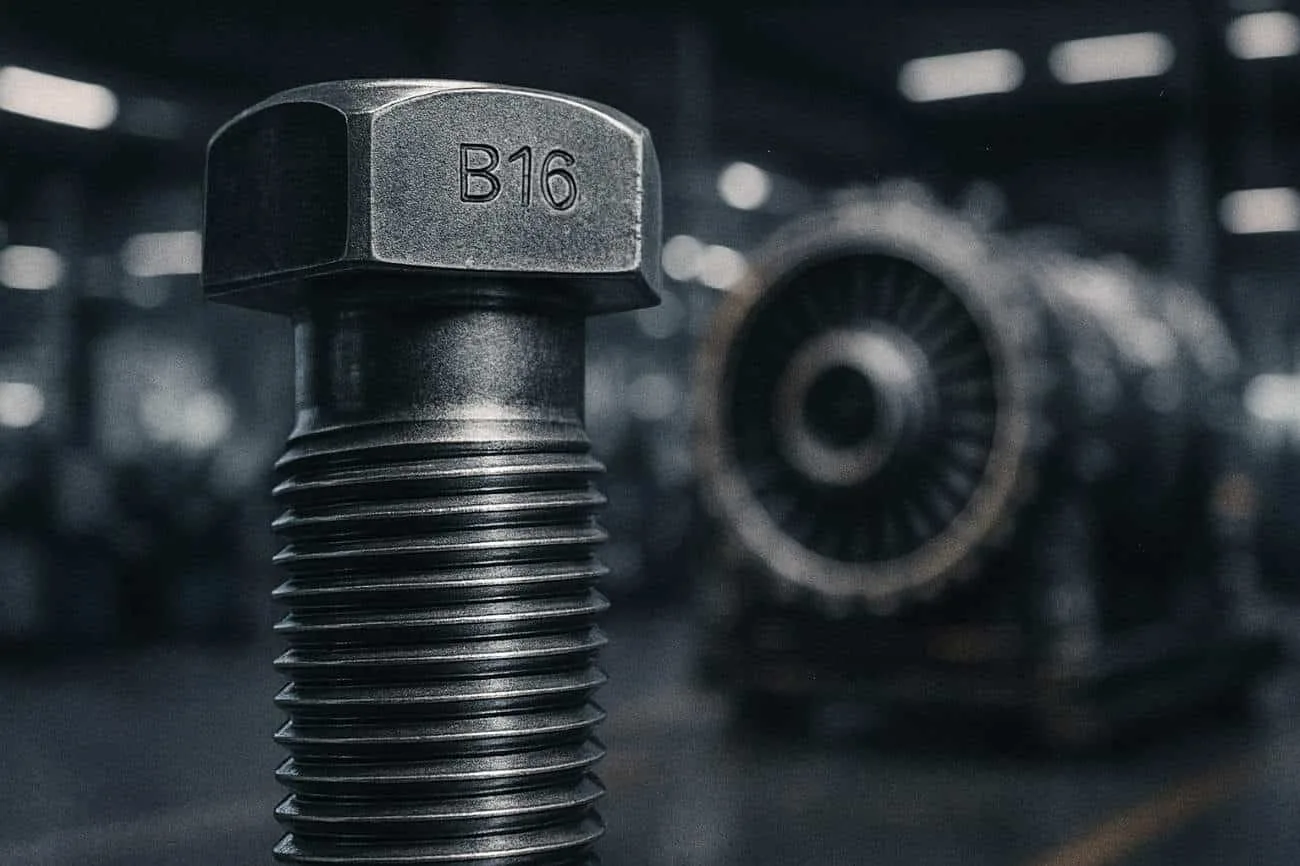
Our Material Grade Guides detail the properties of common turbine materials like B16 alloy steel. B16 is specifically designed for high-temperature service. It contains vanadium, which helps the metal maintain its “creep strength.” Creep is the tendency of a solid material to move slowly or deform permanently under the influence of persistent mechanical stresses. In a turbine, creep can cause a bolt to stretch over time, losing its grip. Zero-defect engineering accounts for this by selecting the perfect grade for the heat profile of the engine.
The Importance of Precision Threading
Threads are the most critical part of a fastener. They are also where most defects occur. In turbine bolting, threads must be smooth and perfectly formed.
Many industrial bolts have “cut” threads. However, for zero-defect turbine applications, “rolled” threads are usually preferred. Thread rolling is a cold-forming process. It displaces the metal rather than removing it. This process preserves the grain flow and increases the fatigue resistance of the threads.
A defect in a thread, such as a burr or a lap, can cause “galling.” This is when the threads lock together during installation. If a bolt galls, the technician cannot achieve the proper torque. This leads to improper tension, which can cause the bolt to vibrate loose.
Coating, Plating, and Hydrogen Embrittlement
Turbine bolts often require specialized coatings for corrosion protection or to control friction. Our Coating and Plating Technical Guide highlights the options available. However, coating a high-strength bolt comes with a significant risk: Hydrogen Embrittlement.
During the plating process, hydrogen atoms can become trapped in the high-strength steel. These atoms migrate to areas of high stress. They eventually cause the metal to become brittle and snap without warning. This is a “delayed failure.” The bolt might look perfect today but fail in three weeks under load.
A zero-defect process eliminates this risk through “baking.” After plating, the bolts are placed in an oven for several hours. This drives the hydrogen out of the metal. For turbine fasteners, we strictly monitor the time between plating and baking. If the delay is too long, the damage is already done. We leave nothing to chance.
Inspection: The Last Line of Defense
Even with perfect processes, inspection is mandatory. Zero-defect tolerance relies on advanced testing methods.
Non-Destructive Examination (NDE)
For turbine fasteners, we use NDE to look inside the metal without damaging it.
-
Magnetic Particle Inspection (MPI): This reveals surface and near-surface cracks that the human eye cannot see.
-
Ultrasonic Testing (UT): We use sound waves to find internal flaws deep within the bolt body.
-
Liquid Penetrant Inspection (LPI): This is used for non-magnetic materials like stainless steel to find surface defects.
Dimensional Verification
We use calibrated gauges to ensure every dimension is within microns of the engineering drawing. A bolt head that is slightly out of square can cause “eccentric loading.” This puts more stress on one side of the bolt than the other. In a turbine, this uneven stress leads to early fatigue failure.
The Cost of Failure
Why do we go to these extremes? Because the cost of failure is astronomical.
-
Human Safety: In aerospace applications, a turbine failure can lead to the loss of life.
-
Asset Loss: A single gas turbine in a power plant can cost tens of millions of dollars. A broken bolt can cause “foreign object damage” (FOD). If a bolt head breaks off and is sucked into the turbine blades, it will destroy the entire unit in seconds.
-
Downtime: When a power plant goes offline due to a failure, the lost revenue can reach hundreds of thousands of dollars per day.
When you weigh these costs, the price of a zero-defect fastener is a bargain. It is insurance against disaster.
Why Houston is the Hub for High-Spec Zero-Defect Bolting
Cyclone Bolt is located in Houston, Texas. This is no accident. Houston is the heart of the global energy and aerospace manufacturing sectors. This location gives us access to a highly skilled workforce and the most advanced testing labs in the country.
Our proximity to major shipping hubs allows us to move these critical components to power plants and refineries across the globe quickly. We understand the local demands of the Gulf Coast and the international requirements of the API.
Partnering for Reliability
Achieving zero-defect tolerance is a partnership. It requires clear communication between the engineer who designs the turbine and the manufacturer who makes the bolts.
We encourage our clients to consult our technical guides early in the design phase. Choosing the right material grade and coating upfront prevents defects later. Whether it is an API 20E BSL-3 alloy steel stud or a specialized 20F nickel alloy bolt, we ensure the final product exceeds expectations.
Turbine technology is pushing the limits of physics. As engines get hotter and more efficient, the demands on bolting will only increase. Cyclone Bolt is committed to evolving alongside these technologies. Our investment in API Spec Q1 and ISO 9001:2015 is just the beginning. We continue to refine our processes to ensure that when a turbine spins up, every bolt stays exactly where it belongs.
Article Recap:
-
Extreme Stress: Turbine bolts face high heat, vibration, and pressure, making any defect potentially fatal.
-
API Spec Q1: This standard ensures a robust quality management system focused on risk prevention and traceability.
-
API 20E & 20F: These are the essential technical specifications for high-strength and corrosion-resistant bolting.
-
BSL-3 Requirements: The highest bolting level requires mandatory NDE testing and microscopic material inspection.
-
Material Integrity: Selection of grades like B16 and the use of forged grain flow are vital for long-term reliability.
-
Hydrogen Embrittlement: Post-plating baking is a critical zero-defect step to prevent sudden, brittle failures.
-
Economic Impact: The cost of a high-quality bolt is negligible compared to the millions of dollars lost in a turbine failure.
Does your project demand the highest level of fastener reliability? Don’t settle for “standard” when you need “Zero-Defect.” Contact Cyclone Bolt in Houston today to discuss your turbine bolting needs. Our team is ready to deliver API-certified excellence for your most critical applications.
To learn more about international engineering standards for fasteners, you can visit ASTM International or the American Petroleum Institute.