
Originally published 2025-11-15 · Cyclone Bolt
A project manager for a multi-billion dollar offshore platform has a problem. A critical piece of subsea equipment needs repair. The entire project, with a burn rate of hundreds of thousands of dollars per day, is on hold. Why? They’re waiting on a pallet of specialty stud bolts. Why gamble? Get certified bolting.
After weeks of delay, the fasteners finally arrive from an overseas supplier. But the documentation is missing. The Mill Test Reports (MTRs) don’t match the purchase order, and the material’s origin is unclear.
The on-site quality inspector rejects the entire batch. The bolts are useless. The project is dead in the water.
This scenario is not hypothetical. It is the reality of supply chain uncertainty, and in high-stakes industries, it is a catastrophic risk.
In a world built on complex, global supply chains, we’ve been taught to accept long lead times and opaque sourcing as “business as usual.” But for the oil and gas, petrochemical, and subsea industries, “business as usual” is a gamble you can’t afford to lose.
At Cyclone Bolt, a Houston-based manufacturer, we don’t just sell bolts. We manufacture certainty. We built our entire process to solve the problem of supply chain uncertainty.
The True Cost of a “Gray Market” Fastener
For many procurement managers, the goal is simple: get the part that meets the spec at the lowest price. This opens the door to the “gray market”—a network of distributors and traders selling parts of unverified or unknown origin.
This approach creates three critical points of failure.
1. The Black Box of Long Lead Times
When you source fasteners globally, you are at the mercy of shipping lanes, port congestion, and geopolitical events. Your critical components are in a “black box” on a container ship for weeks or months. You have zero control and zero visibility. When a delay happens, your entire project timeline is shattered.
2. The Counterfeit and Compliance Nightmare
A “gray market” bolt might look identical to a certified one. It has the same dimensions and head markings. But it could be made from inferior metal, improperly heat-treated, or completely counterfeit.
This non-compliant part might pass a simple visual inspection. But under the extreme pressure, temperature, and corrosive conditions of a subsea blowout preventer (BOP) or a high-pressure flange, it will fail. The cost of that failure is not just financial; it’s environmental and human.
3. The Documentation Death Trap
In our industry, a bolt is not a bolt without its paperwork.
A fastener is only as good as its traceability. You must have a complete documentation package that proves its pedigree, from the original metal mill to the final testing. This includes:
-
Mill Test Reports (MTRs): Certifying the raw material’s chemical and physical properties.
-
Heat Treat Charts: Proving the material was hardened and tempered correctly.
-
Testing Certifications: Verifying its final mechanical properties.
When you buy from an uncertain source, this documentation is often the first thing to be faked, lost, or forged. When your QA team asks for the paperwork, the supplier “can’t find it.” The parts are immediately quarantined and rejected.
The Stakes: What “Mission-Critical” Really Means
At Cyclone Bolt, we don’t just adhere to “quality standards.” We are certified for the most demanding, high-consequence applications on Earth. This is defined by the American Petroleum Institute (API).
Understanding these certifications is the key to understanding why supply chain certainty matters.
What is API Spec Q1?
This is the foundational quality management specification for the oil and gas industry. Think of it as ISO 9001:2015 on steroids. It goes far beyond general quality management. API Spec Q1 is laser-focused on risk assessment, contingency planning, and verifiable product traceability.
Having this certification means our entire process is audited and proven to be robust enough for the industry’s highest demands.
What is API 20E?
This is a specification for Alloy and Carbon Steel Bolting for Use in the Petroleum and Natural Gas Industries.
This isn’t for standard applications. API 20E is for critical-service bolting. It establishes three Bolting Specification Levels (BSL-1, BSL-2, and BSL-3).
-
BSL-1: Standard critical bolting.
-
BSL-2: Higher level, requiring more stringent testing and heat treat controls.
-
BSL-3: The highest level. This is for applications where a bolting failure would be catastrophic.
Cyclone Bolt is certified to manufacture bolting for all three BSL levels.
What is API 20F?
This is the specification for Corrosion-Resistant Bolting for Use in the Petroleum and Natural Gas Industries.
This is the standard for the harshest environments, such as subsea equipment. These fasteners must resist saltwater corrosion and extreme pressures for decades. This specification also uses the BSL-1, -2, and -3 rating system for risk.
Cyclone Bolt is certified to produce BSL-2 and BSL-3 corrosion-resistant bolting.
When a customer orders an API 20E or 20F, BSL-3 part from us, they are ordering a component with zero margin for error. We must have absolute certainty in our process.
The Cyclone Bolt Solution: Certified Bolting
We have engineered our entire company, from our Houston, TX headquarters, to be the antidote to supply chain uncertainty. Here is how we do it.
1. Domestic Control Solves Lead Times
We are not just a distributor. We are a manufacturer. Our 100,000-square-foot facility in Houston gives us complete control over the production timeline.
-
Massive Inventory: We stock a huge range of common and exotic materials (Alloys, Stainless, Duplex, Super Duplex, Nickel Alloys) ready for manufacturing.
-
Rapid Custom Manufacturing: We don’t have to call an overseas agent. We walk your order from the office to our shop floor. We can hot-forge heads, cut threads, and manage heat treatment all under one roof, or with our trusted local partners.
This cuts lead times from months to weeks, or in many cases, days. It gives you visibility and reliability.
2. In-House Testing Solves the Counterfeit Problem
This is our most powerful advantage. We do not “trust” a supplier’s MTR. We verify it.
Our on-site, state-of-the-art Quality and Technology lab is the heart of our operation. When raw material comes in our door, it is immediately quarantined and tested before it ever sees a machine.
Our in-house capabilities include:
-
Positive Material Identification (PMI): We use an X-ray fluorescence (XRF) gun to confirm the exact chemical makeup of the alloy. We guarantee the material you ordered is the material you get.
-
Tensile Testing: We pull the bolts apart to test their ultimate tensile strength, yield, and elongation. We prove they meet the required strength specs.
-
Charpy Impact Testing: This is critical. We freeze samples down to -150°F or colder and strike them to measure their toughness and resistance to brittle fracture in extreme cold.
-
Hardness Testing: We verify the effectiveness of the heat treatment process using both Rockwell and Brinell hardness testers.
When a bolt leaves our facility, its properties are not a “guess” based on a piece of paper. They are a fact we have proven in our own lab.
3. Audited Processes Solve the Documentation Problem
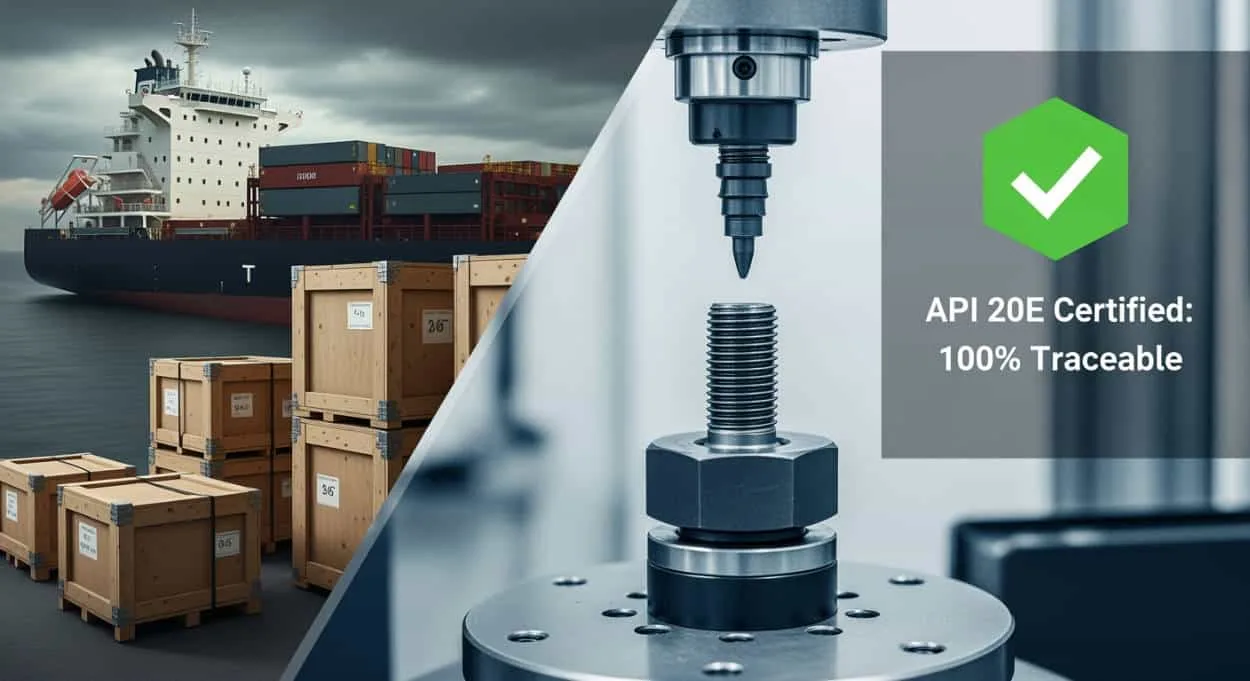
Because of our ISO 9001, API Q1, API 20E, and API 20F certifications, our process is built on a foundation of 100% traceability.
When you receive an order from Cyclone Bolt, you receive a comprehensive documentation package that is verifiable, accurate, and complete. Every time. We have to, in order to maintain our API monograms.
Our quality system links your final part directly back to:
-
The raw material MTR.
-
The heat treat chart.
-
Our internal PMI and mechanical test reports.
There is no “missing paperwork.” There is no “unclear origin.” There is only a clear, unbroken chain of custody.
What a “Certain” Supply Chain Looks Like
Let’s revisit that project manager with the subsea repair.
The “Cyclone Bolt” Way:
-
The Call: The engineer calls our Houston office with specs for an API 20F, BSL-3 fastener.
-
The Plan: Our technical sales team confirms the material and specs. The order is placed.
-
The Process: We pull certified raw material from our inventory. Our lab runs PMI to verify it.
-
The Manufacturing: The material moves to our shop floor for forging, threading, and heat treatment.
-
The Verification: The finished parts go back to our lab for final destructive testing (tensile, Charpy) to prove they meet BSL-3 requirements.
-
The Delivery: The parts are shipped—often in days—with a complete, auditable documentation package.
The project manager receives the correct parts, with the correct paperwork, on time. The repair is completed, and the platform gets back online. We didn’t just sell a bolt; we sold a solution. We sold uptime.
Stop Gambling on Your Supply Chain, Get Certified Bolting
In a global market, uncertainty has become a bad habit. It’s time to break it.
You no longer have to accept the risks of the “gray market.” You don’t have to tolerate fraudulent paperwork or unknown material origins. You don’t have to put your critical projects at the mercy of congested ports.
A reliable, transparent, and high-quality supply chain is not a luxury; it’s a requirement.
From our API-certified facility in Houston, Texas, Cyclone Bolt delivers that certainty. We are your domestic manufacturing partner, your in-house quality lab, and your assurance against a volatile world.
Don’t let your project be the next victim of supply chain uncertainty. Contact the technical team at Cyclone Bolt today and get a quote on manufacturing certainty.