
Originally published 2025-10-11 · Cyclone Bolt
In the high-stakes world of critical industrial service, a fastener is far more than just a piece of hardware. It is a promise. It is the promise that a pipeline flange will hold against immense pressure, that a turbine will remain stable at high temperatures, and that mission-critical equipment will perform flawlessly under extreme stress. The head markings on an ASTM A193 B7 bolt or an A194 2H nut are the symbols of this promise, representing a specific standard of material composition and mechanical strength.
But in an environment where failure is not an option, a symbol is not enough. You need proof. A fastener can be stamped “B7,” but how can you be certain it possesses the precise metallurgical properties that the standard demands? How can you verify that it underwent the correct heat treatment to achieve its required strength? The answer lies beyond the physical specifications of the fastener itself. It lies in its history—a verifiable, unbroken chain of documentation known as material traceability.
For engineers and quality managers in the world’s most demanding industries, traceability is the ultimate currency of trust. It is the irrefutable evidence that a component is exactly what it claims to be. At Cyclone Bolt & Gasket, we believe this proof is not a luxury; it is a fundamental right. It is the core of our commitment to transparency and the reason why complete traceability is a standard, non-negotiable part of every order we ship.
Understanding the Material Test Report (MTR) for A193 & A194
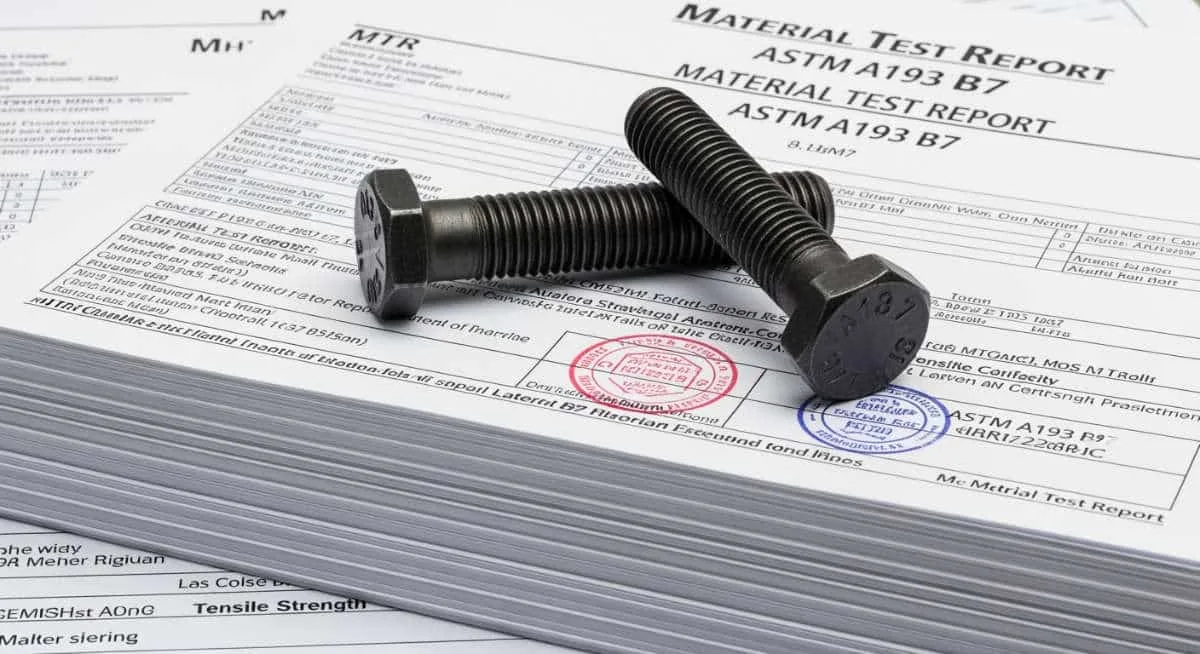
The entire concept of traceability is anchored by a single, critical document: the Material Test Report (MTR), sometimes called a Mill Test Report or Certified Mill Test Report (CMTR). This document is the fastener’s “birth certificate.” It is issued by the steel mill that produced the raw material and provides a complete, certified record of that material’s pedigree.
An MTR is not a generic summary; it is a detailed scientific analysis tied to a unique “Heat Number.” This number is assigned to a specific batch of molten steel, and every bar produced from that heat carries this identifier. The MTR provides a wealth of critical data about that specific heat, including:
- A Complete Chemical Analysis: This section details the exact chemical composition of the steel, breaking it down by element (e.g., Carbon, Manganese, Chromium, Molybdenum). This is the first and most crucial check, verifying that the material is the correct alloy for the specified ASTM grade.
- Verified Mechanical Properties: The mill performs a series of destructive tests on samples from that heat and records the results. This includes:
- Tensile Strength: The maximum stress the material can withstand before breaking.
- Yield Strength: The point at which the material begins to permanently deform.
- Elongation & Reduction of Area: Measures of the material’s ductility.
- Hardness: Often measured in Rockwell (HRC) or Brin-ell (HBW), this is a key indicator of successful heat treatment.
- Heat Treatment Information: The MTR will specify the type of heat treatment the raw material underwent, such as quenching and tempering.
This document creates an unbroken, auditable trail from the origin of the steel to the finished fastener in your facility, providing the absolute assurance of material integrity.
Why Traceability is Non-Negotiable in Critical Service
In many industries, a lack of traceability is not just a quality issue; it is a profound safety and financial risk.
- Oil & Gas: In the extreme pressures and temperatures of upstream and downstream operations, using a fastener with unverified properties is unthinkable. A single bolt failure on a blowout preventer (BOP) or a critical pipeline flange could have catastrophic consequences. This is why the API Q1 quality standard, which governs our operations, places such an immense emphasis on traceability.
- Defense & Aerospace: For flight-safety and mission-critical hardware, every component must have a known and verifiable history. The risk of using a counterfeit or out-of-spec material is simply too high. Complete documentation is not just preferred; it is mandated.
- Nuclear Power: With a design life that spans decades and a zero-tolerance policy for failure, the nuclear industry requires the most stringent level of documentation, where the MTR is the foundational record of a component’s quality.
For engineers, the MTR is the key to confident design. Their calculations for pre-load, joint strength, and safety factors are all based on the assumption that the fastener will perform according to the minimum properties of its specified grade. The MTR is the proof that this assumption is valid.
The Cyclone Bolt Difference: Transparency is Our Standard
In the fastener industry, it is a common practice to treat MTRs and full traceability as an optional add-on, often accompanied by a significant upcharge. This practice effectively places a price on peace of mind and forces customers to pay extra for the very proof of quality they are already expecting.
At Cyclone Bolt & Gasket, we find this practice unacceptable.
We have built our company on a foundation of transparency and partnership. We believe that when you order a certified, high-strength fastener, you deserve the documentation that proves its compliance without having to ask or pay more. That is why Cyclone Bolt provides a full, traceable Material Test Report (MTR) with every single order, as a standard practice, at no additional charge.
This isn’t just a business policy; it’s a reflection of our core philosophy:
- It is a Commitment to Unwavering Quality: It shows that we have absolute confidence in our supply chain, our receiving inspections, and our manufacturing processes. We have nothing to hide.
- It is a Commitment to Our Partners’ Success: We understand the critical role this documentation plays in your quality assurance, safety audits, and engineering processes. By providing it proactively, we make your job easier, safer, and more efficient.
- It is a Commitment to Simplifying Procurement: You never have to worry about adding a line item or paying an extra fee for the essential proof you need. With us, certified assurance is built-in.
In the end, the trust you place in a fastener must be backed by more than just a stamp on its head. It must be backed by verifiable data. By providing complete traceability as a non-negotiable standard, we provide our partners with the ultimate assurance: the proven integrity of the components that hold their most critical assets together.
Don’t pay a premium for peace of mind. Partner with a supplier who believes that transparency is the ultimate standard. Contact Cyclone Bolt & Gasket today.
People Also Ask (PAA) about Fasteners MTR Reports
- What is an MTR or Material Test Report? An MTR is a certified quality assurance document issued by a material manufacturer that records the specific chemical analysis and mechanical properties of a single batch (or “heat”) of material.
- Why is fastener traceability so important? Traceability provides an unbroken, auditable link from the finished fastener back to its original raw material source. This is the only way to definitively prove that the fastener was made from the correct material and possesses the required mechanical properties for a critical application.
- What is a “Heat Number” on an MTR? A Heat Number is a unique alphanumeric code that a steel mill assigns to a specific batch of molten steel. This number is the key to traceability, allowing a finished part to be traced back to its specific MTR.
- Do all A193 B7 bolts come with an MTR? Not from all suppliers. Many distributors and manufacturers treat MTRs as an optional add-on that must be requested and often paid for. Cyclone Bolt’s standard policy is to provide a full, traceable MTR with every order at no extra charge.
- How do I read an MTR? An MTR contains sections for chemical composition (listing percentages of elements like Carbon, Chromium, etc.) and mechanical properties (listing values for tensile strength, yield strength, hardness, etc.). You compare these values to the requirements of the specified ASTM standard to verify compliance.
- What is the difference between an MTR and a Certificate of Conformance (CoC)? An MTR certifies the properties of the raw material from the mill. A CoC is a document issued by the fastener manufacturer or supplier stating that the finished product meets the requirements of the purchase order and relevant standards. For critical parts, you should have both.
- Can a fastener have the correct head marking but be made of the wrong material? Yes. This is a significant risk when dealing with non-certified suppliers or counterfeit materials. The head marking is easy to replicate; the certified chemical and mechanical properties recorded on an MTR are not. This is why traceability is so crucial.
- What does “commingling” of material mean? Commingling is a poor practice where a supplier mixes multiple, untraceable batches of the same grade of material. This breaks the chain of traceability and makes it impossible to know the exact properties of any single fastener from that lot.
- Is traceability a requirement of quality systems like ISO 9001? Yes, ISO 9001:2015 requires organizations to control and identify their outputs to ensure conformity. For manufacturers of critical components, this is fulfilled through a robust traceability system, such as tracking by heat number.
- What should I do if my supplier charges extra for MTRs? For non-critical applications, this may be a business decision. However, for any critical service in industries like oil & gas, defense, or aerospace, you should consider partnering with a supplier who views this essential documentation as a standard part of their quality commitment, not as a profit center.