
Originally published 2025-11-24 · Cyclone Bolt
Is there anything more frustrating than dealing with a costly leak? I’m not talking about a leaky faucet. I’m talking about fugitive emissions (FE)—the invisible, often silent leaks of gas or vapor from industrial equipment. In critical sectors like petrochemicals, power generation, and pipeline transport, FE is a multi-layered problem. It hits your bottom line, it damages the environment, and, worst of all, it compromises safety.
For anyone managing pipelines, processing plants, or refineries, valves are mission-critical. They control flow, manage pressure, and isolate systems. And what keeps a valve sealed tight? The fasteners. The bolts, studs, and nuts holding that flange together are your last line of defense against these disastrous leaks.
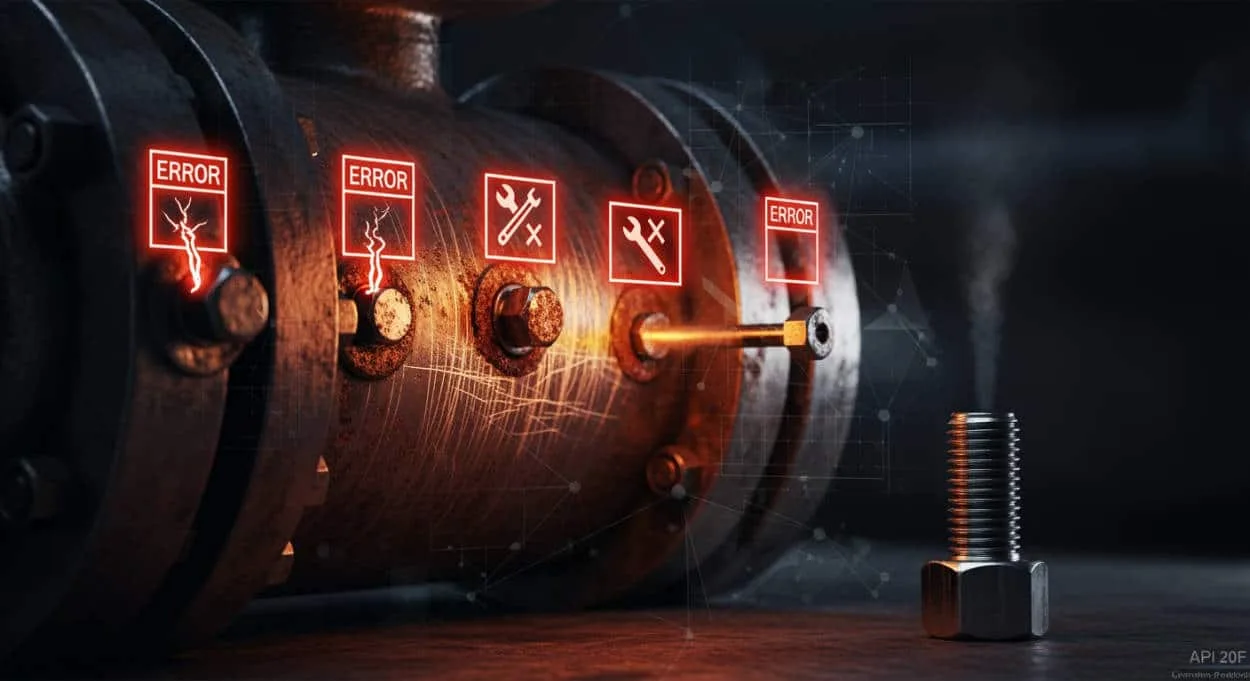
You might think bolting is simple. You twist the nut, and it holds. But the reality is far more complex. The vast majority of flange leaks—and the resulting fugitive emissions—stem from simple, repeatable errors in the bolting process. These mistakes turn what should be a robust, compliant connection into a dangerous liability.
At Cyclone Bolt, located here in Houston, Texas, we specialize in providing certified, high-performance fasteners. We bring a focus on API Spec Q1 and ISO 9001 quality management to every single part we manufacture. We know that the solution to leaks starts not just with good processes, but with superior, certifiable bolts.
Let’s be honest: your facility cannot afford preventable leaks. It’s time to move from reaction to prevention. We’re going to break down the 5 common mistakes in valve bolting that lead directly to expensive, non-compliant fugitive emissions.
The Hidden Cost of Fugitive Emissions
First, let’s quickly define the stakes. What exactly are we fighting when we talk about fugitive emissions?
Fugitive emissions are gases or vapors that escape from pressurized equipment. These aren’t intentional vents. They leak from seals, stuffing boxes, flanges, and, yes, poorly secured valve connections.
The costs of ignoring these leaks are astronomical. They fall into three critical categories:
1. Compliance and Fines
Regulatory bodies worldwide, including the Environmental Protection Agency (EPA) in the United States, impose strict limits on industrial emissions. The EPA actively monitors and regulates leaks of Volatile Organic Compounds (VOCs) and greenhouse gases.
-
Financial Penalties: Non-compliance leads to massive, crippling fines.
-
Reputational Damage: News of major leaks severely harms a company’s public image and investor trust.
-
Mandatory Repairs: Leaks often trigger costly and immediate mandated repair programs.
Protecting the environment isn’t just ethical; it’s a necessary function of staying in business. [External Link Idea 1: Link to EPA’s information page on Methane or VOC emissions control in the oil and gas sector for authority.]
2. Operational Efficiency and Safety
Every leak is lost product.
-
Lost Revenue: If natural gas or valuable chemicals escape, you are literally leaking profit.
-
System Failure: The entire integrity of the pressurized system is compromised. This can lead to decreased efficiency.
-
Catastrophic Risk: Leaking flammable or toxic substances creates an immediate and severe safety risk for personnel. A small leak can be the precursor to a major incident.
3. Degradation and Downtime
Leaking fasteners often indicate deeper issues. Continuous leaks lead to accelerated corrosion and component wear. This necessitates early equipment replacement and unplanned downtime, which is the nemesis of any profitable operation.
The Five Critical Bolting Mistakes
The link between a fastener and a leak is direct. The job of a bolt is to maintain a specific, calculated force (tension) that keeps the flange and gasket sealed. When that tension is compromised, the seal breaks, and the fugitive emissionbegins.
Here are the five most common ways the bolting process fails, starting with the most frequent error:
Mistake 1: Under-Torquing and Inconsistent Tensioning
This is the number one cause of flange failure. It sounds basic, but consistency is hard to achieve in the field.
-
The Problem: The bolt is not tightened to the exact specification required by the flange and gasket manufacturer. The clamp load—the force squeezing the flange faces together—is too low.
-
The Result: Without enough clamp load, internal pressure or thermal cycling overcomes the gasket’s sealing force. This creates an immediate leak path.
-
The Fix: Always adhere to published bolt-load data. Use calibrated tooling. Implement a strict, multi-pass tightening sequence (e.g., star pattern in 50%, 75%, and 100% stages). Ensure the entire crew uses the exact same specified procedures. Fasteners only work when they are tensioned precisely as designed.
Mistake 2: Using the Wrong Material Grade (or Uncertified Materials)
A valve assembly is often subjected to extremes: high heat, cryogenic cold, high pressure, and highly corrosive media. Using a generic bolt that is not certified for these conditions is a recipe for disaster.
-
The Problem: Using a standard carbon steel bolt where API 20F corrosion-resistant alloys are required. Or using a lower strength grade (like B7) when a high-yield grade is specified for high-pressure service.
-
The Result: Creep and Stress Relaxation: At high temperatures, an incorrect material will slowly yield and lose tension (creep), causing the clamp load to drop dramatically. Corrosion Failure: In corrosive environments, non-resistant bolts rapidly rust or crack. This leads to mechanical failure, or the loss of material volume, which instantly relieves tension and causes a leak.
-
The Fix: Only procure fasteners certified to relevant, high-level standards like API 20E (for alloy/carbon steel)or API 20F (for corrosion-resistant alloys). These standards guarantee the material’s chemical composition, heat treatment, and mechanical strength meet the demands of the application. This is non-negotiable for critical service.
Mistake 3: Reusing Fasteners After Yielding
The temptation to reuse bolts after a repair or planned shutdown is high. After all, they look fine, right? This is a costly oversight based on appearance, not engineering.
-
The Problem: When a bolt is properly torqued, it stretches slightly to achieve the required tension. If the bolt was stretched past its yield strength during its initial installation or during operation (due to extreme thermal cycles), its internal structure has been permanently altered.
-
The Result: A yielded bolt cannot reliably hold the required clamp load a second time. It will continue to stretch and fail prematurely when re-torqued. The elastic properties necessary for maintaining a tight seal are gone, leading quickly to fugitive emissions.
-
The Fix: In critical, high-pressure, or high-temperature service, fasteners should be considered single-use components. The cost of a new, certified bolt set is minuscule compared to the cost of an environmental fine or an emergency shutdown caused by a failed reused bolt. Always specify new API 20E/20F fasteners for reassembly.
Mistake 4: Ignoring Flange and Gasket Surface Integrity
A perfect bolt can’t save a damaged flange. Bolting integrity relies on the quality of the surfaces being joined.
-
The Problem: Scratches, nicks, or pits on the sealing face of the flange, or a gasket that has been improperly stored, cut, or damaged. Also, improper gasket seating is a major issue.
-
The Result: Even when the bolt applies the correct tension, the force is not evenly distributed across the compromised gasket surface. This creates localized stress points and allows a clear path for gases to escape, resulting in a fugitive emission.
-
The Fix: Meticulously inspect flange faces before reassembly. Use only new, certified gaskets of the correct type and size. Ensure the tightening procedure accounts for gasket compression. The bolt’s job is to create the force, but the flange and gasket must be pristine to utilize that force effectively.
Mistake 5: Lack of Traceability and Certification Confidence
In the supply chain, the failure to verify material provenance is a fundamental security risk to your operations.
-
The Problem: Procuring fasteners from a supplier who cannot provide full, end-to-end traceability, or whose quality certifications are questionable or nonexistent. This often happens when trying to cut costs.
-
The Result: You have zero confidence that the material is actually the grade you ordered. That B7 bolt might really be a weaker Grade 5. The API 20F alloy might be a cheap steel substitute. This lack of certainty translates directly into unpredictable component performance, premature failure, and catastrophic fugitive emissions.
-
The Fix: Partner only with suppliers who embody extreme accountability, like Cyclone Bolt. We maintain rigorous quality systems certified to standards like API Spec Q1 9th Edition and ISO 9001:2015. Our parts come with complete Material Test Reports (MTRs) and documentation, ensuring every part’s materials specifications and treatment are fully verified. You must know where your fastener comes from and what it is made of.
The Cyclone Bolt Solution: Quality Built on Certification
Avoiding these five mistakes requires more than just careful wrenching; it requires a commitment to certified quality from the ground up. This is where Cyclone Bolt, located in the heart of Houston, Texas, provides the necessary security and expertise.
We don’t just sell bolts. We deliver highly engineered fasteners that meet the world’s most demanding technical standards. Our entire process is predicated on eliminating the root causes of bolting failure and, by extension, eliminating fugitive emissions for your critical infrastructure.
Certified Excellence for Critical Service
Our operational philosophy centers on validated quality and traceability. This is proven by our adherence to top global standards:
1. API Spec Q1, 9th Edition
This is the gold standard for quality management systems in the petroleum and natural gas industry. Achieving this certification means our entire manufacturing and supply process is subject to rigorous, continuous scrutiny. It ensures the integrity and reliability of our products, giving you absolute confidence in the quality of every Cyclone Boltfastener.
2. ISO 9001:2015
As the foundational international standard for quality management, ISO 9001:2015 confirms our dedication to meeting customer and regulatory requirements consistently. Our processes are disciplined, predictable, and focused entirely on quality assurance.
3. API Specification 20E (API 20E)
API 20E is crucial for alloy and carbon steel fasteners used in severe service. It defines three distinct quality levels (BSLs) to match the criticality of the application.
-
Material: It dictates the precise chemical composition.
-
Heat Treatment: It specifies the exact heat treatment processes required to achieve the necessary strength and toughness.
-
Testing: It mandates rigorous testing protocols.
When you purchase an API 20E bolt from Cyclone Bolt, you know its strength and reliability are validated for high-stress environments.
4. API Specification 20F (API 20F)
For extremely corrosive environments, such as sour gas service or subsea applications, standard carbon steel is insufficient. API 20F covers the requirements for corrosion-resistant fasteners (CRF).
-
Alloys: It deals with specialized alloys that resist harsh chemical attack.
-
Corrosion Testing: It requires specific testing to prove resistance to Stress Corrosion Cracking (SCC) and Sulfide Stress Cracking (SSC).
By specializing in both API 20E and API 20F, we ensure you select a material grade that will not fail due to corrosion or heat, directly addressing Mistake #2.
The Role of Precision Manufacturing
The highest quality material is useless if it’s machined incorrectly. Our advanced manufacturing techniques ensure that threads are rolled, not cut, whenever possible. Rolled threads are stronger and less prone to stress fractures. This precision engineering maintains the integrity of the fastener, allowing it to withstand the exact torque and tension required to eliminate the leak path.
Furthermore, we provide full technical standards support. We ensure that our fasteners meet the dimensional requirements of crucial industry standards like ASME B16.5 and B16.47, guaranteeing a precise fit for your flange assembly.
The fight against fugitive emissions is constant. It is a necessary battle for environmental responsibility, operational safety, and financial health. The weak link is often found where you least expect it: the simple, often-overlooked valve fastener.
By correcting the five common bolting mistakes—improper tensioning, using uncertified materials, reusing bolts, ignoring surface damage, and skipping traceability—you fundamentally improve your system’s integrity.
Your infrastructure deserves a security partner that provides uncompromising quality. Don’t risk compliance fines, safety incidents, and massive downtime with generic hardware. Start with a supplier whose processes are validated and whose materials are certified for your exact needs.
Stop fugitive emissions at the source. Start with better bolts. Contact Cyclone Bolt, your Houston-based API and ISO certified fastener expert, today to discuss your next critical application.