
Originally published 2025-10-20 · Cyclone Bolt
In the world of heavy industry—from sprawling petrochemical plants to offshore oil rigs—the smallest components often bear the greatest responsibility. Fasteners are the unsung heroes that hold our critical infrastructure together. But the bolts, nuts, and studs that perform these vital jobs are under constant assault from corrosion, chemicals, extreme temperatures, and friction. A standard, unprotected fastener in these environments wouldn’t last long, coatings are needed.
That’s where the science of coatings comes in. A fastener’s coating is not just a paint job; it’s a sophisticated, engineered layer of defense. The right coating can dramatically enhance durability, reduce maintenance costs, and prevent catastrophic failures. Understanding the different types of coatings and their unique benefits is crucial for ensuring the safety, reliability, and longevity of your equipment.
Why Do Fastener Coatings Matter?
A coating acts as a barrier between the base metal of the fastener (typically carbon or alloy steel) and the hostile environment it operates in. This barrier serves several critical functions:
- Corrosion Resistance: This is the most common reason for coating a fastener. Corrosion, or rust, is an electrochemical process that degrades metal, weakening the fastener and compromising the integrity of the entire bolted joint.
- Friction Reduction: In many applications, managing the friction between the nut and bolt threads is essential for achieving the correct preload or tension. Coatings like PTFE provide a low-friction surface, ensuring consistent and accurate tightening.
- Chemical Resistance: Industrial environments often expose fasteners to a cocktail of aggressive chemicals. Specialized coatings can protect the underlying metal from chemical attack.
- Temperature Stability: Certain coatings are designed to withstand extreme high or low temperatures without degrading, making them suitable for everything from cryogenic applications to high-heat engines.
Let’s explore some of the most effective and widely used fastener coatings in the industry.
The Workhorses: Zinc and Galvanized Coatings
Zinc-based coatings are among the most popular choices for protecting steel fasteners due to their cost-effectiveness and reliable performance. They protect the steel through a mechanism called “sacrificial protection.” Because zinc is more reactive than steel, it will corrode first, sacrificing itself to protect the steel substrate.
Zinc Plating
Zinc plating involves applying a thin layer of zinc to the fastener using an electrical current (electroplating). It’s a precise process that results in a smooth, uniform finish.
- Benefits: Offers good corrosion protection in mild to moderate environments, provides a clean appearance, and is highly economical.
- Applications: Ideal for indoor applications or in environments with low moisture and minimal exposure to corrosive elements. It’s commonly used in machinery, automotive assembly, and general construction.
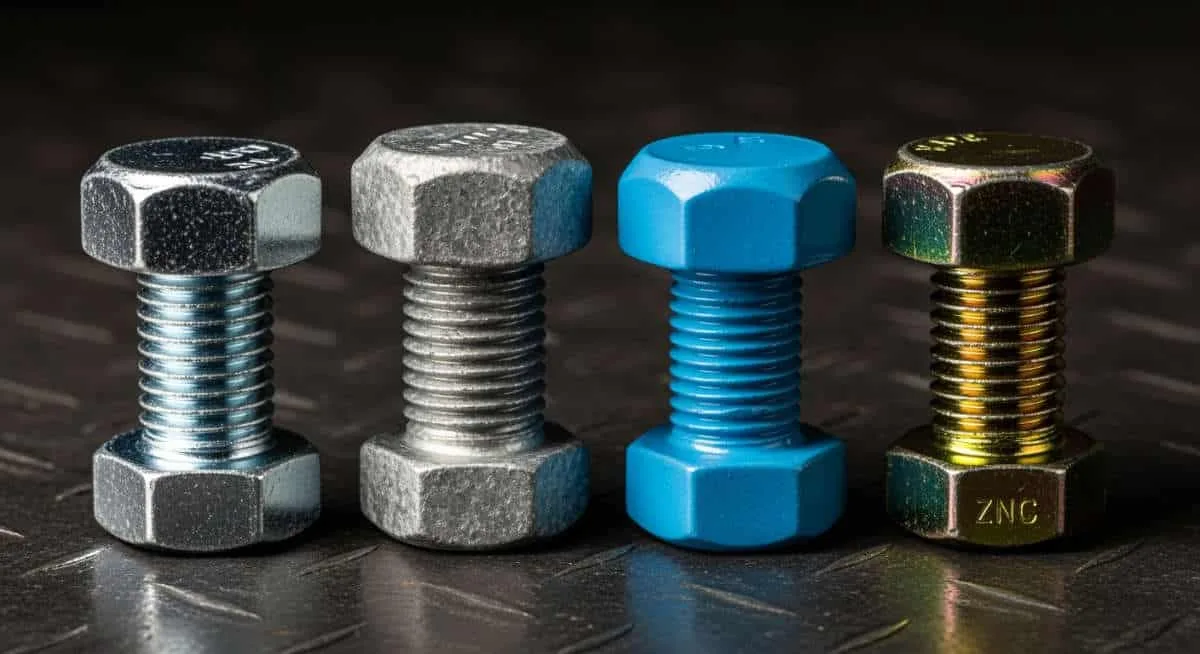
- Good to Know: Zinc plating can be treated with a chromate conversion coating (passivate) for added protection and color. You’ll often see fasteners with clear (silver/blue), yellow, or black finishes, which indicate different types of passivation.
Hot-Dip Galvanizing (HDG)
For maximum protection in harsh environments, hot-dip galvanizing is the gold standard. This process involves submerging the fastener in a vat of molten zinc at temperatures around 840°F (450°C).
- Benefits: Creates a very thick, durable, and abrasion-resistant coating that is metallurgically bonded to the steel. HDG offers exceptional, long-term corrosion protection, even if the surface is scratched.
- Applications: The go-to choice for outdoor structural applications like bridges, transmission towers, and coastal infrastructure. It’s also widely used in chemical plants and water treatment facilities where exposure to moisture and chemicals is constant.
- Good to Know: Due to the thickness of the coating, galvanized nuts must be tapped oversized to ensure they can be threaded onto the bolt. It’s critical to use galvanized nuts with galvanized bolts to ensure a proper fit.
The High-Performers: Cadmium and PTFE Coatings
When standard protection isn’t enough, specialty coatings offer superior performance in the most demanding situations.
Cadmium Plating
For decades, cadmium plating was the premier choice for high-performance applications, particularly in aerospace and marine environments.
- Benefits: Provides exceptional corrosion resistance, especially against salt spray. It’s also naturally lubricious, preventing galling (seizing) of threads, and it plates uniformly, making it great for fasteners with tight tolerances.
- Applications: Historically used in the aerospace, military, and offshore industries.
- Important Note: Cadmium is a toxic heavy metal. Due to environmental and health regulations (like RoHS), its use is now heavily restricted. It has largely been replaced in many applications by safer, high-performance alternatives like zinc-nickel alloys or specialized polymer coatings.
Xylan® (PTFE) Coatings
Xylan® is a brand name for a family of fluoropolymer coatings, often referred to by the generic term PTFE (polytetrafluoroethylene)—the same chemical compound as Teflon®. These coatings are applied as a liquid spray and then thermally cured to bond to the fastener.
- Benefits:
- Unmatched Corrosion Resistance: PTFE coatings create an impermeable chemical barrier, offering outstanding protection in saltwater, H₂S (“sour gas”), and other highly corrosive environments.
- Extremely Low Friction: The non-stick, low-friction surface allows for consistent, low-torque make-up and easy, non-destructive disassembly, which is a huge advantage for maintenance.
- Wide Temperature Range: These coatings can handle temperatures from cryogenic levels up to 500°F (260°C).
- Applications: The dominant choice in the offshore oil and gas industry, petrochemical processing, and chemical manufacturing. The familiar “blue bolts” used in subsea equipment are typically coated with a Xylan®-type PTFE.
Making the Right Choice with Cyclone Bolt
Selecting the right coating is a critical decision that impacts the safety and reliability of your entire operation. The optimal choice depends on a careful analysis of the operating environment, temperature, exposure to chemicals, and required service life.
At Cyclone Bolt, we don’t just supply fasteners; we provide solutions. Our team of experts has deep knowledge of material science and coating technologies. We work with you to understand the specific demands of your application and recommend the precise combination of fastener material and coating to ensure optimal performance and longevity. From standard zinc-plated bolts to custom-coated PTFE fasteners for the most severe service, we have the inventory and expertise to meet your needs.
Don’t leave the integrity of your project to chance. Contact Cyclone Bolt today to discuss your fastener requirements and discover how the right coating can make all the difference.
FAQs from Cyclone Bolt
1. What is the main purpose of coating a fastener?
The primary purpose is to protect the fastener’s base metal (usually steel) from its operating environment. This includes preventing corrosion (rust), resisting chemical attacks, reducing friction for consistent tightening, and ensuring the fastener can withstand extreme temperatures.
2. What’s the difference between zinc plating and hot-dip galvanizing?
Both use zinc, but the process and thickness differ. Zinc plating is a thin, smooth layer applied with an electrical current (electroplating), making it cost-effective for mild, indoor environments. Hot-dip galvanizing (HDG) involves dipping the fastener in molten zinc, creating a much thicker, more durable, and metallurgically bonded coating ideal for harsh, outdoor conditions.
3. Why do hot-dip galvanized bolts need oversized nuts?
The hot-dip galvanizing process adds a very thick, rugged layer of zinc to the bolt’s threads. To ensure a proper fit, the nut’s internal threads must be tapped oversized after galvanizing to accommodate this extra coating thickness, allowing the nut and bolt to be assembled correctly.
4. What do the different colors on zinc-plated bolts mean?
The colors (such as clear/blue, yellow, or black) on zinc-plated fasteners indicate the type of chromate conversion coating, or passivate, applied after the zinc plating. This secondary treatment is added to provide extra corrosion protection and results in the fastener’s final color.
5. What is a Xylan® (PTFE) coating?
Xylan® is a brand name for a high-performance fluoropolymer coating, often referred to as PTFE(polytetrafluoroethylene), which is the same compound as Teflon®. It is applied as a liquid spray and then thermally cured, creating an impermeable barrier known for its exceptional chemical resistance and low-friction properties.
6. What are the benefits of a low-friction fastener coating?
A low-friction coating like PTFE is crucial for achieving consistent and accurate preload (tension) because it requires less torque to tighten. This prevents galling (seizing) of threads and allows for easy, non-destructive disassembly, which is a major advantage for equipment maintenance.
7. Why is cadmium plating restricted?
Cadmium is a toxic heavy metal. Due to serious environmental and health concerns, its use is now heavily restricted by regulations like RoHS (Restriction of Hazardous Substances). It has been largely replaced in many high-performance applications by safer alternatives.
8. What is the best fastener coating for a saltwater environment?
For harsh saltwater or marine applications, you need superior corrosion protection. Hot-dip galvanizing is a robust choice for outdoor structures. For the most demanding subsea or offshore applications, PTFE (Xylan®) coatings are a dominant choice because they create an impermeable chemical barrier against salt and other corrosives.
9. What type of fasteners are used in the oil and gas industry?
The oil and gas industry overwhelming uses high-performance coated fasteners. PTFE (Xylan®) coated fasteners are the standard, especially for subsea equipment and exposure to “sour gas” (H₂S). Their unmatched chemical resistance and low-friction surface are ideal for this demanding environment.
10. How do I choose the right fastener coating?
Selecting the right coating requires a careful analysis of the fastener’s operating conditions. You must consider the environment (e.g., indoor, outdoor, subsea), potential chemical exposure, the temperature range, and the required service life of the joint.