
Originally published 2025-11-08 · Cyclone Bolt
The Dangers of Using Counterfeit or Non-Compliant Bolts in Boiler Repair
A boiler repair is one of the most critical and high-stakes maintenance operations in any plant. Whether in a power generation station, a petrochemical refinery, or a large-scale manufacturing facility, the boiler is the heart of the operation. Its job is to contain and manage immense energy, typically in the form of high-pressure, high-temperature steam.
When a boiler is down for repair, the pressure is on to get it back online. Every hour of downtime costs thousands, pushing procurement and maintenance teams to work quickly. In this rush, it’s easy to overlook the smallest components.
But in a high-pressure steam system, the smallest component carries the biggest risk.
We’re talking about the fasteners. The bolts, studs, and nuts that hold the system together. It’s tempting to treat them as commodities—a 1-inch B7 stud is a 1-inch B7 stud, right?
Wrong.
The hidden danger in boiler repair isn’t a bad weld or a misaligned flange. It’s the counterfeit or non-compliant fastener. It’s a fraudulent piece of metal, stamped to look like the real thing, that lacks the specific metallurgy and heat treatment to survive its environment.
Using a counterfeit bolt in a high-pressure steam system is not a “savings.” It’s a gamble. And it’s a gamble that can lead to catastrophic failure, asset destruction, and severe injury. As a Houston-based manufacturer of API-certified, fully traceable fasteners, we at Cyclone Bolt believe in educating our partners on the risks we help them avoid.
The Brutal Environment: Why Boiler Bolts Are Different
To understand the danger of a fake, you must first respect the environment of the real part. A bolt on a boiler flange is not like a bolt on a car engine. It lives in a world of extremes.
1. Extreme, Sustained Temperature
The steam inside a boiler can easily exceed 600°F (315°C) and often goes much higher. At these temperatures, steel changes. The atoms in its crystal structure have more energy. This brings us to the number one enemy of high-temperature fasteners: Creep.
Creep is the tendency of a solid material to move slowly or deform permanently under the influence of persistent mechanical stress, even at stress levels below its yield strength.
Think of it this way: a bolt is a spring. You tighten it to stretch it slightly, and this “preload” is the clamping force that seals the gasket. In a high-temperature environment, a non-compliant bolt will begin to creep. It slowly, permanently stretches. As it stretches, the preload is lost. The gasket is no longer compressed. The joint fails.
2. Extreme, Constant Pressure
This high temperature is combined with immense pressure, often hundreds or thousands of PSI. This pressure is the “persistent mechanical stress” that fuels creep. It is a relentless, 24/7 force trying to push the flanges apart.
The Engineered Solution: Real vs. Fake Metallurgy
This environment is precisely why specifications like ASTM A193 / A193M exist. This is the “rulebook” for bolts used in high-temperature, high-pressure service.
- A genuine ASTM A193 Grade B7 bolt is not just “steel.” It is an alloy of chromium and molybdenum (known as “chrome-moly”). This specific alloy is engineered to drastically resist creep at high temperatures.
- A genuine B7 bolt is also precisely heat-treated. It is quenched (rapidly cooled) and tempered (re-heated to a specific temperature) to create a microstructure that has extremely high tensile strength without being brittle.
This specific metallurgy and heat treatment are what you are paying for. A counterfeit bolt is a part that skips this process.
The Anatomy of a Counterfeit Bolt
A non-compliant or counterfeit fastener is a fraudulent product designed to deceive a buyer. It can take several forms, all of them dangerous.
- The Mismark: This is the most blatant fake. A manufacturer takes a cheap, low-carbon steel bolt (like ASTM A307 or even unmarked “Grade 2” steel) and simply stamps “B7” on the head. This plain steel has zero chrome-moly alloy and no creep resistance. It will fail in a high-temperature environment, guaranteed.
- The Improper Heat Treat: The manufacturer might use the correct 4140 chrome-moly steel but fails to heat-treat it properly. This “in-the-raw” or improperly treated part will not have the required strength. It might be too soft and stretch immediately, or it might be too hard and become brittle, cracking under load.
- The Falsified MTR (Material Test Report): This is the most insidious fake. The bolts look right, and they even come with an “MTR.” However, this MTR is fraudulent. It was “pencil-whipped” (faked in an office) or belongs to a different batch of steel. The bolt in your hand has no real traceability and no proof of its composition.
This broken chain of custody is how these fakes enter the supply chain. A broker buys containers of unmarked bolts from an unvetted overseas mill, gets a local shop to stamp them, prints a fake MTR, and sells them to a distributor as “commodity B7” for a few cents less.
Catastrophe: What Happens When a Fake Bolt Fails
When one of these fake bolts is installed on a boiler flange, a timer starts.
- Installation: The bolt may torque correctly, or it may stretch and “neck” immediately, giving a false torque reading. The installer may not even notice.
- Heat-Up: As the boiler comes online and reaches temperature, the counterfeit bolt (lacking chrome-moly) immediately begins to creep. It starts to permanently stretch.
- Preload Loss: As the bolt stretches, the clamping force on the gasket is lost. A microscopic gap opens.
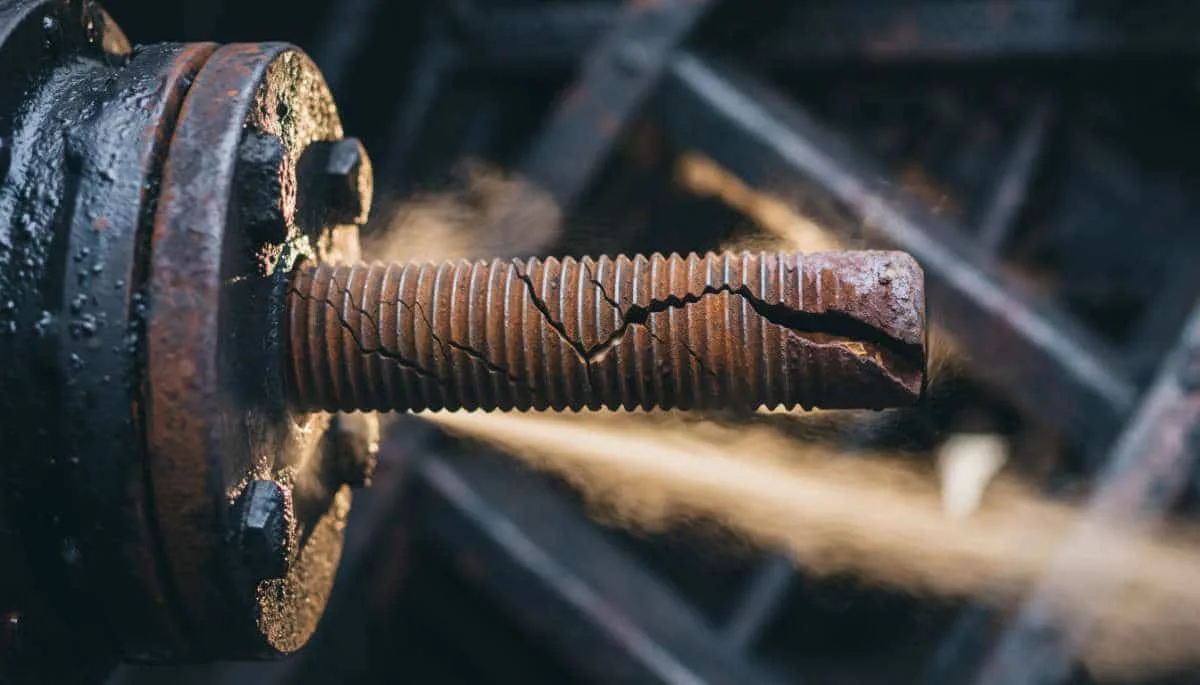
- The Steam Cut: In a high-pressure steam system, this gap is instantly exploited. A hair-thin jet of high-pressure, high-temperature steam shoots through. This isn’t a gentle leak; it’s a violent “steam cut” that acts like a sandblaster, eroding the gasket material and even the steel flange face.
- Catastrophic Failure: The leak accelerates. The other bolts on the flange, now under increased load, begin to fail in a cascading effect. The result is a full-scale joint blowout, releasing a massive, explosive cloud of high-pressure steam.
The consequences are severe:
- Extreme Personnel Hazard: A high-pressure steam release can cause life-altering burns or death to anyone in the vicinity.
- Massive Asset Damage: The flange faces can be destroyed, requiring a multi-day, complex-weld repair.
- Unscheduled Downtime: The entire plant must shut down, costing millions of dollars in lost production.
- Regulatory Violation: Using non-compliant parts is a direct violation of the ASME Boiler and Pressure Vessel Code (BPVC), which governs boiler construction and repair. This can lead to heavy fines and legal liability.
This risk is well-documented. Government and safety bodies, like the U.S. Nuclear Regulatory Commission (NRC), have issued safety notices for decades about the dangers of counterfeit and non-compliant fasteners. The problem is real, and the consequences are dire.
The Solution: A Verifiable System of Trust
You cannot identify a counterfeit B7 bolt just by looking at it. The head stamp is a lie. The only way to ensure safety is to ensure traceability.
This is not a product problem; it’s a process problem. The solution is to buy from a supplier that operates under a certified, transparent, and fully auditable quality system.
This is the core of the Cyclone Bolt philosophy. We don’t just sell bolts; we manufacture and guarantee them through a verifiable system of trust.
1. Certified Quality Systems (ISO & API)
A quality “system” means there are documented, repeatable, and auditable processes for everything.
- ISO 9001:2015 Quality System Certificate: This is the international standard for quality management. Our ISO certification proves we have a robust system for managing our entire process, from order entry to final shipment, ensuring consistency and traceability.
- API Spec Q1: This is the American Petroleum Institute’s far more stringent QMS, designed for the zero-failure tolerance of the oil and gas industry. It requires more rigorous risk assessment and supply chain controls. We are audited to this standard.
2. A True Chain of Custody
When you order a certified bolt from us, you get a real MTR. This document is linked directly to our materials and specifications database. We can trace that bolt from your hand back to the specific lot it was machined from, back to the heat-treat batch it was in, and all the way back to the original steel mill and the raw material test certificate.
This unbroken chain is the only true defense against a counterfeit.
3. In-House Verification
We don’t just trust our mill suppliers. We verify. Our in-house quality and tech lab is equipped with advanced testing equipment. We conduct our own mechanical and chemical analysis on-site to ensure the material we received is the material we ordered. This closes the loop and eliminates any possibility of a fake slipping through.
4. The API Monogram Philosophy
The same risk of counterfeit B7 bolts in boilers is what led the American Petroleum Institute to create the API 20E and API 20F monograms. These are not product specs; they are manufacturing certifications.
An API-monogrammed fastener is the ultimate guarantee of authenticity. It is a part manufactured from an approved mill, under a certified QMS, with full traceability, all verified by third-party auditors. While most boiler repairs may “only” specify ASTM standards, choosing a supplier who holds these API monograms—as Cyclone Bolt does—proves that you are working with a partner who lives and breathes this culture of zero-defect, zero-counterfeit manufacturing.
A Bolt is Not a Bolt
For a desk, a fence, or a shelving unit, a commodity bolt is fine.
For a high-pressure steam boiler, a bolt is a critical safety device, as important as a pressure relief valve. The “savings” of a few dollars on a non-traceable fastener are a complete illusion. That “savings” is actually the price of a lottery ticket for a catastrophic failure.
You cannot afford to take that risk. Your people cannot afford it, and your plant cannot afford it.
The solution is to stop buying commodity parts for critical applications. The solution is to partner with a certified manufacturer that provides 100% traceable, tested, and guaranteed fasteners.
Protect your people and your plant. Order 100% traceable, certified bolts from Cyclone Bolt.
FAQs from Cyclone Bolt about Counterfeit Boiler Bolts
1. What is a counterfeit or non-compliant bolt? A counterfeit bolt is a fraudulent part made from inferior materials but illegally stamped to look like a high-strength, certified bolt (like an ASTM A193 B7). These fakes lack the specific alloys (like chrome-moly) and proper heat treatment required to handle high-pressure, high-temperature service.
2. Why are counterfeit bolts so dangerous for boilers? Counterfeit bolts are extremely dangerous in boilers because they cannot withstand high temperatures. They are susceptible to “creep,” a condition where they permanently stretch under heat and pressure. This stretching causes the bolt to lose its clamping force, leading to a gasket leak, a high-pressure steam cut, and ultimately a catastrophic, explosive joint failure.
3. What is “creep” in a high-temperature bolt?
Creep is the slow, permanent deformation of a metal when it is under constant stress and high temperature. A high-quality boiler bolt (like a B7) is made with a chrome-moly alloy to resist creep. A fake bolt, made of simple carbon steel, will stretch and elongate over time, causing the joint to fail.
4. How can I identify a counterfeit boiler bolt? The most dangerous part is that you cannot identify a counterfeit bolt just by looking at it. The head stamp (e.g., “B7”) is faked. The only way to be certain a bolt is genuine is to purchase it from a certified manufacturer that provides a 100% traceable Material Test Report (MTR), which acts as a “birth certificate” for the bolt.
5. What is the difference between a real A193 B7 bolt and a fake one?
- Real A193 B7: Made from a specific chromium-molybdenum (chrome-moly) alloy steel. It is specially heat-treated (quenched and tempered) to achieve high tensile strength and superior creep resistance at high temperatures.
- Fake B7: Often made from cheap, low-carbon steel (like A307). It has no chrome-moly alloy, no creep resistance, and will fail in a high-temperature boiler environment.
6. What is an MTR, and why does it matter for bolts? An MTR, or Material Test Report, is a quality assurance document that certifies a bolt’s exact origins and properties. It shows the chemical analysis and mechanical test results (like tensile strength) for the specific batch of steel the bolt was made from. A valid, traceable MTR is the only way to prove a bolt is not counterfeit.
7. What happens when a boiler bolt fails? When a bolt fails on a high-pressure steam boiler, the clamping force on the gasket is lost. This can cause a high-velocity “steam cut,” where steam erodes the gasket and flange. This can quickly escalate into a full-scale joint blowout, releasing an explosive cloud of high-pressure steam, causing severe equipment damage and posing a life-threatening risk to personnel.
8. What is a “steam cut” on a boiler flange? A “steam cut” is a dangerous leak that occurs when a high-pressure steam joint begins to fail. As the bolts lose preload, a tiny gap forms, and a thin, high-velocity jet of steam escapes. This jet is so powerful it acts like a cutting torch, eroding the gasket material and even cutting grooves into the steel flange faces, leading to a rapid, cascading failure.
9. How does traceability prevent counterfeit bolt failures? Traceability, often through systems like API Spec Q1 or ISO 9001, creates an unbroken, auditable chain of custody from the steel mill to the final product. A certified manufacturer can provide a valid MTR linking a bolt to its specific batch and raw material. This process ensures that 100% of the bolts are made from the correct alloy and are properly heat-treated, eliminating the possibility of a counterfeit.
10. What is the safest way to buy bolts for boiler repair? The safest way is to bypass commodity suppliers and purchase directly from a certified manufacturer that holds quality system certifications like ISO 9001:2015 or API Spec Q1. This ensures you receive 100% traceable, tested, and certified fasteners that are guaranteed to meet the required ASTM specifications for high-pressure, high-temperature service.