
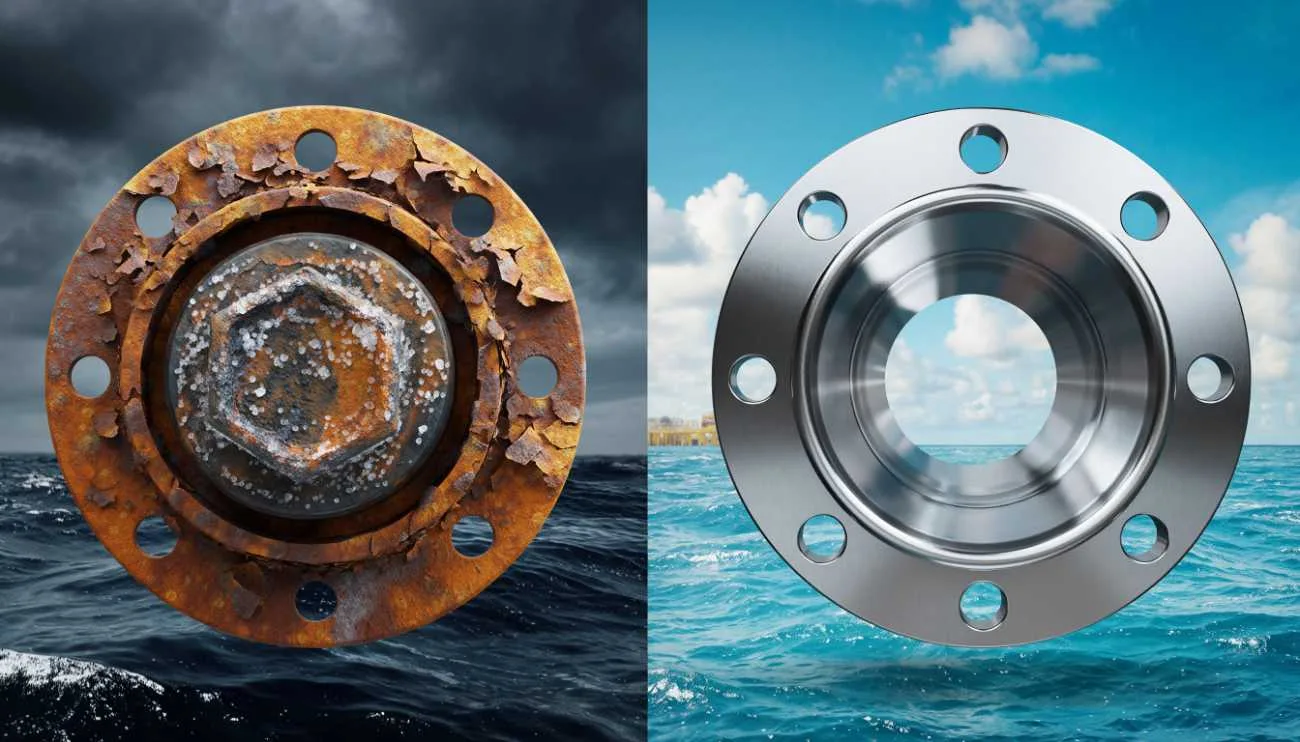
Originally published 2025-11-12 · Cyclone Bolt
What is API 20F? And Why It Matters for Offshore Heat Exchanger Bolts and Corrosion
In the world of offshore and marine engineering, saltwater is the relentless enemy. It doesn’t sleep, it doesn’t stop, and it will exploit any weakness. For a project manager, procurement specialist, or engineer, this environment turns even the most common component into a critical failure point.
Nowhere is this threat more concentrated than on an offshore heat exchanger.
This single piece of equipment is a “perfect storm” for corrosion. It’s a high-temperature, high-pressure environment where dissimilar metals are forced to work in close proximity, all while being bathed in a constant, chloride-rich salt spray.
In this environment, a simple fastener isn’t simple at all. It’s the literal lynchpin holding a multi-million dollar asset together. When a bolt fails here, it’s not a minor leak. It’s a catastrophic shutdown, a potential environmental incident, and a severe safety hazard.
This is why the American Petroleum Institute (API) created Specification 20F.
This article explains what API 20F is, what it covers, and why you should never use a non-certified fastener on a critical offshore application like a heat exchanger.
The Perfect Storm: Why Offshore Heat Exchangers Destroy Bolts
To understand the solution (API 20F), you must first respect the problem. A heat exchanger is, by its very nature, a corrosion nightmare.
A heat exchanger’s job is to transfer thermal energy, typically between a hot fluid inside a set of tubes and a cooler fluid (like seawater) on the outside. This creates several major corrosion risks.
1. Galvanic Corrosion
A heat exchanger is an assembly of different metals. You might have:
- Titanium or Inconel tubes
- A Super Duplex tube sheet
- A carbon steel shell
- Stainless steel fasteners
When dissimilar metals are in electrical contact (like being bolted together) in the presence of an electrolyte (saltwater), a galvanic cell is created. The “less noble” metal will corrode at an accelerated rate, sacrificing itself to protect the “more noble” one. If your fasteners are the weak link, they will be the first thing to dissolve, leading to a total loss of joint integrity.
2. Pitting and Crevice Corrosion
Chloride ions, the primary component of salt, are an enemy of passive “stainless” materials.
- Pitting: Chlorides attack the passive oxide layer on stainless steel, creating tiny, deep holes that can penetrate the material and cause a failure.
- Crevice Corrosion: This is an intense, localized attack that happens in tight spaces with low oxygen. The areas under a bolt head, under a washer, and deep in the threads are the perfect environment for crevice corrosion.
3. Stress Corrosion Cracking (SCC)
SCC is one of the most insidious forms of failure. It’s a trifecta of doom:
- Tensile Stress: (Which a bolt has by definition—it’s torqued)
- Corrosive Environment: (Saltwater)
- Susceptible Material: (Many standard grades of stainless steel)
The bolt can look perfectly fine from the outside but be riddled with micro-cracks that are spreading through its grain structure. It will then fail suddenly and catastrophically, well below its designed tensile strength.
What is API Specification 20F?
This is where API 20F comes in. Officially titled “Corrosion Resistant Fasteners for Special Service in Petroleum and Natural Gas Industries,” this is the industry’s answer to the extreme challenges of corrosion.
It is critical to understand what API 20F is (and is not).
- It is NOT a design guide. It doesn’t tell you what size bolt to use.
- It IS a manufacturing, quality, and traceability standard. It ensures that the fastener you did design for is exactly what you are getting, with all the properties it’s supposed to have.
API 20F establishes the minimum requirements for the manufacturing and documentation of fasteners made from Corrosion Resistant Alloys (CRAs). Think of it as a pedigree. It’s the bolt’s birth certificate, resume, and test report, all rolled into one.
The standard is built on three pillars of quality.
Pillar 1: Strict Material Controls & 100% Traceability
This is the foundation. You can’t have a corrosion-resistant fastener if the metal is flawed.
- Approved Alloys: API 20F is intended for high-performance CRAs, such as Duplex, Super Duplex, Monel, Inconel, and various high-grade stainless steels. The standard dictates the acceptable material specifications.
- Full Traceability: This is the most important part. An API 20F-certified manufacturer like Cyclone Bolt must be able to trace every single fastener all the way back to its origin. This includes the Mill Test Report (MTR) for the original heat of metal.
This means you know, without question, the exact chemical composition and mechanical properties of the raw material. With a non-certified “mystery bolt” from a bin, you have zero assurance.
Pillar 2: Manufacturing & Process Controls
This standard governs how the bolt is made. A fantastic alloy can be ruined by poor manufacturing.
- Heat Treatment: This is a precise thermal process that gives the fastener its final metallurgical properties, like strength and corrosion resistance. API 20F mandates that this is done in a controlled, calibrated, and documented way.
- Thread Rolling: The standard specifies how threads must be formed. Rolled threads are generally superior to cut threads as they provide better fatigue strength—critical in a high-vibration offshore environment.
- Manufacturer Qualification: The standard requires the manufacturer to prove they have the right equipment, competent personnel, and an established quality system to produce the fasteners.
Pillar 3: Rigorous, Mandatory Testing & QA
This is the proof. API 20F requires a battery of tests to verify the final product. A Quality Plan (QP) is created for each batch, dictating which tests are required.
This can include:
- Tensile Testing: To prove the bolt’s strength.
- Impact Testing: To ensure the bolt isn’t brittle, especially in cold subsea applications.
- Hardness Testing: To verify the heat treatment process was successful.
- Corrosion Testing: In some cases, to prove the material’s resistance.
- Non-Destructive Testing (NDT): Such as Liquid Penetrant (LPI) to find surface-breaking cracks that are invisible to the naked eye.
This is a level of scrutiny that goes far beyond a standard commercial-grade fastener.
API 20F vs. “Standard” Stainless Bolts: Why Pay for the Pedigree?
This is the question a procurement manager must answer. The API 20F bolt may have a higher upfront cost. Why not just buy a “316 Stainless” bolt?
Here’s the difference:
- The “Standard” 316 Bolt is a promise. It comes from a distributor who got it from another distributor, who bought it from a manufacturer overseas. Is it real 316? Was it heat treated correctly? Was it made from scrap? You have no way of knowing. You are risking a multi-million dollar asset on a mystery.
- The API 20F Certified Bolt is proof. It comes with a complete documentation package that proves its material origin, its manufacturing process, and its final test results.
You are not paying for a bolt. You are paying for certainty. You are paying for reliability, safety, and the prevention of catastrophic failure. For critical applications, this is the only choice.
For more information on the industry-wide push for material standards, organizations like the Association for Materials Protection and Performance (AMPP) (formerly NACE) provide extensive resources on corrosion.
Cyclone Bolt: Your API 20F Certified Partner
Understanding API 20F is one thing. Finding a partner who can deliver on it is another.
Here at Cyclone Bolt, quality isn’t just a department; it’s our entire culture. We are not a distributor; we are a Houston-based, API-certified manufacturer. Our entire business is built to service the most demanding industries in the world, and our certifications are our promise to you.
We are proud to be audited and certified for:
- API Specification 20F: Demonstrating our proven capability to produce traceable, high-performance corrosion-resistant fasteners.
- API Specification 20E: For high-strength, critical-service fasteners.
- API Spec Q1 & ISO 9001:2015: This is the foundation of our entire Quality Management System, proving our processes are repeatable, documented, and focused on continuous improvement.
When you work with Cyclone Bolt, you are working directly with the manufacturer. Our in-house team and testing lab control the entire process. We understand the technical standards, we have the right materials, and we have the proven expertise to protect your most critical assets.
Don’t Risk Your Asset on a “Mystery Bolt”
For offshore heat exchangers, the fastener is the weakest link… or the strongest. The choice is yours. A non-certified bolt is a gamble. An API 20F-certified bolt from Cyclone Bolt is an insurance policy.
Beat saltwater corrosion and protect your critical infrastructure. Our team in Houston is ready to deliver. Get a quote for your API 20F certified, marine-grade fasteners today.
FAQs from Cyclone Bolt about Corrosion and API-20F
1. What is the difference between API 20E and API 20F?
API 20E (Bolting for Critical Service) focuses on high-strength fasteners, typically made from carbon or alloy steel. It ensures the fastener has the required tensile strength and integrity for high-pressure, high-temperature applications.
API 20F (Corrosion Resistant Fasteners) focuses on corrosion resistance. It applies to fasteners made from alloys (like Duplex, Super Duplex, or Inconel) that are specifically designed to resist failure in highly corrosive environments, such as saltwater. Cyclone Bolt is certified for both standards.
2. What materials are covered by API 20F?
API 20F covers a range of Corrosion Resistant Alloys (CRAs). These are high-performance materials, not standard steel. Common examples include:
- Duplex
- Super Duplex (e.g., S32750, S32760)
- Nickel Alloys (e.g., Inconel 625, Inconel 718)
- High-Grade Austenitic Stainless Steels
- Monel (e.g., K-500)
3. What does BSL (Bolting Specification Level) mean in API 20F?
BSL stands for Bolting Specification Level. API 20F defines three levels: BSL-1, BSL-2, and BSL-3. BSL-3 is the most stringent and is intended for the most critical applications. It requires the highest level of manufacturing controls, material testing, and traceability. The project’s design engineer will specify which BSL is required.
4. Why can’t I just use standard 316 stainless steel bolts for offshore applications?
Standard 316 stainless steel, while good for general-purpose corrosion resistance, is highly vulnerable to failure in warm, chloride-rich (saltwater) environments. It is particularly susceptible to pitting, crevice corrosion, and Stress Corrosion Cracking (SCC). Furthermore, a non-certified “316” bolt lacks the guaranteed material traceability and manufacturing controls of an API 20F fastener.
5. What is Stress Corrosion Cracking (SCC) in bolts?
SCC is a dangerous failure mechanism that can cause a bolt to fail suddenly and catastrophically. It occurs from a combination of three factors:
- Tensile Stress (which all torqued bolts are under)
- A Susceptible Material (like standard stainless steels)
- A Specific Corrosive Environment (like saltwater) The bolt can look perfectly fine externally but be riddled with micro-cracks, leading to a brittle failure.
6. Why is fastener traceability so important for API 20F?
Traceability is the core of the API 20F specification. It provides a complete, documented history of the fastener, from the original heat of metal (at the mill) through every manufacturing and testing step. This is the only way to prove that the fastener’s chemical composition and mechanical properties are 100% correct and that you aren’t using a counterfeit or substandard alloy that will fail in service.
7. Is API 20F certification mandatory for offshore projects?
While not a universal law, API 20F is increasingly specified by name in project contracts from major oil and gas operators and EPCs (Engineering, Procurement, and Construction). For any critical application, especially subsea or in a marine splash zone, using API 20F-certified fasteners is considered the industry benchmark for safety, reliability, and risk management.
8. What is the best bolt material for a saltwater heat exchanger?
The “best” material depends on the specific operating temperature, pressure, and fluid media. However, Super Duplex stainless steels (like S32750 or S32760) are a very common and effective choice. They offer an excellent combination of high strength and superior resistance to chloride pitting, crevice corrosion, and SCC, making them ideal for saltwater service.
9. What’s the difference between an API 20F certified manufacturer and a distributor?
A distributor (or “supplier”) simply resells bolts. They may not know the true origin or quality. An API 20F certified manufacturer, like Cyclone Bolt in Houston, has been audited and approved by the American Petroleum Institute. A manufacturer has the in-house quality systems, calibrated equipment, and proven expertise to produce, test, and certify the fasteners themselves, giving you direct control over quality and traceability.
10. How can I order API 20F certified fasteners?
You can order API 20F certified fasteners by contacting a certified manufacturer directly. Contact the Cyclone Bolt team in Houston with your project specifications. Be sure to include the material grade (e.g., Super Duplex), fastener size and type, quantity, and the required BSL (Bolting Specification Level) to get a fast, accurate quote.